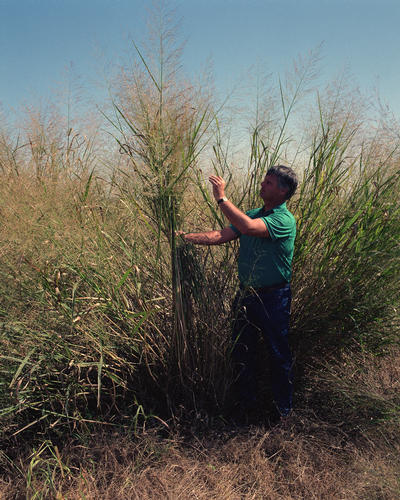
I read this article today in the business section of the Washington Post. This was new information for me, and it made me jump-up-and-down happy to read it.
Moderators, please move this downstairs to TNPCF (the New Political / Controversial Forum) if you think it belongs there!
I was very excited to read this article. I’ve had such mixed feelings about corn-based ethanol. Corn is a “greedy” crop-- takes a lot of fertilizer-- and is vulnerable to all sorts of insects, and to drought.
I’m wondering what individuals can do to encourage this kind of research / development.
Man, this is nothing but good news. I agree that growing corn for fuel seems expensive, when you consider the mountains of cellulose plant waste everywhere around us.
I always felt corn was an in-between solution for ethanol.
Really, the neat thing about this is that it has the potential to turn a waste product into fuel. Instead of a municipal mulch pile, we could have ethanol production. It could be a new avenue for recycling and will reduce some of the land fill load (also lowering the amount of methane released due to decomposition).
Well, Shell Oil just announced some new big venture into cellulosic ethanol. It was in the business pages a few days ago. This announcement today puts it into context. Second time in a week I encountered the word “cellulosic.”
Are you guys on drugs? Bio-fuels have already been shown to be the WORST solution, using more energy to produce, and causing more pollution in their production, than just continuing to burn gasoline. The only people pushing bio-fuels are the people who plan to make big dollars from them. Recent increases in food prices have already been directly attributed to big buyers sucking up large amounts of crops with the intention of turning them into bio-fuels.
…The only people pushing bio-fuels are the people who plan to make big dollars from them. Recent increases in > food prices > have already been directly attributed to big buyers sucking up large amounts of > crops > with the intention of turning them into bio-fuels.
djm
Right! That’s why this Q microbe is so exciting. You don’t need to use crops. One of the things they’ve been talking about using it on is “switch grass” which isn’t really a crop??? It’s easy to grow, and tough as nails. It doesn’t need fertilizer, and is drought resistant.
The article mentioned using the Q microbe on wood chips. That would be cool. They also talked about using the fibrous biproducts of corn ethanol production. That would mean using the corn twice. The advantage I can see to that is-- it might be easier for people to accept. Kind of an add-on instead of a completely new thing.
The tall, native grasses of the prairie, so vital to our land’s ecological past, may prove equally vital to its economic future. Such grasses once fed millions of bison.
Apparently they do use fertilizer on it, but I bet it takes less fertilizer than most crops, since it’s a native plant.
Now, to make switchgrass even more promising, researchers across the country are working to boost switchgrass hardiness and yields, adapt varieties to a wide range of growing conditions, and reduce the need for nitrogen and other chemical fertilizers.
If there’s people doing genetic research to improve yields, that means there’s biotech money to be made.
Switchgrass will grow on soil that can’t be used to grow other things.
In the hard, shallow soil of southern Alabama, Dave Bransby is turning cotton fields into swatches of grassland. Some Alabama farmers joke that there’s no soil in Alabama to farm…Yet Bransby, a forage scientist at Auburn University, has found a crop that thrives there…Bransby’s 6-year average, 11.5 tons a year, translates into about 11,500 gallons of ethanol per acre.
Now, this sounds really encouraging–
Many farmers > already grow switchgrass> , either as forage for livestock or as a ground cover, to control erosion. Cultivating switchgrass as an energy crop instead > would require only minor changes > in how it’s managed and when it’s harvested. Switchgrass > can be cut and baled with conventional mowers and balers> . And it’s a hardy, adaptable perennial, so once it’s established in a field, it can be harvested as a cash crop, either annually or semiannually, > for 10 years or more > before replanting is needed. And because it has multiple uses—as an ethanol feedstock, as forage, as ground cover—a farmer who plants switchgrass > can be confident > knowing that a switchgrass crop will be put to good use.
It is the cost of running mowers, balers, harvestors, etc. and then the transport to an ethanol producing plant where all the additional pollution and energy use comes in that makes bio-fuels such a wrong idea. Fertilizers, if any, are an additional expense on top of the harvesting costs.
I live in a big ag state. Later this year, the upper Sacramento Valley will be choking with the smoke of burned rice waste. Go up to Trinity, where they do a lot of logging and you’ll find the air filled with timber slash burning. Producers are growing both of these products, only to turn around and burn the non-usable portions. If that’s not contributing to pollution, I don’t know what is…
Hopefully, the producer units can be sited near the waste, not far away. I understand your objections, though. Looking over them, I see that my conception is what you do with waste, more than what you specifically produce to create the stuff.
It grew very fast, was drought resistant, and was a great source of renewable firewood. It was introduced all over the tropics and many areas became dependant on it. Then an insect pest showed up and decimated the Leucaena plantings. That was where the story had ended when I last read about it.
Apparently in the following years, the situation has stabilized…
The arrival of the leucaena psyllid where it has not occurred before represents a significant disturbance of the existing ecosystem. Given time, a balance has been reached in most areas invaded by psyllids.
Whoever works on Switchgrass will have to avoid the Leucaena problem! And no doubt, there will be unforseen problems as well.
Our hills are covered with eucalyptus trees, introduced as the wonder plant of the late 1800s. They choke out native vegetation, enabling only poison oak to grow under them, and shed prodigious amounts of bark and wood, which in turn becomes a huge fire hazard.
Oh yeah, we know about unintended ag consequences!!
the cost of running mowers, balers, harvestors, etc.
the transport to an ethanol producing plant
Fertilizers, if any, are an additional expense
burned rice waste.
timber slash burning
It makes sense to me that whatever form of energy we use, it’s going to create some pollution. Just the fact that we’re here at all means that there’s an effect (using up water, exhaling CO2). It’s a question of finding something practical that does the least damage. It’s a complicated question…
The idea of solar energy is very attractive to me, too-- but it’s so electronics-based. I worry about the side-effects of manufacturing, and the disposal of old equipment.
That’s why the Q microbe got me so excited. Somehow it just seems more…natural.
Now please excuse me, I have to put my Birkenstocks back on and take the granola out of the oven. Then there’s all those trees to hug
From what I’ve read, the least problematic solution still seems to be hydrogen (not that it doesn’t also have production issues). But like Vitamin D, there’s no big profit to be had in hydrogen, so it is getting the least attention, whether it’s good for us or not.
Let’s suppose a time arrives when the equipment used to grow the ethanol source crop runs on ethanol, and whatever agricultural chemicals needed can be produced using ethanol.
In that case, ethanol becomes almost completely a real time, solar powered resource. The CO2 released by burning ethanol is CO2 that was removed from the atmosphere when the plant produced the cellulose, so its return to the atmosphere when the ethanol is burned does not add to the total greenhouse gasses. That CO2 will be removed from the atmosphere again by the next season’s crop, and so on … .
The point is, using fossil fuels is releasing carbon dioxide that was removed from the atmosphere millions of years ago, so it creates a net increase in atmospheric CO2. However, using carbon dioxide that was removed from the atmosphere a season or two ago and will be removed again next season, by the crop we grew to produce ethanol, does not create a net increase in atmospheric CO2.
So the point is, eventually, cellulosic ethanol has the potential to be an almost purely solar energy source itself. Solar energy cells convert solar energy to electricity. Ethanol crops convert solar energy to ethanol.
You are missing the point that it costs two gallons of ethonol to produce one gallon of ethanol, and in the process you are burning two gallons of ethanol. Where’s the savings, especially once an economy turns to growing ethanol-producing crops because there’s more money in it than producing food crops? Who takes the hit in the end?
Hydrogen still buries bio-fuels/ethanol as a solution, but again, no big profits in it, so let’s just kill ourselves off instead, right?