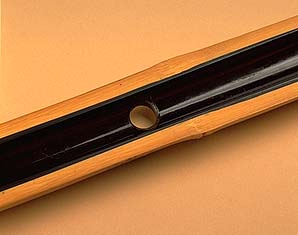
The chanter (bottom right) was in ABW as, according to BC, the Kingwood was difficult to work with. Pity, as it’s a gorgeous looking wood.
Not so much that it was difficult to work with, In terms of lathing and cutting. It is a difficult wood to accurately finish the bore, and consequently didn’t make a very good chanter. Grain fibers were very long and tough and tended to finish “hairy”. It was, however, within tolerance of consistency for regs and drones.
It’s done on the Japanese Shakuhachi. However, those are made from porous bamboo. Unless the coating material has good penetrating properties and you have 2 reamers designed for this process, so the coating is substantial and doesn’t get reamed away, what works in theory could fail in application.
Bassoons have a hard rubber liner for part of the bore which is either glued in or on the best instrument cast into the bore around a mandrel. It’s quite thick, 3-4mm. The reason for the liner is that maple eventually gets hairy as a result of water damage which destroys the tone. It’s important that it is acoustically well bonded to the maple. Some of the tone holes are also lined with rubber, nickel silver, or silver.
Instruments made out of ebony, rosewood or blackwood (a few bassoons, oboes and clarinets) don’t need this.
The best instruments are made from mountain maple that grows in Bosnia, Berg Ahorn (Acer pseudoplatanus), which is also called sycamore maple. The riegal or curly variety looks and sounds the best (and is the most expensive). It’s steamed then air dried for 7-12 years before the bores are drilled over a period of another couple of years.
Fox the Amrican maker also uses Black Maple (denser), Big Leaf Maple (less dense), Red Maple (a cheaper version of Berg Ahorn), and Sugar Maple (very durable).
Denser wood generally produces an instrument that is less flexible. This dredges up the old argument that the material has no effect on the sound. Fox makes instruments with identical bores and different maples - the density of the wood definitely makes a difference.
An important characteristic of the maple used is that it must be machineable since the key posts are screwed directlly into the wood.