Albert Cooper, master flute maker, 1924-2011, has passed away. Albert started his apprenticeship at Rudall Carte in 1938. There’s an interesting tribute to Albert in the BFS’s latest journal, “Flute”, July 2011. Photographs from the 1940’s and 50’s of Rudall’s workshop, and of Albert’s shed with broken windows at the bottom of his garden where he made his famous head joints. Photo of an old interesting looking file, from the Rudall & Rose days, that was a favourite tool of Albert’s which he used on metal head joints. The article is about Albert, the craftsman, his head joints, and his time at Rudall Carte, not about simple system flutes, but still very interesing nonetheless, especially the photos and stories from and about Rudall Carte
 Ah, Cooper!
Thanks Jem and Tintin, Albert Cooper it is, not Alfred Potter. Freudian flute slip 
Albert also spent time developing the Bohem flute so that it was easier to play in tune.
The Cooper scale together with the Cooper head joint made for a formidable flute.
http://www.antiqueflutes.com/cgi-bin/catalog.cgi?snum=911
I think you mean Albert Cooper.
Here’s an interview with him: http://www.epplerflutes.com/interview.html
Here’s an image of him working at Rudall Carte:
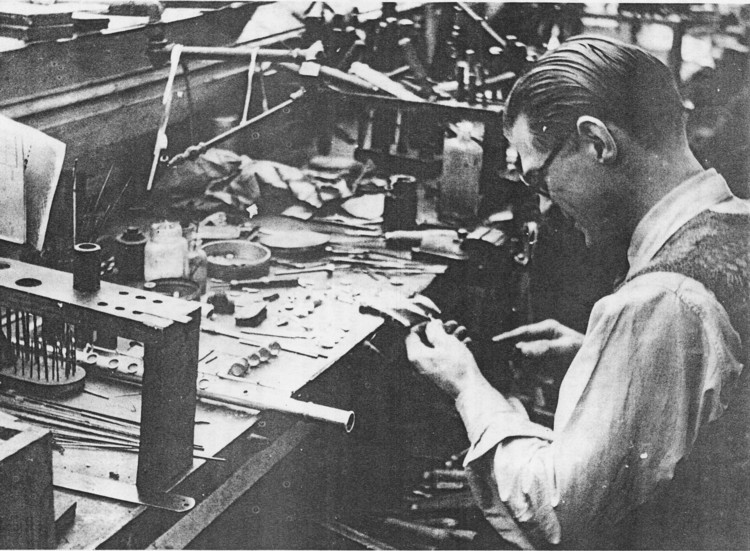
Earlier images of the Berner’s St workshop at:
http://www.mcgee-flutes.com/RC_Wshop1922.htm
I believe it’s possible to relate Albert’s bench with the one in the image second from the top.
Terry
Very interesting interview, thanks Tintin -
An extract from the interview:
“AC: Yes, my first job when I went to Rudall-Carte was making nameplates for flute cases. I soon progressed to pad making, then to the making of six-key piccolos. Of course they don’t make them now. I used to make B-flat flutes for the military people. But from the age of fourteen to eighteen-and-a-half, when I was called up, I learned the business in those four and a half years. I came back at about twenty-two after the war and demobilization a skilled flutemaker.”
“AE: In those years, can you give a rough estimate as to how many flutemakers were working in England?”
“AC: A, that’s a good question. When I first went to work at Rudall-Carte in 1938 before the war the staff was about 15 and they had about 400 flutes in stock. Of course, once the war started half of these men went into the service straightaway and the other half died off. There were about three or four of us left in 1940; it got down to only two in the war. It’s a wonder the trade survived. When the war finished two or three of them came back, but it never really got going again.”
"Earlier images of the Berner’s St workshop at:
http://www.mcgee-flutes.com/RC_Wshop1922.htm
I believe it’s possible to relate Albert’s bench with the one in the image second from the top. Terry M.
I think you’re right Terry. This photo of Albert is also in the “Flute” article.
Very sad to lose such a master craftsman. RIP, Mr.Cooper. I thought I recognised the name, and remembered it from the sleeve notes on a CD, “The Celtic”, by the BT Scottish Ensemble.
Flute player and composer Dave Heath had this to say :
"In 1994 one of the great craftsmen of the century, Mr Albert Cooper, was 70. Albert Cooper, in my opinion, makes the best flutes in the world, and I wanted to write a piece to celebrate his 70th. Living in Cupar, Fife, I decided to base the piece on an early version of a popular local song - “The Wee Cooper of Fife” - which became “The Cooper of Clapham”.
also - “Heath plays on an early Cooper flute, “the Excalibur”, rebuilt for him specially by the renowned maker, Albert Cooper”.
I had the pleasure to meet Mr. Cooper thirty years ago. What a charming man!
The world is a little colder and darker place for his loss.
Bob