Recently my wife & I went on vacation in Spain. We went to Barcelona, and took a packaged bike trip mostly in the province of Girona, in the north east corner of that country. Once we looked at the bike trip itinerary, I realized we would be passing within a mile or so of Medir S. L., a supplier of reed cane for musical instruments, including uilleann pipes. I have been buying cane from them for over 20 years. I relished the opportunity to visit them.
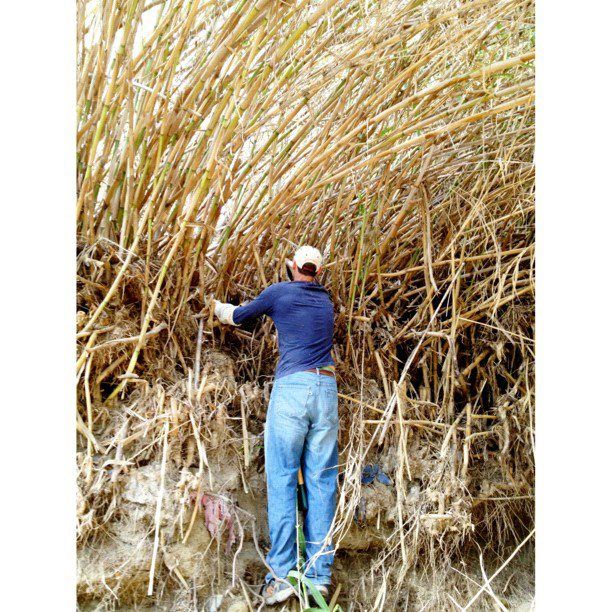
Cane (latin name arundo donax; canya in Catalan, the local language) is very common in Girona; one sees it almost everywhere. It likes wet areas and grows along watercourses and ditches, in estuaries and damp spots. This plant grows in many parts of the world but the cane which grows near the Mediterranean coast in northeast Spain and southern France is generally regarded as among the best for making reeds for musical instruments.

Medir is located just outside the costal town of Palamos, in the beginnings of hills, up a dirt road, no signage. The proprietor, Carles Medir, and much of the staff was away and Ramon was left to mind the shop. He was kind enough to show us around.

Outside a man was feeding cut stalks one by one through a machine which stripped them of their leaves. In the yard, an area where stalks were left in the sun to cure. Exposure to the sun dries out the cane and changes the color of the stalks from greenish to the lovely golden color most people expect to see when looking at reed cane. Summers are quite dry in this region, so rainfall on the curing stalks is not a problem.


Ramon told me that for the most part Medir harvests cane from land they have rented. I wish I had asked him for more detail about exactly what kind of growing conditions make for the best quality cane. I told him that in our riding around I had seen what looked like varieties or subspecies of cane, or perhaps different cane-like plants alltogether. “It’s all cane,” he said.
We went inside. Ramon demonstrated the machine used to cut tubes to length. Also the bench where cut cane is sorted by diameter. Reeds for different instruments require cane of different diameters.


Then to the storage area. Before cutting to length, cane is stored for one year for uilleann pipe cane, two years for most other instruments (more about this later). It is rough-sorted by diameter & kept in the shed. Bundles for clarinet here, tenor sax there, etc.

Here are bunches of uillleann pipe drone cane awaiting their turn:

Ramon said it was Medir’s understanding that uilleann pipe reedmakers prefer their cane on the soft side. Cane which has cured for two years will be harder than cane which has cured for one year. Hence the shorter cure time for uilleann pipe cane. When Medir sends me reed cane they include the year of harvest on the invoice. I told Ramon that I usually waited a year after receiving their cane before using it, give it more time to cure. He was bemused by this.
All in all a very interesting experience. I wish I had asked more questions. Ramon’s English was good and I believe I understood what he was saying. Any errors of fact or interpretation are my fault entirely.
Nick Whitmer