I am drunk with all of these! Thank you all so much.  (And any latecomers: suggestions still welcome!)
carrie
I am drunk with all of these! Thank you all so much. (And any latecomers: suggestions still welcome!)
carrie
An old favorite of mine:
High Flight
by John Gillespie Magee, Jr.
Oh, I have slipped the surly bonds of earth,
And danced the skies on laughter-silvered wings;
Sunward I’ve climbed, and joined the tumbling mirth
Of sun-split clouds…and done a hundred things
You have not dreamed of…wheeled and soared and swung
High in the sunlit silence. Hov’ring there,
I’ve chased the shouting wind along, and flung
My eager craft through footless halls of air.
Up, up, the long, delirious burning blue
I’ve topped the windswept heights with easy grace
Where never lark, nor even eagle flew.
And while with silent, lifting mind I’ve trod
The high untrespassed sanctity of space…
…put out my hand, and touched the face of God.
Redwolf
Hi. I’m 14 and alot of the poems listed are good but I think they are a little above the level of most 9th graders. Anyway, here is a poem that was written by my Dad’s college advisor. He was nominated for a Pulitzer Prize in poetry. The poem is about another poet who was also a writing teacher my Dad had in college and who was killed in a car accident when he was in his 20s or 30s. I hope you like it. I know I do. Especially the imagery and the sound or tone of the poem. It really gets to me.
Michael
Heading East Out of Rock Springs
for Andrew Grossbardt, long gone
By: Jim Barnes
On a high plateau where the earth rounds off
the edge of nothing and the sky pours down
like hail so heavy that the pickup squats
on its springs and groans toward the horizon,
you think of Andy, all those years long gone.
What had he thought when he left Missoula
and headed toward a millennium of doubt
he called poetry?–his own old Ford fooling
itself under the hood and gasping out
of the long valleys then turning south
onto the plains. Then those years of Missouri,
camped on a side street in Kirksville, among
the detritus of sojourners, the misery
of travelers haunting him like a song
and something solid growing daily wrong
inside his head. You remember Andy’s hands
if you remember right: the way they shook
like aspen leaves, always in flux and
pale. Past Red Desert you begin to look
for signs that mean trails end or roads fork.
The land grows abstract as your horoscope.
What you read once as bright now reads dim
in the falling light. His fine-boned poems lope
like deer on the living language plains and seem
to fade to haze, are all that’s left of him.
Sundown. An owl heads for Cheyenne. The pickup
drones toward the dark. You hardly knew the hills
then, though you recognized the thirst and the cup
and watched him drink at the roiling source until
he knew the strength of word and the word could kill.
Between Boot Hill and the shopping mall, you park
the truck under hanging light. The road’s been long
and there’s long to come, Andy. You can’t face dark
turns to Dis or Denver without sleep: no song
worth the risk nor the risk worth this time going.
Published in Quarterly West (Fall 2000)
My favourite poem of transition involves Prufrock contemplating whether or not to cross the boundary between the non-peach-eaters and the peach eaters. Might be a bit subtle for 9th graders.
Seriously, could there be a better poem of transition to another world than this?
‘Do Not Go Gentle Into That Good Night’
Do not go gentle into that good night,
Old age should burn and rave at close of day;
Rage, rage against the dying of the light.
Though wise men at their end know dark is right,
Because their words had forked no lightning they
Do not go gentle into that good night.
Good men, the last wave by, crying how bright
Their frail deeds might have danced in a green bay,
Rage, rage against the dying of the light.
Wild men who caught and sang the sun in flight,
And learn, too late, they grieved it on its way,
Do not go gentle into that good night.
Grave men, near death, who see with blinding sight
Blind eyes could blaze like meteors and be gay,
Rage, rage against the dying of the light.
And you, my father, there on the sad height,
Curse, bless me now with your fierce tears, I pray.
Do not go gentle into that good night.
Rage, rage against the dying of the light.
– Dylan Thomas
Ok, I admit it. I’m in one of my wild and windswept moods tonight.
MY DARLING, WE SAT TOGETHER
by: Heinrich Heine (1799-1856)
MY darling, we sat together,
We two, in our frail boat;
The night was calm o’er the wide sea
Whereon we were afloat.
The Specter-Island, the lovely,
Lay dim in the moon’s mild glance;
There sounded sweetest music,
There waved the shadowy dance.
It sounded sweeter and sweeter,
It waved there to and fro;
But we slid past forlornly
Upon the great sea-flow.
This English translation of “Mein Liebchen, Wir Sassen Zusammen” was composed by James Thomson (1834-1882).
Mein Liebchen, wir saßen beisammen,
Traulich im leichten Kahn.
Die Nacht war still, und wir schwammen
Auf weiter Wasserbahn.
Die Geisterinsel, die schöne,
Lag dämmrig im Mondenglanz;
Dort klangen liebe Töne,
Und wogte der Nebeltanz.
Dort klang es lieb und lieber,
Und wogt’ es hin und her;
Wir aber schwammen vorüber,
Trostlos auf weitem Meer.
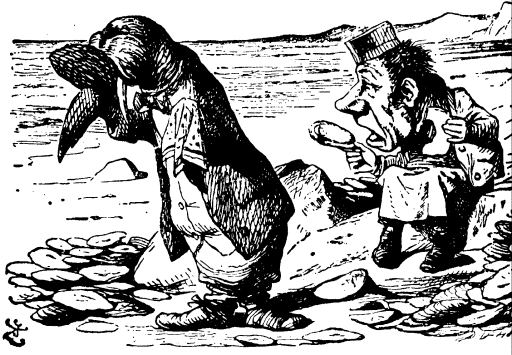
The Walrus and The Carpenter
The sun was shining on the sea,
Shining with all his might:
He did his very best to make
The billows smooth and bright–
And this was odd, because it was
The middle of the night.
The moon was shining sulkily,
Because she thought the sun
Had got no business to be there
After the day was done–
“It’s very rude of him,” she said,
“To come and spoil the fun!”
The sea was wet as wet could be,
The sands were dry as dry.
You could not see a cloud, because
No cloud was in the sky:
No birds were flying overhead–
There were no birds to fly.
The Walrus and the Carpenter
Were walking close at hand;
They wept like anything to see
Such quantities of sand:
“If this were only cleared away,”
They said, “it would be grand!”
“If seven maids with seven mops
Swept it for half a year.
Do you suppose,” the Walrus said,
“That they could get it clear?”
“I doubt it,” said the Carpenter,
And shed a bitter tear.
“O Oysters, come and walk with us!”
The Walrus did beseech.
“A pleasant walk, a pleasant talk,
Along the briny beach:
We cannot do with more than four,
To give a hand to each.”
The eldest Oyster looked at him,
But never a word he said:
The eldest Oyster winked his eye,
And shook his heavy head–
Meaning to say he did not choose
To leave the oyster-bed.
But four young Oysters hurried up,
All eager for the treat:
Their coats were brushed, their faces washed,
Their shoes were clean and neat–
And this was odd, because, you know,
They hadn’t any feet.
Four other Oysters followed them,
And yet another four;
And thick and fast they came at last,
And more, and more, and more–
All hopping through the frothy waves,
And scrambling to the shore.
The Walrus and the Carpenter
Walked on a mile or so,
And then they rested on a rock
Conveniently low:
And all the little Oysters stood
And waited in a row.
“The time has come,” the Walrus said,
“To talk of many things:
Of shoes–and ships–and sealing-wax–
Of cabbages–and kings–
And why the sea is boiling hot–
And whether pigs have wings.”
“But wait a bit,” the Oysters cried,
“Before we have our chat;
For some of us are out of breath,
And all of us are fat!”
“No hurry!” said the Carpenter.
They thanked him much for that.
“A loaf of bread,” the Walrus said,
“Is what we chiefly need:
Pepper and vinegar besides
Are very good indeed–
Now if you’re ready, Oysters dear,
We can begin to feed.”
“But not on us!” the Oysters cried,
Turning a little blue.
“After such kindness, that would be
A dismal thing to do!”
“The night is fine,” the Walrus said.
"Do you admire the view?
“It was so kind of you to come!
And you are very nice!”
The Carpenter said nothing but
“Cut us another slice:
I wish you were not quite so deaf–
I’ve had to ask you twice!”
“It seems a shame,” the Walrus said,
“To play them such a trick,
After we’ve brought them out so far,
And made them trot so quick!”
The Carpenter said nothing but
“The butter’s spread too thick!”
“I weep for you,” the Walrus said:
“I deeply sympathize.”
With sobs and tears he sorted out
Those of the largest size,
Holding his pocket-handkerchief
Before his streaming eyes.
“O Oysters,” said the Carpenter,
"You’ve had a pleasant run!
Shall we be trotting home again?’
But answer came there none–
And this was scarcely odd, because
They’d eaten every one.
djm
Jabber-Whacky
Or
On Dreaming, After Falling Asleep Watching TV
Isabelle Di Caprio
'Twas Brillo, and the G.E. Stoves,
Did Procter-Gamble in the Glade;
All Pillsbury were the Taystee loaves
And in a Minute Maid.
“Beware the Station-Break, my son,
The voice that lulls, the ads that vex!
Beware the Doctors Claim, and shun
That horror called Brand-X!”
He took his Q-Tip’d swab in hand;
Long time the Tension Headache fought–
So Dristan he by a Mercury,
And Bayer-break’d in thought.
And as in Bufferin Gulf he stood
The Station-Break, with Rise of Tame,
Came Wisking through the Pride-hazed wood,
And Creme-Rinsed as it came!
Buy one! Buy two! We’re almost through!
The Q-Tip’d Dash went Spic and Span!
He Tide Air-Wick, and with Bisquick
Went Aero-Waxing Ban.
“And hast thou Dreft the Station-Break?
Ajax the Breck, Excedrin boy!
Oh, Fab wash day, Cashmere Bouquet!”
He Handi-Wrapped in Joy.
'Twas Brillo, and the G.E. Stoves
Did Procter-Gamble in the Glade;
All Pillsbury were the Taystee loaves,
And in a Minute Maid.

djm
Is Chinese a minority? Here’s a verse from a book of 81 verses, written in China, supposedly around 300 to 200 BC.
Well, it’s more about the eternal nature of change than a specific change. It’s a little esoteric, but my son understood it at 14.
Dao de Jing, Verse 16
Empty the self completely;
Embrace perfect peace.
The world will rise and move;
Watch it return to rest.
All the flourishing things
Will return to their source.
This return is peaceful;
It is the flow of nature,
An eternal decay and renewal.
Accepting this brings enlightenment,
Ignoring this brings misery.
Who accepts nature’s flow becomes all-cherishing;
Being all-cherishing he becomes impartial;
Being impartial he becomes magnanimous;
Being magnanimous he becomes natural;
Being natural he becomes one with the Way;
Being one with the Way he becomes immortal:
Though his body will decay, the Way will not.
–Laozi
Maybe too esoteric - whatever. 
I hope you used your hair-gel.
The problem with Tao Te Ch’ing and such is that they don’t necessarily say what you wrote. If you have a hundred different interpreters you will get a hundred different interpretations.
djm
besides, the Dao that can be spoken of is not the eternal Dao…

It shows
I take a very dim view of those who disrespect Prufrock but for you an honourable exception will be made…
just this once mind ye..
Slan,
D. 
Indeed. Yet of the 20 or so translations that I’ve read over the years, Peter Merel’s seems to follow a fairly middle, unbiased road, and still remain approachable by Westerners. Some translations are anhydrous gobbldy-gook to the uninitiated.
So I use Merel’s translation most often when discussing The Dao with Westerners.
True that. It takes years to transition; reading different translations, understanding, accepting, internalizing.
Ok, back on topic.
Done with the work of breathing; done
With all the world; the mad race run
Though to the end; the golden goal
Attained and found to be a hole!
A SONG ABOUT MYSELF
by John Keats
I.
There was a naughty boy,
A naughty boy was he,
He would not stop at home,
He could not quiet be-
He took
In his knapsack
A book
Full of vowels
And a shirt
With some towels,
A slight cap
For night cap,
A hair brush,
Comb ditto,
New stockings
For old ones
Would split O!
This knapsack
Tight at’s back
He rivetted close
And followed his nose
To the north,
To the north,
And follow’d his nose
To the north.
II.
There was a naughty boy
And a naughty boy was he,
For nothing would he do
But scribble poetry-
He took
An ink stand
In his hand
And a pen
Big as ten
In the other,
And away
In a pother
He ran
To the mountains
And fountains
And ghostes
And postes
And witches
And ditches
And wrote
In his coat
When the weather
Was cool,
Fear of gout,
And without
When the weather
Was warm-
Och the charm
When we choose
To follow one’s nose
To the north,
To the north,
To follow one’s nose
To the north!
III.
There was a naughty boy
And a naughty boy was he,
He kept little fishes
In washing tubs three
In spite
Of the might
Of the maid
Nor afraid
Of his Granny-good-
He often would
Hurly burly
Get up early
And go
By hook or crook
To the brook
And bring home
Miller’s thumb,
Tittlebat
Not over fat,
Minnows small
As the stall
Of a glove,
Not above
The size
Of a nice
Little baby’s
Little fingers-
O he made
'Twas his trade
Of fish a pretty kettle
A kettle-
A kettle
Of fish a pretty kettle
A kettle!
IV.
There was a naughty boy,
And a naughty boy was he,
He ran away to Scotland
The people for to see-
There he found
That the ground
Was as hard,
That a yard
Was as long,
That a song
Was as merry,
That a cherry
Was as red,
That lead
Was as weighty,
That fourscore
Was as eighty,
That a door
Was as wooden
As in England-
So he stood in his shoes
And he wonder’d,
He wonder’d,
He stood in his
Shoes and he wonder’d.
THE END
.
On the Ocean Floor
by Hugh MacDiarmid
Now more and more on my concern with the lifted waves of genius gaining
I am aware of the lightless depths that beneath them lie;
As one who hears their tiny shells incessantly raining
On the ocean floor as the foraminifera die.
When I was 14 or so I was obsessed with
the Lotos Eaters by Tennyson
Here’s one by a friend of mine that it meant for younger kids but maybe yours would like it.
I immediately thought of - The Highwayman-
http://www.potw.org/archive/potw85.html
nothing too deep- love, sacrifice, bravery, “bad boy” hero, yeah, the girls will love it, don’t know about the guys…
great thread - glad you started this Carrie.
and nowit’s too late, I have to go to bed and get up and go to work yet again… grrrrr…I’m into week five with only sunday off and it’s getting old,old,old… I NEED MORE POETRY!!!
Everyone needs more poetry, even if they think they don’t I sat down with a Yeats book the other day, and the kids thought I was nutso (I am, but don’t give them the satisfaction of knowing that). “How can you read that?” they asked. How in the world did I, who could read poetry all day long, acquire such children, is what I want to know? It must be their father’s fault.
Had they asked me that particular one, I would have answered,
“I do put my heart in it .”