Dear friends of Chiff & Fipple forums,
it is a great pleasure for me to stay here among such excellent and admirable fluters.
My name is Rodrigo and I am writing from Rome, Italy.
I would like to dedicate my first post to the matter of CONICITY regarding Irish flutes.
We can define CONICITY (C) as the ratio between the difference of the two diameters of the cone section (D and d) and the distance between them (L).
C = D-d/L
We can also express its value in the form of:
1/K
thus: C = D-d/L = 1/K
In this way we express CONICITY by indicating for which length K along the cone axis we have a 1 millimeter variation in the diameter.
For example: some Italian bagpipes have a 1/28 conicity in their chanters. Some French ones, by contrast, have a 1/33 conicity.
So, my question is: what is the CONICITY used in Irish flutes?
This could be very useful at the time of getting the proper reamer for the conical part of the bore or just as another aspect of our beloved instruments that awaits to be discovered.
I hope to hear from you. Bye!
I am an amateur instrument maker. While I do not consider myself an expert on this topic (or any other for that matter)I will nonetheless try to start the discussion. You will discover that the bore of a traditional wooden flute is not usually a regular conical shape but rather a complex shape if you take measurements of existing flutes. You might also discover that these complex shapes vary from maker to maker. The complex shape of the bore helps to keep the scale of the flute in tune, especially across octaves. For those reasons, you cannot simply buy a reamer with a straight conical shape. Flutemakers generally turn their own reamers or have them made by a local machinist.
Your question has been asked before. And it has been postulated before that a simple conical reamer would approximate the bore of an Irish simple system flute. The topic has been discussed here and on the Yahoo Flutemakers list. Here is one example: http://launch.groups.yahoo.com/group/flutemakers/message/5633
Try to search through both forums. You should be able to find a lot of background material.
Also, Terry McGee has provided a wealth of information about the design and history of the wooden flute on his terrific site. We are very grateful to Terry for making this information available. You might start looking at his site here: http://www.mcgee-flutes.com/bores.htm
I’ve had the impression* that bore shape is a compound cone, ie not at the same pitch (steepness?) at every point along it’s length. A fast look at Terry’s chart doesn’t seem to indicate that. I’ve been longing for someone to make & photograph some negative flutes just so I could understand it better. By negative flute I mean sticks turned to the shape of the space inside a flute. Making one (let alone a comparitive set of Rudall vs Pratten, etc models) would be completely unrenumerative and scientifically useless, so I understand why I’ve never seen such a thing.
Since Hammy’s book, so I realize that the research has advanced considerably since then.
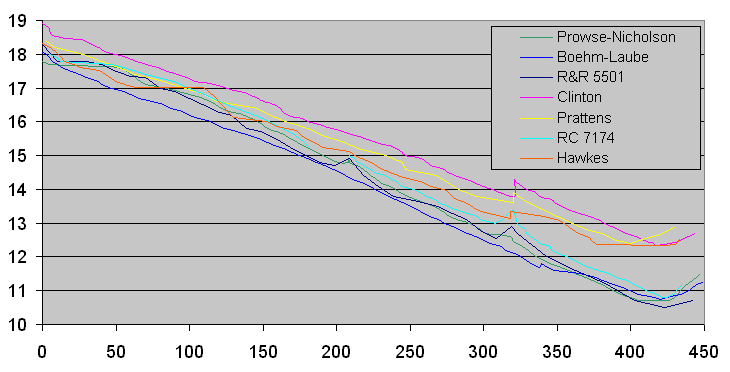
Follow the orange curve (the Hawkes) for a good example of a far-from-simple conical bore. Or hold the edge of a piece of paper up to the screen, so that it just touches the ends of the green Nicholson’s Improved curve. Now look at how far the centre of the curve is from the piece of paper.
Rockstro got a bit pedantic about the non-perfectness of the cone and insisted on terming the shape conoidal, but that was probably a setup so he could then have a real good go at Boehm for his use of the expression parabolic. Thank goodness we were spared paraboidal! Parobular?
We makers see your “negative flute” every day, but we call them reamers. But they are so long and thin that the variability of the curve is not at all evident to the eye. We’re only talking, even in the case of the Hawkes above, of deviations from the nominal of about a half millimetre. This can be enough to have quite surprising effects acoustically.
Nobody to my knowledge has done a careful study of how accurate we have to be (it’s not a simple question because the same 1/2mm deviation will produce very different degrees of change depending on where the deviation is located). No wonder makers vary on their views on this topic. Ward shows us that there was disagreement even back in 1848:
The quack vendors of these instruments mystify the pretended effects of what they term chambering the bore, to convert to the best account their deficient skill, or their want of proper implements; as well as to cover a large amount of ignorance and pretension.
When old, I shall write like that about the current crop of makers. And wear purple.
Do you have one that would do a full flute, or even a full section in one pass? Or is there a succession of reamers, each of which represents the negative of a relatively brief portion of the final cavity?
In my case, usually a reamer per section. But there seems to be some evidence that back in Rudall & Rose days, a succession of spoon bits might have been used, giving the maker scope to experiment with varying depth of penetration of each reamer. This could be the “chambering” (as it is likely to lead to a series of diminishing cylinders rather than a cone) that Ward rails about, although some believe that chambering was an increase of diameter greater than that of a preceding point (like the chambering in caves that spelunkerers talk about). Obvious and unanswered question - how do you cut such a thing?
We may be able to progress understanding by detailed examination and comparison of a large number of bores from the same period. It’s yet another thing on my list of matters to investigate!
I have an X-ray of a flute, but again, the very mild taper is not easy to appreciate. I fear this is an area where careful measurement and heavily exaggerated graphs do best.
A flute with a single straight taper will work (have seen and tried a few), but the old makers (and the current ones as well) certainly had something in mind when messing the regularity up.
However I heard that Rudall&Rose used forged (!) reamers - so a certain randomness and luck during their construction might have been a factor to consider. I must admit, though, that I don’t know how accurately those smiths were able to work back then (remembering a quote of a cornish metalworker I read somewhere on Terry’s site).
I don’t know if I should be giving this little known gem away but…
I use (as a measuring guide & as a step drill substitute) some “off the peg” reamers in various forms. They are made by Dormer, they come in a variety of sizes. The length is the main limitation but given that Rudalls come in comparatively short sections it is possible to buy the length at taper required. I use a bespoke set of reamers with spiral flutes rather than these, expensive to buy but worth it in the long run.
Hand taper pin reamers (spiral flutes) are affordable, can be re-ground for the perfectionist at minimal (but specialized) effort, & are of excellent quality. they are available in 1/48 & 1/50 which are the sizes closest to the traditional requirements and I would recommend the spiral flute type (avoids chatter). You need to be careful when buying as different companies give their stock at different reference points (some measure the large end and call it a 15mm reamer for example and other measure the introducing end and give that as a size). Dormer produces a catalogue with actual drawings with measurements against their stock codes. - and to professional makers; these are excellent to use in place of a “step drill” or roughing out reamer.