Since compiling the “changes in flute scaling” page, I’ve been keeping an eye out for variations in other makers’ flutes. I’ve been repairing a Metzler flute and thought to compare it to my own. Mine is more ornate, has engraved sterling silver rings and keys, and looks older; it has a c#d# length of 251.5mm. The one under repair is simpler and more modern in appearance, and is in nickel silver; it has a c#d# length of 246mm. I haven’t added it to the graph because, as Metzler didn’t employ serial numbers or addresses in his mark, I have no way of estimating the dates. But it’s interesting to visualise them on the graph:
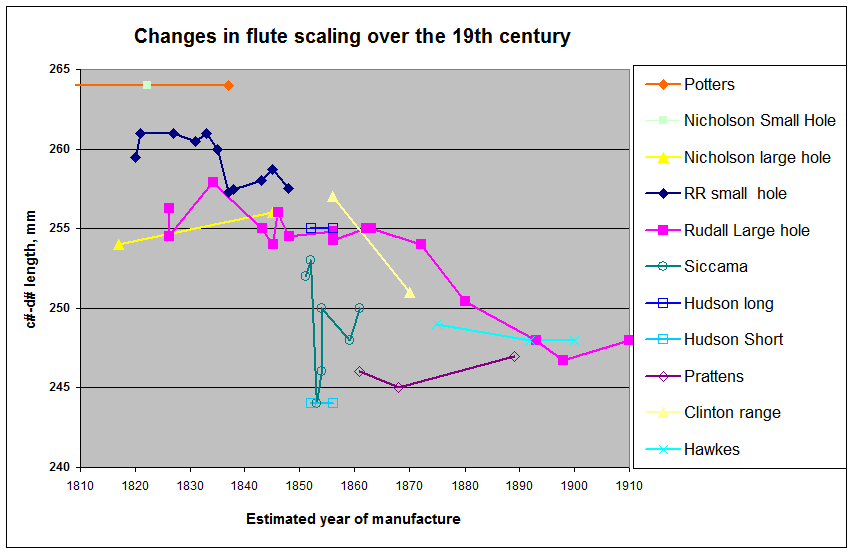
There is no evidence of the flute having been shortened, and the reduction of length occurs gradually along the flute, not in any one section.
As you can see, 246mm is pretty short, leading me to wonder if it was intended to be a High Pitch flute. Certainly, the slide has to be out about 20mm for A440, but then again, so does the older one. If it were a High Pitch flute, the low notes, e.g. D, should be higher in pitch than the top of tube notes, such as B, when playing A440. But not so, indeed, there’s still some flat foot evident, although more in the order of 20 cents rather than the older flute’s 40 cents. And yet, set for High Pitch, the octave relationships seem better. So we are seeing a familiar pattern, not all of the possible pitch indicators agree on any particular pitch.
Perhaps we’re still seeing the need for any particular flute to work over the range low pitch to high pitch, but with high pitch being seen as more critical? More thinking still needed.
Terry

 )
