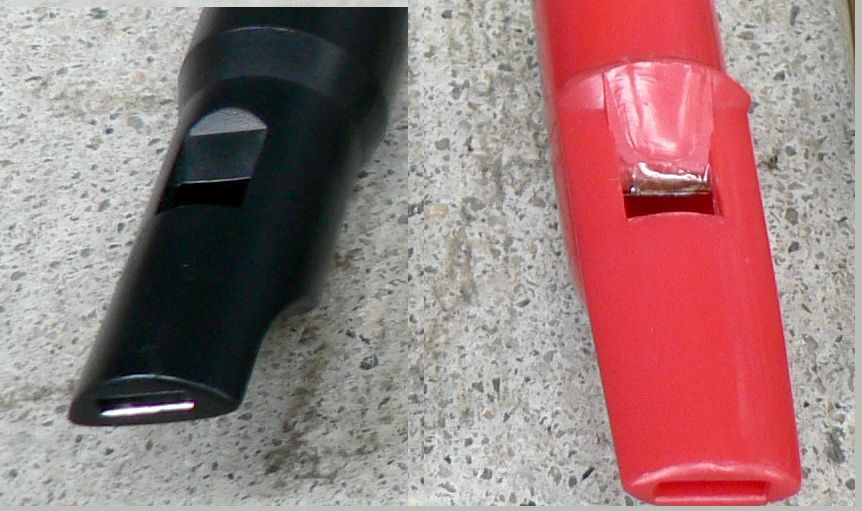
Beaks vary a lot in shape. The beak’s underside can go from a straight cut at say 45 degrees, through various types of concave roundness, with varying amount of beak “depth” one can push beyond the outer edge of one’s lips, to perhaps really longish and straight beak shape. To say nothing of whistles without a beak like those found in Bulgaria, where the window is on the underside. The top of the beak can vary as well, from flat to round etc.
When I look at my whistles made through the last four years, I notice that I’ve shaped the beak’s underside progressively more and more concave, as my technique of cutting has improved. So I clearly like a well rounded underside, in shape of a concave cylinder. As for the top side: I never had a chance to experiment with it, as the curved windway and the tubular head design meant that the beak top is arched and can’t be any different.
I guess I’m not fussy about the shape. As long as there’s no sharp ridge against the lower lip when tilting the whistle down toward the vertical. And that’s more a matter of the adequate length of the cutout than the exact shape.
Actually, the Balkan-type inverted fipple is comfortable in that regard, with the convex tube against the lower lip. Other whistles can give a similar feel by turning the head 180 degrees. That’s also an easy way to experience what a non-convex top of the beak feels like (it feels a bit odd at first).
The only beak shape I’ve ever seen a real problem with is Guido Gonzato’s original design. He was cutting a straight diagonal section from the top edge of the whistle’s “cylinder”. The result was a rounded and very sharp beak edge which was actually quite dangerous as an accidental stabbing hazard. On my advice, he began blunting and smoothing the tip of the beak, which solved the problem.
I like the curved underside. The ones that are cut straight at a 45 degree angle don’t rest quite as comfortably on your lip, although I have owned some whistles like this and got used to them pretty quickly. I like the Chieftain V3 beak the most, I guess. My Goldies are a little sharp on the edges due to the squared off design. That doesn’t stop them from being my favorites…
I grabbed the image from a wiki page and cropped it to suit my purpose though I have and enjoy both Clarke and Generation whistles these where much better photos of the fipples than I could have provided here’s the link to the wiki you may find an answer to your question there.
Brent, that appears to be a Freeman tweaked Generation whistle head. Maybe a Gen D, by the looks, next to what looks like a Sweetone.
As for the original topic, there are only a few whistle beaks that I don’t seem to care for. The Clarke original is one I don’t care for. I believe I offered the same observation as MTGuru to Guido Gonzato. The tent stake design doesn’t feel right. And for similar reasons I have not bonded with the beak on some Abell whistles. The Susato L series mouthpiece is larger than it needs to be but I still have had no issues when playing them.
I like the beaks that burkes have the best. Really comfortable, and doesn’t hurt my bottom teeth like goldies did, for some reason. Just the metal pushing down on my lower lip slightly, which then pushes into my teeth, would cause those lower teeth to feel uncomfortable.
To me, the burkes have the most comfortable mouthpiece, and many other whistles have something very similar which I like, such as the sindt. Also, this type of mouthpiece does not cause excessive drooling, for me.
While I love my MK, it makes me drool constantly, and I think it’s from the beak. That’s a very strange shape , and I don’t like it much.
Especially in the low whistles, I think the burke mouthpiece really is the best option. Low burkes feel more comfortable than any other low whistle, in my opinion.
I’m not that picky about this either, thought if forced to choose I’d favor the Copeland. But I have to say that your existing mouthpiece, at least on the one you made for me, is pretty comfortable and hard to criticize Hans. I’d call it a feature.
And not to derail either, but be careful when the cat adores the mouse!
And on topic: the avatar illustrates a common problem with beaks: they can get gnawed, especially longer thin beaks, like on Generations. My old plastic beaked whistles all show signs of teeth abuse. Is it a teenage thing?
Hans,
I don’t believe the chewing of whistle beaks is directly related to the age of the offender as posed by your question “Is it a teenage thing”? Rather, this is typical of animals known as “WHISTLE PIGS”, who must chew / gnaw on things in order to control the rate of growth specific to their continuously elongating incisors. Rumor has it that a number of these critters frequent this forum.
Not to derail any further… but, be it known that all my teeth are intact, a little capping here and there. I think the beak biting may be more frequent from the en- dentured whistlers with issues of slippage. Just a wild guess. And BTW, I feel like a teenager.
OINK OINK, Let’s see a photo of those “beaks” ye posted on this thread, let’s say a year from now. I hope Pat O’ Riordan’s engraved signature is not all obscured with teeth marks. Ye can throw any Blarney ye like, but the forensic science is such that those chomper marks can be traced back to a specific “WHISTLE PIG”.
Your assumption opens the door for a lot of discussion. I didn’t say I owned that beak. I merely stated that beak “looks comfortable” without concern who is chewing on it. BTW, speaking of beaks, how about you posting a beak of yours here on the forum.
The thread could use a few more beaks for educational purposes.