I have a new flute with a natural corked head. Being playing with a synthetic for 20 years. Is there any noticeable difference or do I just need to pucker up.
I wouldn’t expect a noticeable difference, sculptor. Is there something bothering you?
Thanks for replying Terry, I have been playing it for two weeks now and it’s fine but don’t seem to have the same resistance to push against. Maybe it’s the larger squarer embouchure. Mind you it has improved my playing on the keyless Hammy.
Yep, could be the larger, more square embouchure hole. Or perhaps something to do with the bore? Are the flutes radically different (eg a Prattens model vs a Rudall), or are they otherwise pretty similar?
The notion of “resistance” is an interesting one for the scientist as the flute, being open at each end, can’t be expected to present much resistance in say the sense that blowing down a narrow straw is harder than blowing down a wide straw. But a resonant system does offer “impedance”, and the higher the “Q” (Quality) factor of the resonance, the more impedance we can expect. That might put scientist and player on the same page!
And the the higher the “Q” (Quality) factor, the more output (sound volume) we can expect. IE, Q factor relates to efficiency. Does the new flute seem quieter than the old flute?
The new Reviol short foot bore is about the same size. A bit louder if anything and brighter almost too bright. I want to play with other musicians not blow them off the stage. Might be the embouchure.
The standard way to do this may be just bare cork, but apparently some modern flute makers depart from the standard method in various ways. The stopper ideas are so different that I doubt there is a significant difference between natural and synthetic cork. For example, the three flutes I’ve owned have all had different ways of making an adjustable stopper:
My initial Windward flute had a solid natural cork stopper, so there was 100% cork at the interface with the flute bore.
The stopper on my Aebi flute is a thin metal disk that terminates the adjusting rod with a gasket around the edge, so it’s a bare metal disk facing the bore.
The stopper on my Noy flute has a thick layer of cork wrapped around the plastic rod that terminates the screw adjustment, so there is about 50% cork and 50% plastic facing the bore.
All these flutes sound very good to my ear. If there was one method of making a stopper that was significantly better for the sound of a flute, vs. any other considerations like ease of assembly or replacement, one would think flute makers would have converged on it by now.
FWIW, I notice a big difference between a rectangular embouchure and an elliptical embouchure, and I would exactly describe it in terms of resistance. The rectangular embouchure has a larger area and takes more air to fill. I find it difficult to obtain a focussed sound with the rectangular embouchure. I noticed this difference 55 or so years ago when I was learning to play the flute and I had two student-model silver flutes by the same maker (DeFord) but with one embouchure being noticeably more rectangular than the other (which was still not elliptical). The more rectangular one was louder but had a less nuanced sound and was more difficult to control. Chet
I think that’s right. From time to time, someone comes up with a suggested improvement, but the said improvements don’t seem to catch on. I can remember Robert Bigio incorporating a small hole through the stopper, and claiming big benefits, cf “The Bigio Stopper”. I experimented with the idea and got nowhere. And I experimented with dishing the face of the stopper, which I think Hammy also tried, but with no measurable outcome. I settled on a flat-faced Delrin stopper sealed with a thin strip of tenon cork in a trench around the outside. I like it because it’s pretty indestructible, compared especially with the old plain-cork stopper which could get damaged by cleaning rods or when trying to move it. And connected by a short threaded rod to the cap, so that turning the cap moves the stopper:
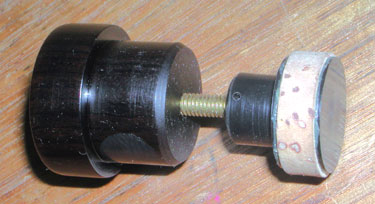
It’s proven a good approach. But I won’t argue it’s the best approach!
I’m thinking that both have their place in the world, and it might depend on your embouchure approach as to which will work better for you. If you follow the modern “French School” approach of blowing across the embouchure at the edge, the rectangular embouchure might best give the loud and bright sound they look for. And better flexibility in the third octave. But if you follow the 19th century English (Mr Nicholson, I’m looking at you…) or Irish approach, blowing down the embouchure at the bottom of the hole, the Elliptical will give the darker and more focussed tone.
I’m suspecting that the two approaches might also benefit from different stopper set backs, but I haven’t had time to play with that question.
Am I wasting my time trying to use the Nicholson technique on a squarer embouchure hole.
I tried Robert’s innovations on my headjoints as well. Both the hole in the cap end as well as some of the grooved metal stoppers made from various alloys. I couldn’t hear any difference, and players who tested them didn’t seem to notice any difference, so I ended up doing exactly what you did, Terry (cork and Delrin). Those grooved metal stoppers were a pain in the neck, and I saw no reason to create more work for something of questionable benefit  .
Delrin…sacrilege !
I guess cork is so available here and not minding trimming a new piece if nescessary, not that have needed to, but then modern flutes often have mechanics at that end, for reasons that so far elude me.
I understand Bigio’s idea though, at the least it would fall into some category of “instrument worship” that would excuse any accusations of vanity … I also remember you saying somewhere flutes should be “laviscious” Terry, though you might have since repented.
Anyway, I think pressure/resistance is almost entirely a product of flute embouchure size. I notice it as the following :
The resistance felt is actually the pressure before the lips, and flutes that need (i.e. with trained embouchure) more air to play need wider player embouchure to allow that through.
They need more air because the players embouchure is further from the blowing edge, and also because there is loss of pressure from size of flute embouchure, the resonance of the airflow at blowing edge being due to pressure difference just outside of it versus just inside.
So what classical players might call a fine jet blown from near rim of embouchure, e.g. to gain 3rd octave or play quietly, on rennaisance flute is all that is needed to play first two octaves, but using less air even. On both you would note the resistance, but on classical 3rd you might feel you are reaching a note, on rennaisance 2nd that you are filling a note, the difference being that first two octave sounds are relatively full, i.e. the amount of sound for air used.
For first octaves with large flute embouchure, blown from rim needs more air relative to small embouchure . It is possible to raise the pressure to do this but still the sensation is of less resistance due to the increased air flow.
All flutes* with large embouchure can be played with increased cover to increase resistance and/or decrease distance. Kissing out classical style does both, rolling the flute, increasing lower lip cover, and increased top lip cover, all do this. On large embouchure flutes I am able to play with around 50% lower lip cover for a quieter and different sound, for example, with the reference volume being the notes that cannot be played more quietly. However the kind of sound a player might find acceptable might need more open playing.
- The angle of cut of the embouchure (the blowing face) is important. On one flute there was too much undercut , and the result was that it could only be played properly rolled right out and from rim, and once corrected behaved properly. Reviol would know what he was doing I should think though.
For square embouchure I don’t know, but I would imagine they are designed for more open playing because effects of increasing lip cover will be less with those.
All the above should be disregarded by players though, beyond the fact that set of the flute and embouchure style have great effect, and so not to be disuaded from spending a good time playing with the flute set at different angles, different airflows or embouchure size etc. to discovered what kind of range is available. On a new flute it will usually take me several weeks to become familiar with it and to decide on the set/s of the flute I prefer to continue with, and those then get further refined.
I don’t know, here’s where I think we need a bit more work. My playing history is possibly indicative.
I had first taught myself to play metal flute, then took a few lessons. My teacher was appalled I played so flat, even with the head hard in. So every week I copped the same message - lip up, lip up. This flute came from an era that expected the French “across the hole” approach, and left the player with no choice but to obey. Bit by bit, I got up to pitch, but I didn’t like the tone as much as when I blew instinctively down the hole.
Then I moved to wooden flute, and probably relaxed a bit. Old wooden flutes have plenty of room on the slide, as they had to allow for the range of pitches in use back in the day. But I noticed that I still played sharper than other, usually self-taught players. When we swapped flutes at sessions, we both had to retune.
Then I started making flutes, and of course experimenting with different embouchures. Still using at least some of my learned French approach (blowing across), I found the rectangular hole worked best. But I soon found that other players found differently, and also blew a lot flatter. This was a challenge until I reinvented the tuning slide!
Then, some years later, I decided to reapproach the question of embouchure approach and try out the (fairly limited) advice from the English 19th century writers. I figured it was their flute we were reviving, we should pick up from their experiences, not the 20th century French approach. As I blew more downward, I enjoyed the tone and power more, and had to tune sharper. And I went back to the elliptical hole, as it seemed to work perfectly well in this approach, and possibly better. But I can only say “possibly” as I haven’t put the work in to be sure. As everyone knows, the day you sit down to try out matters like this, it will be a “bad embouchure day”.
I still make rectangular embouchures on demand, and still find they suit players who started on metal flute and maybe want to keep their metal flute going for other musical styles.
“Am I wasting my time trying to use the Nicholson technique on a squarer embouchure hole?” I can’t confirm that. I can probably still play louder and brighter on a rectangular hole, and think it has some merit on small hole flutes that can tend to sound a little constrained if not driven hard. But I’ve happily gone over to the Dark Side.
A lot to think about there. Guess I was lucky on the first flute this is going to take some work but sure what else would I be doing. 
As it isn’t really empirical there is plenty of room for confusion, with a lot of explanation based on perceptions, if you haven’t found these already you might try…
http://vintagefluteshop.com/articles/embouchure/art5.html
..to add some, and
https://thesession.org/discussions/39482
Third comment suggests he is playing darker tone with square tonehole…maybe.
GreenWood:
Delrin…sacrilege !
Heh heh, confronting, eh?
One of the interesting benefits of working a lot with period flutes is that you get to see what doesn’t work well, and old-time stoppers were a good example. They were typically wooden rods with a tapered screw thread cut at one end for screwing into the cork, and a parallel screw thread at the other for engaging in the threaded hole in the end cap. Wood is just not a good material for cutting screw threads in, and you get to see (and have to fix) a lot of failures. And the screw threads have to be coarse, which makes fine setting of the stopper tricky.
The Boehm flute replaces that with a fine threaded rod in metal, typically 4mm (even in US-made flutes?). Typically silver-soldered to a silver disc to act as the front of the stopper, getting around the second issue, which is that the face of a plain cork stopper is easily damaged. I stole that approach for a while, but still didn’t like it. The cork seemed to want to shrink over time. And good quality cork was becoming an issue since wine bottles were increasingly going screw-cap.
Hence the current version, in delrin with a thin cork seal set around it. Easy to control the tightness. Smooth, totally waterproof front face. Easy to replace the tenon cork strip if ever needed. And a fine, strong threaded metal rod to mate with a threaded insert in the cap to allow easy adjustment.
Romantic? Not particularly. But the stopper’s lot in life is not a romantic one - it serves a really important but invisible role. So I reckon this is a place where utility trumps romance!
“Heh heh, confronting, eh?”
Sort of, but it was tongue in cheek. The difference is not really about romantic ideals, but just personal approach to the instrument. I’m happy poking the cork into place, or adjusting it, with a cleaning rod, and usually it does not get further adjusted from a position I am happy with except when cleaning the whole flute…and gets returned to same. I am not sure if micro adjustment should be by cork placement or player embouchure, and decided that continuously playing with cork position to try to improve sound was probably a distraction.
Others might differ, and so would want to be able to adjust with threaded cap, and there I agree with you… were I to make such a contraption it would want to anchor firmly on the stopper, and I would probably choose Boehm’s way for ease of construction and using basic materials, if not actually just gluing the rod three quarters way into the cork somehow.
For cork shinkage I don’t know, but as I don’t mind preparing stoppers the thought doesn’t put me off. The oldest cork I have in place is three years or so and it still fits fine. Even changing once a year would be no bother, but I imagine most people would find that a hassle. I find it fun collecting and shaping cork bark, even if most would not miss an excuse of buying a quality bottle of wine. Come to think of it, some are over a century old with cork still intact, so maybe shrinkage is humidity… or very small beetles that also have a form of wine aversion ?
Anyway, I’ll just say I find your approach with delrin functionally elegant, and similar for delrin flutes and so on.
[As for damage to the cork from cleaning etc., I suppose it depends how anyone goes about that. I will swab the flute after playing with a cloth wrapped also around end of rod and being careful to not push on cork much, and that doesn’t seem to damage it. Older texts advise removing the cork and cleaning after each playing, and there I could imagine eventually it would get damaged, but that would depend on if the player expected a perfectly smooth and level face to it ?
I take out the cork a few times a year and that doesn’t seem to cause damage, and probably oil added or pushed up the bore when being cleaned levels the cork and also possibly forms a sort of concave at that end which otherwise anyone would pay handsomely for in the form of a speciality dished stopper that improves the sound at the speed of light ]