I am not quite clear what you want it for. Is it for stitching the neck, or what?
You can get unwaxed yellow hemp in high street instrument shops or GHB suppliers,as the former sell it to woodwind players of all kinds, and GHB players use it for ferules etc as we do.
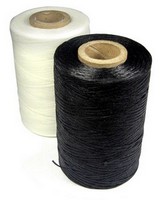
You can split the waxed polyamide thread, as supplied by the NPU, once freeing off an end between two nails and grasping each bit and pulling apart; or similarly double or triple up the same thread to the thickness you want, if that is what is required. I do the former for drone reed bridles (and often repeat the process on one separated piece), and the latter for tying in drone stocks. Ships chandlers, yacht chandlers, sell the same stuff in different thicknesses, as used for whippings and mending, but usually in shorter lengths than the NPU roll.
I have also used top stitching thread, a thicker polyester sowing thread, on reed bindings. That is quite strong, can be waxed etc, and doubled as explained before. It is stocked in haberdashery depts of big stores and sowing supply shops.
Have you ever tried Breyden Ployester Lacing Tape before?
Unlike wax polymide, lacing tape is flat and is great for chanter tops and even for tying in reeds. You may want to add just a bit more wax on it if you are making reeds though.
Ted is a materials man, amongst many other talents. He can supply what you need and give you the reason why it is used and how to use it best for your needs. You will not get that from someone that just sells you some thread. His products come with tried and true expertise.
The College of Piping and the National Piping Center in Glasgow sell waxed black hemp and unwaxed yellow hemp. It may be a bit dear but the waxed stuff is nice.
It supposed to cover the holes in place of the bottom hand on the chanter.This is to free that hand up for tuning. Havn’t seen the need, myself. I’ve heard they’re a waste of money.
One of the best things I’ve found for many different applications is Johnson & Johnson - Reach waxed dental floss (that’s how its marketed in North America at least). It is flat, fine, strong and has a particularly tacky wax. I use GHB black waxed hemp for many things as well, but often find it too coarse for close fittings - one layer can take me from too loose to too tight. This floss is excellent in those situations.
I remember from my days playing GHB’s in the 1970’s, that there was an issue with dental floss when used on moveable friction joints. Excess wear occured on drone slides etc.
How true that was I don’t know, I never used the stuff for wrapping joints on my pipes. Maybe the composition of the floss has changed too.
I have tried all sorts of stuff, and have gone back to yellow, unwaxed hemp as the material of choice.
That’s interesting, I’ve never heard of that, but it could be very true. Might be more of a risk with coarser unwaxed floss from the 70’s. The J & J stuff almost smears together like teflon tape, forming a very smooth waxed joint, easy to turn and move, but holds its position very well due to the grippiness of the wax. It would certainly be fine for any brass on wood sections.
A lighter weight of hemp is a better choice than dental floss, IMHO. The waxed and raw “hemp” sold by GHB suppliers is rather thick for SSP or tenor UP drone wraps. I sell a half weight hemp which is great for not adding much extra thickness in a joint. A base layer can be made from the thicker “hemp” with the final wrap or two being the lighter weight hemp. Many GHB makers advise against using dental floss as the wax can pick up dirt which is abrasive and can cause wear in the tuning area.
Good advice Ted. I have a thinner diameter strand ball of hemp at the minute that suits very well. I may well be in touch as and when I run out.
I have used the thicker stuff successfully, for thinner uses, by abrading it by running the required length across a solid surface a few times, (a sharp table edge) and peeling off the scurfe. Not very satisfactory, as it it is not consistent in diameter and strength.
I do something similar with the waxed polyamide thread from the NPU, when I want something thinner, for bridles etc. Take a length, split one end with a thumb nail, and part the two halfs; repeating if necessary. The lengths here are much more consistent in diameter, and equally so more reliable