Is there such a thing as a Sopranino D whistle, that is, an octave higher than the regular D whistle?
I have a student in my first grade whistle class that is under 3 feet tall and probably won’t grow much more. She can almost cover the top hand holes but there is no way that she is going to be able to get the bottom hand holes covered. I’d like to keep her in D so that the fingerings will be the same as the rest of the class.
The link is broken. There seems to be a DNS problem with Daniel’s site at the moment. Maybe because the domain registration is about to expire? Daniel?
I wouldn’t immediately move the player up an octave. As has been stated that could be tough on the ears of everyone in the class. I don’t see that anyone has asked what brand/model of whistle the student is playing. I’ve had younger students that had difficulty covering holes on Walton/Feadog/Gens. I have had some luck moving them to Clarke’s Sweetone. The Sweetone, like other Clarkes, has a conical bore. It uses smaller tone holes and they are spaced closer together as well. I would try something like that first. Otherwise I would consider trying a piper’s grip. I know it is a bit unorthodox on a high D but it sound like your student is experiencing the same issue that many adults have with the holes size and spacing on a low D. The piper’s grip is an accepted solution in the adult case. So why not try the piper’s grip with your student? Another solution that comes to mind is using an Eb or F whistle as your class whistle.
Pipers grip was my first thought too, but even for that her hands aren’t big enough. I’d say her entire hand is smaller than my palm and there is a certain lack of mobility in her joints due to her condition. But they are all on Walton’s right now. I think I’ll bring in a Clark Sweet Tone and see if she can manage.
It’s an interesting thought on changing the whole class to Eflat or F. The problem is that I’d have to change the whole school, grades 1 through 5 as they sometimes play all together. Yes, that’s about 40 elementary school whistle players doing Hot Crossed Buns together.
It’s something that I’d change for the next school year (staring in September). I only get to see each grade once a week for 20 minutes (although I’m working on upping that to twice a week if anyone knows any grant money that might be available) so it hasn’t been too much of an issue as we were mostly doing only top hand tunes for the first graders but now that we are into more challenging stuff using both hands I can see her frustration building.
On a Waltons D whistle, the T1-T3 span of the top holes is 43 mm, center to center. The B1-B3 span of the bottom holes is … also 43 mm. So if her top hand can cover the top, her bottom hand should be close to being able to cover the bottom (unless her hands are really different sizes).
The problem on the bottom is not so much the whole span as the distance between B2 and B3. Piper’s grip is one solution. Pinkie grip is another. Just use the pinkie finger instead of ring finger to cover the bottom hole; the ring finger just floats above the others. In fact, there’s no reason this can’t also be used on the top hand if it’s more comfortable for her.
Finally, there’s no reason she can’t combine piper’s grip and pinkie grip. That is, on the bottom hand use the middle joints to cover B1 and B2, and the pinkie to cover B3. I did this myself when I first started playing low whistles. I’ll bet you a Chiffy Buck that would do the trick for her.
FWIW, the Sweetone hole span is the same as Waltons on top, but a bit smaller (40 mm) on the bottom. So maybe that’s a good idea, too.
Now you’ve got me thinking about why she can’t get the bottom holes and I’m picturing her in my mind and it’s almost like she can’t actually reach the bottom holes, like her arm isn’t long enough which sounds impossible but it’s how I’m seeing it in my minds eye. I’m thinking also, that she holds the whistle out a little far from her body (almost parallel to the floor), so if I had her bring it in a little and use the pinky grip and used a Sweet Tone, it might be enough.
Thanks everyone for your input, it’s helping me analyze her playing better and hopefully I’ll get to a solution. I’ll see her again on Friday and let you know how it goes now that I’m looking at it a little differently.
Yes … Part of mulling over the above involved me holding a low D whistle and imagining that I was half-size, instead of the whistle being double size.
Part of the problem with normal grip on a low D is not just finger span but also hand/arm angle. Bringing your bottom hand down that far with the fingers perpendicular to the whistle body puts the hand and entire arm in a strained, uncomfortable crooked position. Piper’s grip or piper’s/pinkie grip lets the arm take a more natural angle.
Another idea … By all means have her hold the whistle more vertically, more parallel to the body. But she can also angle the whistle sideways and up toward flute position, maybe 30-45 degrees. This definitely takes strain off the bottom hand and arm. Some whistlers play like this anyway, because it looks cool. Don’t be surprised if other kids want to imitate her.
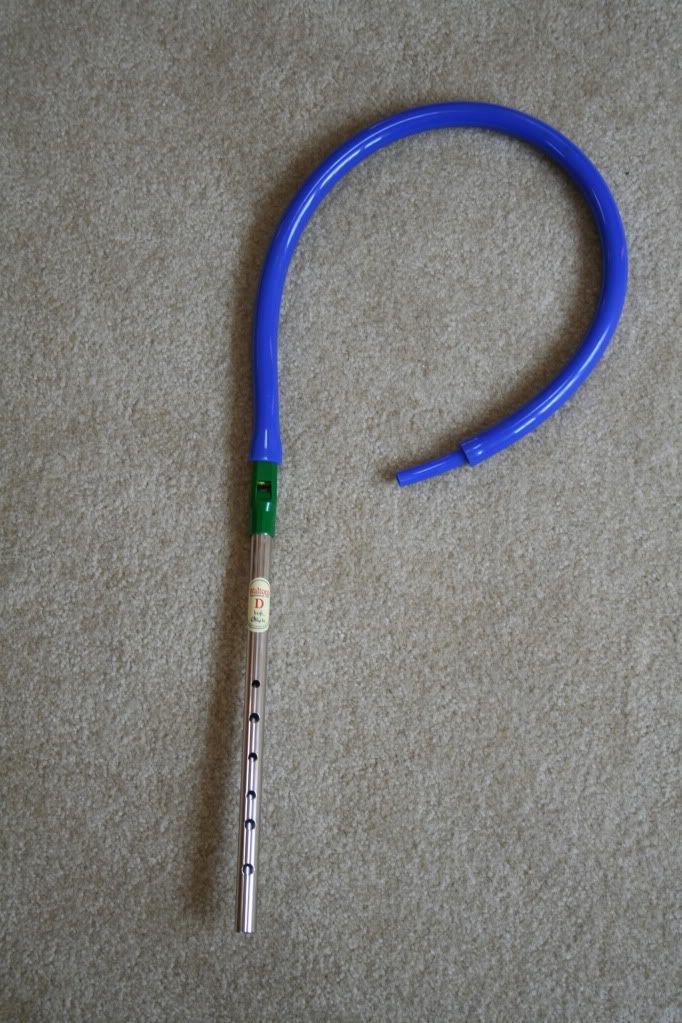
Wow, this is an interesting situation. It really sounds like a similar case as an adult learning with a low D or low C whistle. It’s a shame that no one makes a bent neck high D whistle or a high D whistle with keys. Could you fashion a “bocal” out of flexible tubing where one end press fits over the whistle head and the other in the child’s mouth? Hmmmmmm? A stiff brass/copper (I’m thinking hardware store plumbing supplies now) tube might be needed to hold the whistle up high enough, then connect the brass to the whistle head via flexible vinyl tubing. Could that work?
Hoopy Mike’s thought of the tabor pipe is brilliant!
If you have a set of Gens, (I know that is presumptious of me) I would suggest experimenting with the higher pitched whistles seeing if they are any more playable for this student. This may be a case where the Generation high G is the perfect whistle. Many adults have difficulty playing that diminutive whistle.
Ian, “I feel your pain” but only when I am playing the Gen high G. The holes are too close together for me to play anything quickly on a Generation G. Maybe that would work for this student? Then you might be able to set some tunes in the key of G or something like that. Would it be at all workable to have the class learn on the D’s and have the one student practice on a G whistle to get comfortable with playing?
Yes, I was also thinking along the lines of devising an improvised extension key for the bottom hole. Then it occured to me that pinkie grip is a more natural solution. I tend to think the same about those Susato keys, too.
If the whistle does prove to be unmanageable, another alternative could be a garklein recorder:
It’s a half-size C soprano, an octave higher. Within the diatonic compass that the whistlers are probably playing (1 1/2 octaves), the fingering is essentially the same as whistle (except F#/f# and d). And Aulos offer a nice plastic garklein for around $20.
The obvious problem with the higher whistles (Eb/F/G) is playing together with the other students. But I could see using them as training aids for the young lady to work her way down to a D whistle.
As for the bocal idea…This will solve the arm length issue if they can cover the holes with their fingers. The breath response is just like a normal whistle too.
Yes, it would look better on a blue top Generation.
I don’t know about Donncha O’Briain, I first used a polyvinyl tubing solution when I was a Philly based folk-rocker back in the seventies. One of the members of that group played bassoon and bass recorder (among other instruments) so the bocal thought was right there in front of us. It allowed me to play a melodica and a Rhodes at the same time. The melodica was anchored on top of the Rhodes along side a lap steel guitar. other wind instruments would later receive the same treatment.
In this case it allows the whistle player to put their arms anywhere they are comfortable. The whistle can be help up higher or to the side or on the lap. The whistle head is not anchored in the mouth making the right hand stretch difficult for short arms. It doesn’t solve the tone hole size or distance problem. I’m still pondering that one.