I realized I couldn’t even remember who was Goofy and who was Pluto—what a terrible thing! So I had to go find out and it is pretty interesting. Er…, this is a little off the Pez topic. Sorry.


http://en.wikipedia.org/wiki/Goofy
“Goofy is a fictional character from the Walt Disney’s Mickey Mouse universe. He is an anthropomorphic dog and is one of Mickey Mouse’s best friends…”
“Later, starting with How to Play Baseball (1942), Goofy starred in a series of cartoons where every character in the cartoon was a different version of Goofy. This took Goofy out of the role of just being a clumsy cartoon dog, and into a more complex role of symbolizing the struggles of the common man. The epitome of this staid everyman role for Goofy was in the cartoon No Smoking (November 23, 1951) where Goofy, in a world of Goofies, struggles desperately with nicotine addiction. The cartoon, a divergence into an edgier subject (something Disney has always tried to avoid), is now rarely if ever seen due to popular culture’s aversion to cigarettes.”
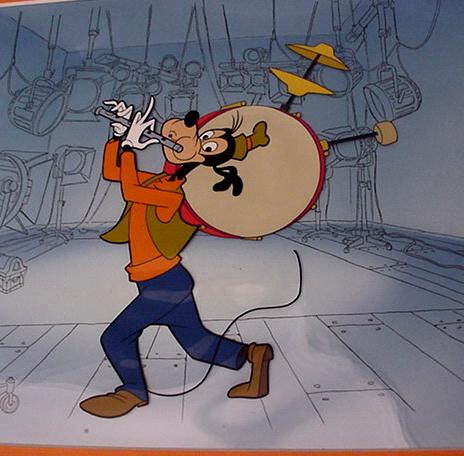
Art Babbitt’s (creator of Goofy) analysis of Goofy:
“It is difficult to classify the characteristics of the Goof into columns of the physical and mental because they interweave, reflect and enhance one another. Therefore, it will probably be best to mention everything all at once. Think of the Goof as a composite of an everlasting optimist, a gullible Good Samaritan, a halfwit and a shiftless, good-natured hick. He is loose-jointed and gangly, but not rubbery.
He can move fast if he has to, but would rather avoid any overexertion, so he takes what seems to be the easiest way. He is a philosopher of the barber shop variety. No matter what happens, he accepts it finally as being for the best or at least amusing. He is willing to help anyone and offers his assistance even when it is not needed and just creates confusion. He very seldom, if ever, reaches an objective or completes what he has started. His brain being rather vapory, it is difficult for him to concentrate on any one subject. Any little distraction can throw him off his train of thought and it is extremely difficult for the Goof to keep to his purpose. Yet the Goof is not the type of halfwit that is to be pitied. He doesn’t dribble, drool or shriek.
He has music in his heart, even though it is the same tune forever and I see him humming to himself while working or thinking. He talks to himself because it is easier for him to know what he is thinking if he hears it first.
His posture is nil. His back arches the wrong way and his little stomach protrudes. His head, stomach and knees lead his body. His neck is quite long and scrawny. His knees sag and his feet are large and flat. He walks on his heels and his toes turn up. His shoulders are narrow and slope rapidly, giving the upper part of his body a thinness and making his arms seem long and heavy, though actually not drawn that way. His hands are very sensitive and expressive and though his gestures are broad, they should reflect the gentleman.
Never think of the Goof as a sausage with rubber hose attachments. Though he is very flexible and floppy, his body still has a solidity and weight. The looseness of his arms and legs should be achieved through a succession of breaks in the joints rather than what seems like the waving of so much rope. He is not muscular, yet has the strength and stamina of a very wiry person.
His clothes are misfits: his trousers are baggy at the knees and the pants legs strive vainly to touch his shoe tops but never do. His pants droop at the seat and stretch tightly across some distance below the crotch. His sweater fits him snugly except for the neck and his vest is much too small. His hat is of a soft material and animates a little bit.
The Goof’s head can be thought of in terms of a caricature of a person with a pointed dome; large, dreamy eyes, buck teeth and a weak chin, a large mouth, a thick lower lip, a fat tongue and a bulbous nose that grows larger on its way out and turns up. His eyes should remain partly closed to help give him a stupid sleepy appearance, as though he were constantly straining to remain awake. But, of course, they can open wide for expressions or accents. He blinks quite a bit.
He is very bashful. Yet when something stupid has befallen him, he mugs the camera like an amateur actor with relatives in the audience, trying to cover up his embarrassment by making faces and signaling to them. He is in close contact with sprites, goblins, fairies and other such fantasia. Each object or piece of mechanism, which to us is lifeless, has a soul and personality in the mind of the Goof.
The improbable becomes real where the Goof is concerned. He has marvelous muscular control of his fanny. He can do numerous little flourishes with it and his fanny should be used whenever there is an opportunity to emphasize a funny position.
Well, this little analysis has covered the Goof from top to toes, and having come to his end, I end.”


http://en.wikipedia.org/wiki/Pluto_(dog)
"Pluto (also known as Pluto the Pup) is a fictional character made famous in a series of Disney short cartoons. Pluto has most frequently appeared as Mickey Mouse’s pet dog, although he has also been Donald Duck’s pet, and occasionally as the pet of Goofy (who, notably, is himself a dog). He also had an independent starring role in a number of Disney shorts in the 1940s and 1950s. Pluto is unusual for a Disney character in that he is not anthropomorphized beyond showing an unusually broad range of facial expressions; he is actually represented with the characteristics of his species."
“Pluto first appeared in the 1930 Mickey Mouse cartoon The Chain Gang as a bloodhound on the trail of escaped prisoner Mickey Mouse. The bloodhound character was adapted into Minnie Mouse’s dog Rover. He later changed his name to Pluto and his owner to Mickey Mouse, making him Mickey’s best pal.”
“Pluto is considered one of the first Disney characters to break out of the “rubber hose and circle” formula style the studio had relied on; the dog’s design gave him the appearance of actually being round instead of flat. In addition, Pluto is one of the first cartoon characters that is actually shown to have thought processes through the use of character animation. The dog’s thought processes are showcased in a landmark scene from 1934’s Playful Pluto, in which Pluto becomes stuck to a piece of fly paper, and attempts to figure out ot a way to get himself unstuck.”


