Over-oiling?

As a Fifer in an American Civil War Reenactment unit, I have been in the habit of keeping my Sweetheart blackwood Bb fife well oiled, and rubbing it in as I would do with a musket stock. It just seems to play better if the wood is impregnated with oil, IMHO.

I once bought an 1864 CLOOSE “C” fife at a pawn shop that would not play at all - come to find out it had a hairline grain seperation / split / crack along the bottom that i could hardly see, but which rendered the fife essentially mute. It would make noise, but no music.

Did I break out the glue - pot? NO!! But after a good oiling and some time, the parched wood expanded back to it’s original volume, the split closed up, and the fife played again as I imagine it might have back in 1864.

As the natural resins in the wood which fill out the spaces between the cellulite structures evaporate (they are somewhat volitile) the wood tends to contract, or shrink. This is why “wooden indians” and chainsaw art usually splits in several places as it drys out.
We don’t want that happening with our flutes, now do we?

I have slathered oil onto the inside of old guitar decks that have split, and you can just about see the wood expand and the splits close up.
Needless to say, I’m becoming a big fan of oil finishing on guitars as well as flutes and fifes.

Oil at least partially replaces the lost resins, helping the wood to maintain it’s volume and prevent splitting. I think it also contributes to the density of the material, and thus it’s harmonic resonance.
Oil impregnated wood seems to be a more efficient conductor of sound than dry wood with it’s multitude of air-filled chambers among the cellulite matrix.

Some of you here would pitch a fit if you saw the way I utterly SLATHER the oil (I used to use peanut oil, but found that it went rancid after a while and smelled nasty, so now I use toasted sesame seed oil. Works for me) to my wooden instruments.

As a general rule, if the surface looks dull and feels dry, I’ll pour a nip of oil into the ambrochure, tip the flute up so it runs down to the end (and all to often dribbles on to the carpet - gotta quit doing that), run a .410 (for the fife - 28 guage for the flute) shotgun mop-swab up the bore with a length of shotgun cleaning rod while twirling it around a bit, then rub whatever slobbers out the holes into the exterior until it glistens.

Sometimes I take a Q-tip to make sure that the end grains around the edges of the holes get a good dose as well.

I’ve been using this technique on my low “G” black walnut flute “Gilead”
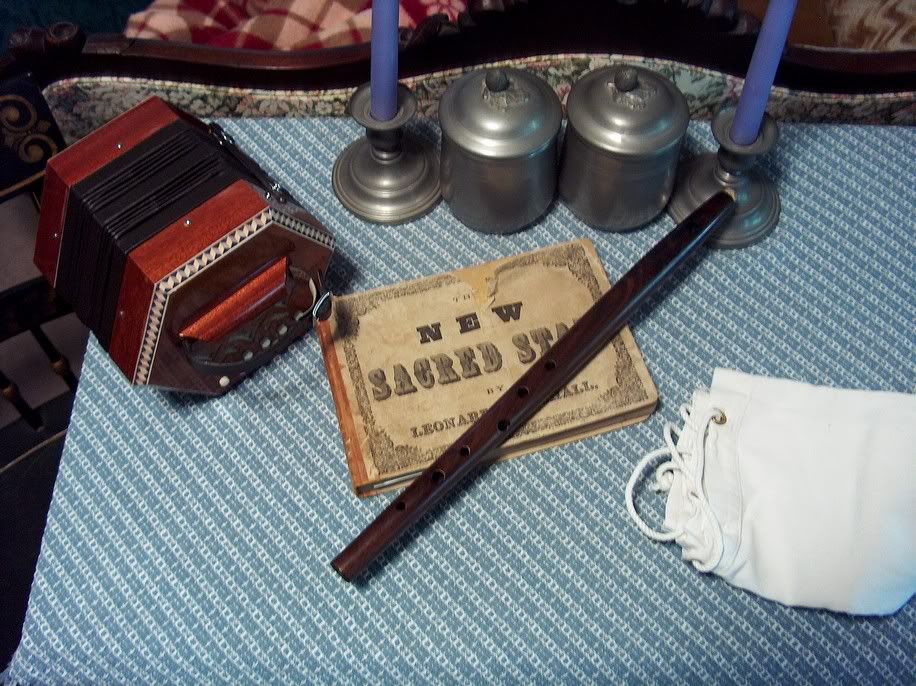
for years now, and the slipprier she is, the sweeter she sounds.

Lovely instrument Uncle Jaque :sunglasses:

Thanks Maire.

I turned it out of a black walnut piano leg or something that I scrounged from the dump, as I recall. It had a small knot at one end, so that’s where I put the ambrochure, smack in the middle of the knot-hole. I also scraped or “jugged” out the bore between the abrochure and tone holes.

Is there a web site where one can upload a *.wav file to demonstrate what an instrument sounds like? I’d be glad to share if so.

Have tried to replicate this instrument a couple of times, but just can’t seem to get them to come out right. Still working on it, though.

You might find that info on the other forum I frequent: www.thesession.org.
I am a complete technophobe, sorry :smiley:

I feel a little obliged to wade into the bore oil controversy and get my feet either sticky or slippery. I’m not an expert on anything I’m going to talk about, but there are some issues which haven’t yet been raised here.

Some (actually, many) years ago I worked for an industrial finishes manufacturing company (in other words, a paint maker) and my job was to promote sales to musical instrument manufacturers. As a guitar player with retail music experience I knew nothing about paint beyond “wet,” “dry,” and maybe “pretty.” So I was on a pretty steep learning curve for a time so as to not embarrass myself or, worse, my employers when I went out to talk to instrument makers.

Basically, I learned most finishes are made up of three components. An article on Wikipedia calls them binder, diluent, and filler and additives. They can also be called oil, solvent, and solids. According to Wikipedia, only the binder (oil in our discussion) is essential. In fact, oil has elements of the other two components. So when we oil the bore of a flute, we are actually applying a finish to it.

So why do this? There are two main reasons, to protect and to restore. Think about what happens inside a flute. Stormy Weather. A warm wet wind gets blown across a wooden surface. Depending on the type and condition of the wood, it will absorb some of this moisture, then dry out. As a result, the wood can first swell, then shrink. The surface can become uneven, and the instrument itself can split or warp.

And think about the nature of that warm wet wind we blow. Yes, there is water. And digestive enzymes. And beer. Germs. Halitosis. Barbecue sauce. Sounds like a NASA weather report from a planet closer to the Sun than our own. I have trouble believing this stuff is good for the insides of flutes.

Finishes often serve as sacrificial protective barriers. That is, a finish is destroyed as it protects the surface underneath. Then we replace the finish. Think of the varnishes and paints used on boats and houses. Which would you rather do? Repaint? Or replace the wall or window sill years of wind, rain, and summer sun have destroyed?

The other thing an oil can do is restore dry and damaged wood. It can replace both the moisture and solids neglect, abuse, and climate suck out of it. I was able to turn a junk maple fife into a pretty good-playing instrument by first sanding smooth the bore (it looked like a corn cob turned inside out when I started) then oiling it. I repeated the sanding and oiling several times, until the grain no longer rose when I oiled the bore. At one point I thought I had gone too far, that I had over-oiled the thing and ruined it, because it wouldn’t play clearly. But I let it sit a few days and the problem disappeared. (Or maybe my embouchure improved!) In any event, my junky little maple fife now plays well and sounds pretty darned good. I read with interest comments about how over-oiling had ruined instruments. I’m curious as to what actually happened (first-hand experiences only, please).

With one caveat, I don’t think the type of oil one uses matters all that much. My one concern is safety. If there is any mention on the label of calling a physician or the Poison Control Center, or how the fumes from the oil can induce hallucinations, convolutions, or death, maybe that product ought not to be slopped onto something which is going into or next to our mouths for extended periods of time. In other words, let’s not use stuff which will make us sick or dead. Petroleum products are out. Any light oil from a non-toxic vegetable source ought to do the job. Recently I was introduced to Bore Doctor (www.doctorsprod.com). Although a bit pricey, it is made for our purpose, safe enough to drink (though not very tasty) and comes in all sorts of different-sized containers.

There. I think I’ve said my say. Thanks.

John,

From a scientifc standpoint, the oils typically used for oiling wooden flutes do not act as an effective vapor barrier, and so, do not keep moisture from moving into and out of the wood, they only slow the process slightly, the merits of which can, and have been debated, of course.

There are ways to completely seal the bore against moisture penetration, but few wooden flute makers do so.


Loren