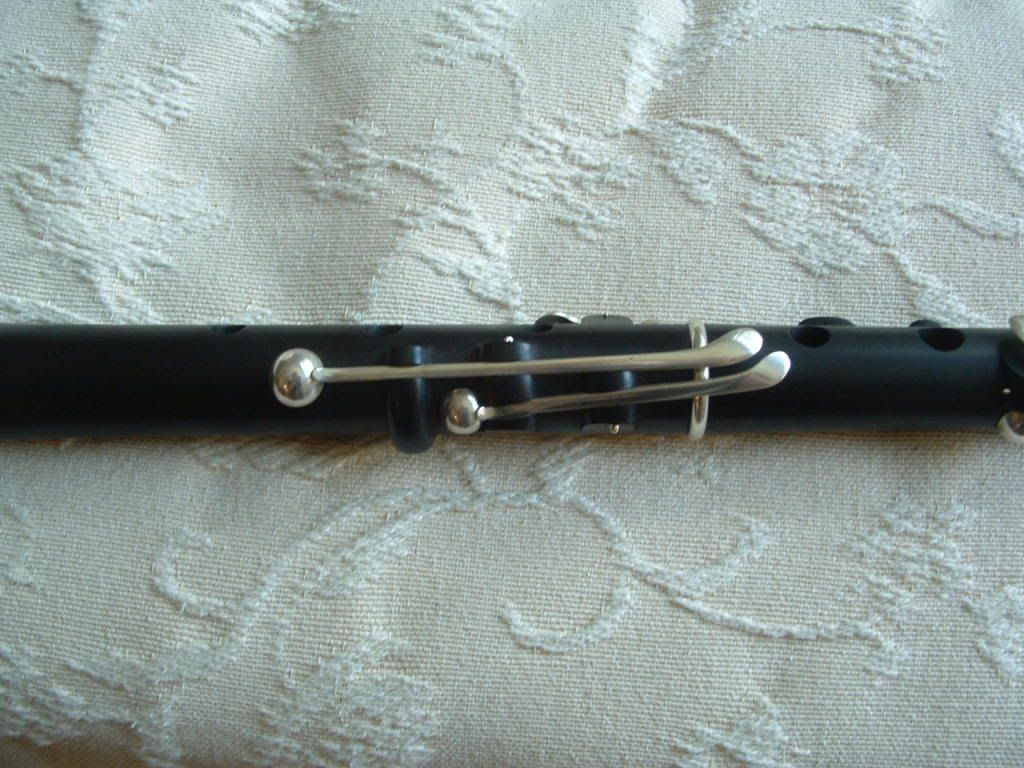
I’m puzzling over something I saw on the DCM collection website.
The flute in question is by Pask, visible here. As usual, I’m attracted to the extra Bb touch, but this one comes with a difference. If I read the picture aright, the right-hand touch is perched on the shank of the C key, so actuating the Bb opens the C as well. Trouble is, you’d get a C, not a Bb, if it worked that way.
I know from my own flute that opening the Bb in conjunction with the C gets you a brighter, sharper C. Would Pask have gone to the trouble of providing a whole separate key just to brighten up the odd C?
One of the downsides of the R1 Bb is that you can’t do an easy Bb to C, which is a common requirement in the flat keys. Is it possible that this is a solution to that?
Press the mysterious bit of silver lightly and you get Bb, press harder and you get C?
Maybe even be able to trill Bb/C?
Otherwise, as you infer, it doesn’t make sense, other than perhaps to provide a sharper C in the second octave (with the addition of Bb’s venting).
Or maybe all of these things?
Now Mr Pask has form on this sort of thing. In Edinburgh you’ll find a Pask with the usual thumb Bb (although executed in rod’n’axle form), the usual R1 C key, and an R1 D key, again with its touch extended over the shaft of the C key.
You’ll find some more stuff about Pask starting at:
I confess, I was fishing for a reply from you Terry! I had seen some info on these flutes on your website, sometime in the distant Pask (sorry, couldn’t resist!). It could well be just what you say, a light touch producing the one note, with a deeper dig actuating the C key. I got on this topic whilst pondering similar issues with my own flute. Aran Olwell did me a lovely custom Bb, curled neatly around the C. I can do a Bb-C transition pretty well, but the tradeoff is that the Bb itself is hard to jit in the heat of battle without accidentally venting the C. I was, oddly enough, wondering about having the C touch sit on top of the Bb shank, as per some of those 13-key Rudall models; Pask’s paradox popped up during a surfing session to support this particular musing of mine. Here’s the current setup:
You can’t see in this shot, but the Bb is higher than the C, which I guess was Aran’s main way of getting clearance between the two. I’ll probably have him shorten the touch and raise it up, that is, if I don’t get impatient and grab the needle files myself first. If that doesn’t work, I might try Pask in reverse. Either way, I want it all: Bb-C nice and easy (nearly there as is), C-Bb (super easy as-is; just slide the finger down the shafts of both keys until the C slaps down - must be venting both sumultaneously of course), Bb with no obstructions (well…), C ditto (currently possible to get two different shades/pitches of C, nice for airs). Demanding bugger, amn’t I?
Indeed you are, but that’s a fine thing in a customer, if we are to continue to make progress. If Irish music continues to expand away from Breathnach’s “good Christian keys”, we will need to make playing in the new-fangled Protestant keys easier.
The combination of a c thumb-hole and R1-Bb works well for some, particularly those with a Boehm background, but many older 8-key types find it hard to adapt to. Pity, because the thumb hole c dramatically improves c and c# too.
There was also that approach by Boosey that gave both the L thumb and R1 normally closed keys for both Bb and C. And Clinton’s sneaky arrangement that gave the L thumb and R1 one key that did both Bb or C depending on whether you were covering L2! So, great minds have spent time on it, but that’s not to say they’ve found the solution.
Terry, you just need to come up with a McBbee key!
Rob, it looks from the Pask photo that the block was added on the flute, I wonder if the customers were just as bad as the modern ones, in changing there mind?
I am working on a Pask right now, but it is the “plain Jane” variety 8 key model.