Has anyone replaced the stamped metal tailpiece on their mando with an Allen (or other) cast tailpiece?
Did it make a genuine difference?
If nothing else they look cool, but I’ve not been able to justify their high price. However, I was looking at the Allen website and noticed that they have factory cosmetic seconds for like $45 for the unpolished bronze. I can live with that for my beloved Fullerton Gloucester. I have a buffer and can polish it myself.
Head to Mandolincafe.com. There’s endless discussion about it. In a nutshell, some see a difference, others don’t. Sometimes it’s a big change, sometimes it’s so subtle they aren’t sure if anything happened. It’s one of those things. Like when someone changes the material of the nut and claims a difference in the tone of fretted strings. There’s no indisputable science to back it up (hence the endless dispute), but it still seems to happen for some players. A lot seems to depend on the individual instrument and player. Some mandolins respond significantly to small changes like increasing string gauge by a small amount, others not so much. About the only thing everyone agrees on is that some of the fancier designs make string changing easier. There’s the aesthetic consideration too. If you think it looks cool, that’s a good reason. Just be careful that the new one fits properly. Not all replacement tailpieces fit all instruments, even if they’re for the same style mandolin.
Turns out that Allen have very few seconds, and none suitable for my mando. I bought one of these instead: http://www.instrumentalley.com/Ashton-Bailey-Cast-Mandolin-Tailpiece-Chrome-p/ab-tp-fslash-c.htm
I’ll report in when I’ve installed it, along with some photos of the solid maple bridge I had installed 
Better tailpiece is the next step for my Fullerton Gloucester. Right now it’s with a luthier friend getting a bone nut and a Red Henry bridge. I hope the bridge is as good as some say.
btw, that Ashton Bailey looks nice, especially for the price. I hope the quality proves to be comparable to other, more expensive options.
The Ashtons are one of the designs people like for easier string changes, so that’s cool.
The Red Henry is the type of bridge I had installed, and I really think it made a huge difference in both the tone and the feel of the Gloucester. It feels more “alive” in my hands and barks like crazy.
I also had a refret job with bigger fret wire, and a bit of radius added to the fingerboard. So far, I’m as happy as can be.
Good call on the fret wire. I upgraded to ‘modern’ frets on my old Gibson A50, and also added a Brekke bridge. Both helped a lot. I’ve never tried a cast tailpiece, though.
I put cast tailpieces on all of the mandolins I build. Not sure if they sound better, but they don’t break. The old crimped ones sure do.
Rob
The stamped ones look kinda cheesy too.
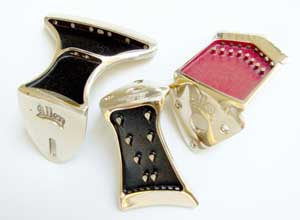
I don’t think I want quite so much chrome on my mando do I’m taking a hint from the Allen site and customizing my tailpiece with some paint:
What’s the benefit to having bigger frets? Is it worth considering as a future upgrade?
They last longer, and are easier to fret.
True enough. I’d go a bit further and say that they actually sound better, thanks to their greater mass. The easier fretting seems to result from less finger contact with the fingerboard, thus requiring less pressure for a nice, positive stop.
I hear there is now small gauge stainless steel wire available; I’m going to switch to that and save someone a load of trouble doing periodic refrets (probably me).
Rob
Hmmm. I may have to inquire on how much more that would cost… easier fretting would be a huge plus for me.
Paul,
I just wanted to interject something about the frets that are on your mandolin. The type of fret wire that is on your mandolin is more of a vintage (small) fret wire that just happens to be a little taller than average. Stew Mac calls it Modern Standard # 0764
http://www.stewmac.com/shop/Fretting_supplies/Stewart-MacDonald_Fretwire/Narrow_Fretwire.html
I have seen some people go up to more of a guitar wire on their mando but personally I think it is a little large.
Thanks for letting me barge in here, just my 2c!
Nate
(Nate is the fellow who did the excellent lutherie work on my mando).
Whatever that fret wire is, it’s a big improvement over the old stuff. The mando seems to play itself now.