No, sorry, because I’m not at all convinced that it will…
Peter might well have fingers, but he’s 1. tired of trying to help when you keep rejecting his advice, 2. grateful to MTGuru for the backup and 3. not posting to this thread again now!
No, sorry, because I’m not at all convinced that it will…
Peter might well have fingers, but he’s 1. tired of trying to help when you keep rejecting his advice, 2. grateful to MTGuru for the backup and 3. not posting to this thread again now!
Jleo, if you are more interested in screaming at others than learning something from teachers here who genuinely know what they’re talking about and are volunteering to help - which is, I presume, a reason for beginners to participate here and ask questions - you’ll make little progress.
If I say the word “dog” and you write the word “cat”, you’ve made a mistake. It doesn’t matter if you show me a chart with the word “cat” on it. It’s not what I said.  And it’s certainly nothing to become angry about.
Listen again to Andreas’ clip. And listen carefully to that third-to-last note. Match it up with the same note on a piano, or whistle, or glockenspiel - it doesn’t matter. Identify the pitch of the note. And write that note down.
As a hint … Andreas is playing a D whistle, and fingering that third-to-last note as xxxxoo. What pitch is that?
Question: Why, do you think, would Peter and I tell you you’ve made an error if you hadn’t made an error?
[ And thanks to Peter for a minor correction. ]
what a pitty, this was a good exercise to do
thats why i did not send the notes to that exra part and a soundfile instead, so that one should/could/ had to learn it by ear and writing it down was a good aditional exersice, as i learnd when i wrote down “me a gar eur goulmik” and did it wrong, i am still trying to understand all that in my thred ( i am still reading there) and in this one about it
it was a good, interesting and helpfull, conversation to read and to learn
do we just have some case of missunderstanding here right now?
to easily things which were written down firendly, are understood unfriendly while readed (right word?)
or is it just too hot in your countries too as it is herer in germany right now?
lets not end this in anger
i think i understand why there should be that “#” sign in the beginning to make a “f#” out of an “f” … but i dont understand why Jleo think its not needed cause its in “C” or so … this would be another chance for many, as for me, to learn, dont end it in anger … we all seem to be nice guys dont we
Exactly. The clip you played is in G Major, not C. If one likes charts, one can look up the key signature of G Major, and use that.
Andreas if the F note should be sharp thats cool. Simply means I heard an F instead of an F sharp (my transcribing software allows me to listen back what I’ve notated) I was incorrect but only you would actually know by looking at the original notation. No one else can provide the proof as you made the recording. Peter Duggan and Mtguru insisted that it was an F sharp but provided no proof. If I was to write a piece of music purely in the key of C there would be no F sharp, not unless I wanted one.
With that all said my apologies for any offense I may have caused.
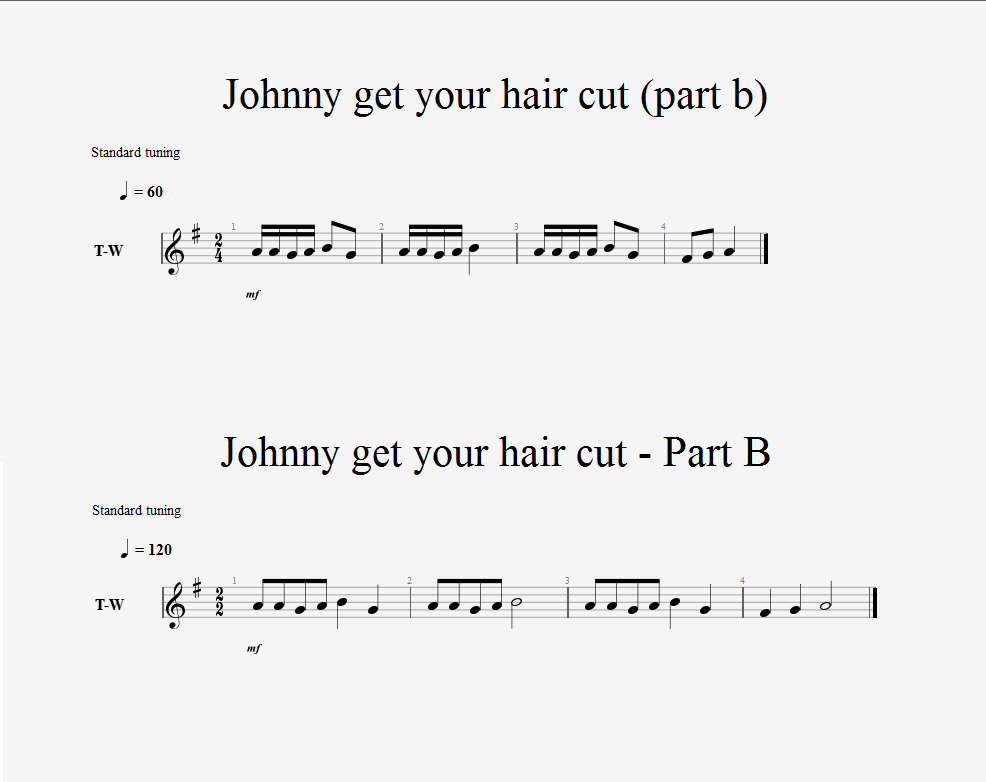
well, the more impirtant thing is
i am still sure, no one here did mean to be unfriendly and it was just a missunderstanding thing, friendly teaching on one side and not unfriendly, not understanding why, … does these words make sence? well, in german they would
lets be happy that we have music and lets hope i can write and read it soon … oh and being able to play it well would be nice as well
oh there is a new message since i wrote…
JLeo maybe they , with well trained ears did hear that its a D whistle and did hear the difference between f and f#?
well i dont hear the difference between a d and an f (i have to try which one suites and still have to do that several times untill i am still unsure, but my ears are very untrained
or maybe its because generaly notation for whsitle is made in d?
i dont know, thats why i dont understand all of it i think
Afraid you’ve dragged me back for one last time here…
No, almost anyone who listened to the recording would know and many would also deduce it from your notation.
No one else can provide the proof as you made the recording. Peter Duggan and Mtguru insisted that it was an F sharp but provided no proof.
There was plenty of ‘proof’ in both recording and context, and suggesting that Andreas’s printed source was somehow more important than what he actually played (the same in both cases as it happens) in establishing the accuracy of your transcription of the recording is both ludicrous and (yet again) offensive when attached to our names like that!
Bingo!
Woof!
hope i can make you stay, because we can learn a lot from you
i keep saying; i am sure, there was just missunderstanding between 2 friendly nice guys, whose discussion, however it was written/understood, was helpfull and made me understand more of musictheory … and i realy need to understand more of it
D … E … N-N-Y … 
Yes, of course. Does it seem amazing?
Jleo, your transcriptions are now correct.
I am still trying to figure out why you keep mentioning the key of C. I have a feeling you don’t yet understand what that really means, or how keys and key signatures (and scales and modes etc.) work. There’s no shame in that - it’s hard for beginners to integrate all the isolated bits and pieces. But believe me, this stuff is all very, very rudimentary for us. And at least at this level, very cut and dried and factual and not a matter for debate.
And I’m not sure what you mean by proof. Did you understand and actually carry out what I wrote above?
Listen again to Andreas’ clip. And listen carefully to that third-to-last note. Match it up with the same note on a piano, or whistle, or glockenspiel - it doesn’t matter. Identify the pitch of the note. And write that note down.
That would be a good start.
Since you’re back to rub my nose in it a little more explain this. My notation below doesn’t start on G so how could it be in G Mixolydian as per your quote. It’s obviously in A Aeolian, as the tonal center is A i.e. C Major’s natural minor scale.
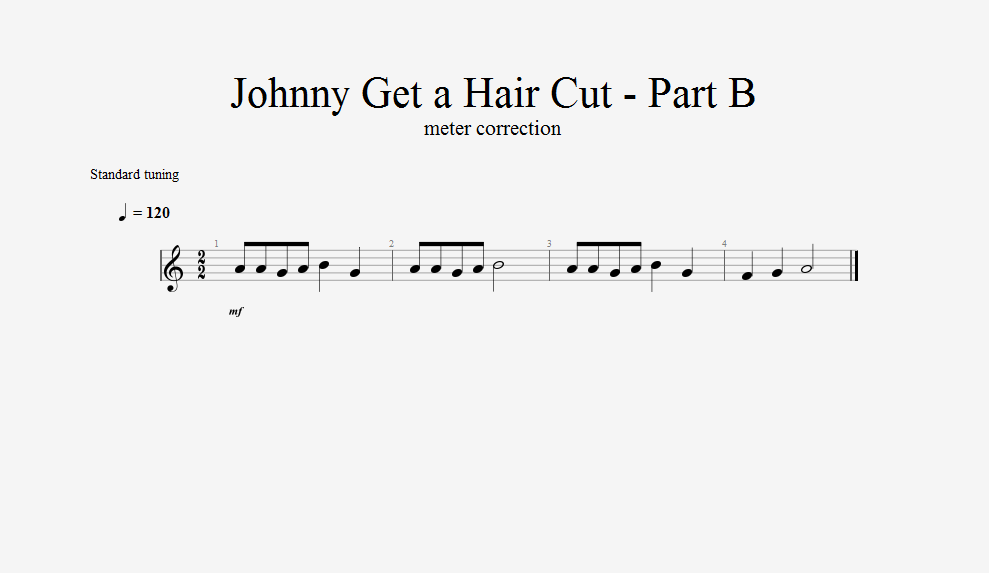
I know… I’d managed all day too!
channeling 
, he was.
still miss that one 
Could ya put the F# back in and call it A Dorian so we can get over this?
Denny you might as well join the slaggin’ since you’ve added nothing to any content in this thread that I created for feedback on my recordings all I’ve got so far is lots non positive reactions on the F sharp fly in the soup and none willing to explain but very willing and able to completely ignore anything else my thread has to offer. I hope your 23k posts had more to offer others than your input above 
A Dorian derived from the G major scale so yes it would require an F sharp.
To me. YES of course - does that seem amazing to you?
Dont forget there are people in this world who never learned something about music before, even not in school and start very late with it. -… Like me.
You could play an “F” and tell me its an “Y”, i would be surprised there is an “Y” but ask where it comes from and that i tought there are just a,b,c,d,e,f,and g and those again and again (wondering how many times again)
I am a musicidiot trying to learn.
Maybe your regular students are to talentet or well trained before you see them?
We are Beginers here and if we dont understand …well than we dont understand.
we wish to, but we have to understand it first, thats why we are here and talk about it, if u want to join, great ( id apreciate) but please dont tell us to stop talking about it or barking like a dog, this is confusing and seems unfriendly
did u forget that we are beginners?
and i understand Jleo very well, no one did give him any feedback of his recording … we are all oftopic its interesting but the topic shouldnt be ignored
and as a teacher i know very well how important it is to give some positive feedback to encourage before telling all what was wrong and count the mistakes
damn it must be hot everywhere
I will reattempt to allow you to blather on without me 
Do enjoy!
All of this talk about dorian/ionian/modes aside: It doesn’t really matter what key Andreas’ tune was written in. It matters what whistle it was played on.
Was it played on a D whistle? If so, then he played an F#. There are good logical reasons it should be an f# (which Guru and others have pointed out), but let’s cut to the chase. What was the note that was actually played that you based your transcription on?
Guru, Peter and Denny have all said it should be an F#. If you take a listen to the sound files in MtGuru’s signature, you might get an indication that perhaps he knows what he’s talking about–he’s been playing a number of years, and it shows in his recordings. The note certainly sounded like an F# to me too–I’ve been playing 16 years, myself. But to put all doubts to rest (since you go on about ‘proof’), I imported the document into Adobe Soundcloud, put that one note on repeat, and put my tuner up against it. It’s an F#… There’s no reason to get hostile or defensive over the mis-identification. It might be better, instead, to try to understand what it is a more experienced player is trying to tell you, rather than lash out as if you’ve been attacked.
Andreas, while hearing that it’s an F# may seem wondrous, after you’ve been playing long enough, you’ll likely grow a more discerning ear. It’s something that musicians tend to develop, because we learn to listen to music differently than before we took up the study of music. There was a time when I could not have told you whether I was sharp or flat when playing with others, for instance. I’m much better at it now. Unless I’ve been drinking
As to the topic at hand: Jleo, I’ve listened to your recording of the lewis bridal song and Katie Bairdie. I think you’re doing fairly well for someone who’s been playing 2 or 3 weeks. However, in particular, I think you’re missing the rhythm of the ‘scotch snap’ a bit in last two notes at the end of the phrases..It sounds to me like you’re drawing out the first note of the pair a little too long, and thus having to shorten the second note a bit to get it to fit rhythmically within the time signature–you lose the ‘snap’.
Accepted it’s hard to beat a guy with a sense of humour 
Thanks for your level-headed post, Wanderer. You’ve just stopped me from pulling some plugs around here. At least for now.
I am, however, going to call a halt to this thread. At least for now.