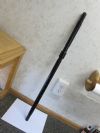
On advice learned here, I bought a spray can of Krylon Fusion-Satin Black, for plastices. A helpful hint: I took a cardboard tube out of a near empty roll of gift wrap paper and split it completely down the length one cut. I compressed the cardboard tube enough to slide onto it my three pieces: the part with holes the part with the window, and the collar for the tunable whistle. I made sure the split side of tube was away from holes. Now I could spray the whole whistle using a glove and turning tube upside down while spraying to get all ends. Plus I have a way to stand the whole thing up while resting between coats. The black satin looks nice IMHO. As a newbie, I don’t know if this is old news, but i sure seems to work.
?Should I paint the clip-on mouthpiece or leave it white. I was wondering about any hazard with your mouth on the dry paint if I paint it?
You can but be careful on the underside. Paint too thick or uneven will affect the windway height. I did and messed up the tone. Removed and all was well.
Also, you can use a poly coat if you want to make shiny and durable. I did . Make sure dries completely. I still would not do unde4r the cover.
Interesting. I wonder if the thickness of the paint on the inside of the holes (reducing hole width) or the increase in thickness of the tubing (chimney height) has any noticeable effect on tone/intonation. My guess is that the thicknesses involved are far too small to have any effect, but it might be worth making sure you do not do too many thick coats…
Whatever your reason for painting I hope your experiment comes out better than mine. A few years ago when I was just starting on whistle (and before I was ready for a low whistle!), I bought a nice low D from Guido Gonzato which sounded far better than a couple of other big name whistles, who shall remain nameless. Though the reasoning confounds me know, I thought the PVC looked, well…unpleasant.
Bought a can of bronze krylon, bent up an old coat hanger, stuck masking tape over both ends of the windsay and painted away. I have spray painted many things in my life using spray cans and professional equipment so I was careful to get two even coats, the first a little lighter than the second. After letting it dry for two days, I tried desperately to play it with no success. It sounded horrible. I reasoned that it was the toneholes since it was equally flat up and down the scale and very muted in sound. So I got out my trusty file and carefully cleaned up the edges of the toneholes which helped the flatness somewhat but not the rest. I then surmised that I it must be the windway got a little something in it despite my careful approach so I took a pipe cleaner with alcohol on it and vigorously scrubbed the windway. Nothing. When I looked through the windway from the mouth end, I noted that there was a tiny run of paint clinging to the bottom of the blade so I got out my small round file and carefully rubbed that off. Much better but still not clear sounding. Then I noticed that the same running effect was present on the inside of the tube around the toneholes. Barely noticeable but there indeed. So I took a round wire brush, stuck it in a drill on slow speed and “reamed” the bore lightly. This brought the instrument back to normal.
Later after playing it maybe 60 times for 30 minutes at time over a period of two months, the paint has worn off the holes and the back where I place my thumbs and it looks like absolute crap.
IMO, it’s not worth it. A monumental waste of time. The PVC is fine the way it is. Good luck with yours.
Lots of good information here. Some a bit scary. I will do some playing after paint hardens well. For now I will leave mouthpiece unpainted. I will hope I don’t have to tweek it, but now I know where to look for problems. I better get my files and sandpaper ready for the holes and window. I will report back on project. This is Low D Whistle #4 I have made in this lesson on learning about these beasts. Hopefully, I didn’t just turn it into a wallhanger.
Thanks, Brad
Hopefully this is the same process as the old BHO site for photos. Here are the parts still mounted tightly on the split cardboard tube.
Brad
well i see pic is too small for much of a looksee.
I do know that the shakuhacchi flute makers (high end flutes) laquer the holes. I also know that you can reduce hole width and affect the note. I have painted pvc holes before and put too much in them. Had to go back and remove. I have painted the holes via the shak method.
I agree that you have to be careful with the holes and painting them.
I took the parts off of the cardboard tube. The tube did keep the paint out of the insides of all of the parts. On this whistle my holes are sized out with a countersink bit then fin tuned to size with file, so not much paint could build up on hole sides. When paint is thoroughtly set I will fine sand lip to make sure it is smooth, sharp and clean. (I have not located locally any black ABS plastic pipe yet to make one out of that) Here is a bigger picture of my mounted split cardboard tube:
MSDS specs on paints have little to say about the dried condition of that paint. Virtually all of the chemicals listed for Krylon are volatiles and quite gone when the paint is dry.
That looks so much better in black. Like a Susato or something. I hope it plays well when you’re finished. You guys are a lot more professional at painting than I am so I’m not going to try it.
I think I may try this on my Tipple, but leave a few white rings on it where the metal rings would usually go. I;m thinking if I do it right it could look like a delrin flute with artificial ivory rings, sort of like what Dave Copley offers.
i have a friend that is a painter, and had him do the ABS mouthpiece of a Hoover low E for me (exceptionally long mouthpiece, 5" or so). i DID keep the last 2" paint free (white) to avoid getting paint in my mouth, even though it might be okay. Didn’t want to take my chances, and it looks nice 2 tone anyway.