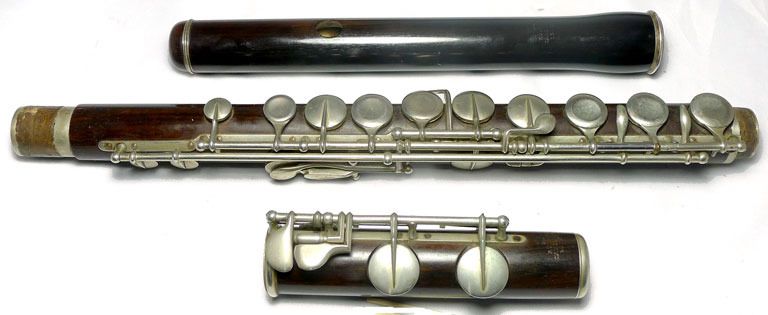
I just purchased an Rudall Carte rosewood bohem flute. I was told it was made in the early 1900’s.
Is there any out there who can help me to find the exact year it was made?
The serial number is 3563.
I’ve tried to search this forum for the answer, but there are so many threads and so far I haven’t found right one in order to help me with my question
Well according to Bigio’s book your flute was completed in 1903. The first serial number in 1903 was 3484. The first serial number in 1904 was 3590. So your flute was maybe completed in the latter months of 1903.
Kul att du har en Rudall flöjt in Norge. Jag har tre stycken gamla Rudall flöjter med åtta klaffar och det finns en ostämplad Rudall i Kristianstad, Skåne. Annars jag tror inte att det finns fler Rudall flöjter i Skandinavia. Ha det bra
It is cocuswood. This looks to antiques/furniture people like a Rosewood so they call it that and the (mis)usage has become common in auctions, including eBay. Rosewoods are a large group of tropical hardwoods with assorted properties and best uses in joinery etc. Cocuswood is not botanically a rosewood (though the common woodwind timber African blackwood/grenadilla is). You can look all that up in old threads here and in other online resources if you’re interested. But “rosewood” as such was not normally used for making flutes, and RC&Co. always listed their timber as cocuswood (or grenadilla/blackwood when they offered that).
Your flute has nickel-silver fittings which are unlikely ever to have been silver plated. This places it at the cheaper end of their output, but it will still be a good quality instrument.
The bad news (sorry if you didn’t realise this) is that, with a sounding length of 580mm, it is a pretty High Pitch instrument (above A=450) and will not be usable in ensemble at modern pitch. There is no practical/viable/cost effective remedy for this fact. Pulling the head way out may get you a chosen reference note at Concert Pitch, but the rest of the scale will be unusably distorted. A longer head or having the tenon extended will be no better. If the vendor told you it could be played at modern pitch, they lied. This should be a consideration in deciding to spend any further money on e.g. having it overhauled. In the 1920s & 30s RC&Co. themselves offered re-pitching of their older High Pitch flutes - only usefully achievable by making new, longer and longer-scaled body and foot tubes and expanding the mechanism to fit the new tubes. You won’t find anyone today willing to undertake such a task (even if they have suitable timber!) for a cost much less than a brand new high class Böhm flute!
Realistically a HP RC&Co. flute like this should not cost more than about £350-400 in good playing condition. A Concert Pitch one is worth about 5 times as much or more. Quality and condition don’t make much difference, nor does the recent glut of HP RC flutes at “over-optimistic”, not to say inflated, unrealistic and disingenuous prices on eBay.
I do hope you knew it would be High Pitch and didn’t mind. I’m very sorry indeed if you didn’t know and my information is upsetting. It won’t be a consolation, but many years ago I made a very similar, expensive mistake.
Robert’s records of the 8key flutes begin very late in the serial number series, unfortunately. the company records long missing.
there are some resources out there, notably Andrw Pickering, whose number guesses are based on average annual manufacture, which aren’t that far off, it appears.
The lLangwill’s book offers some timeframe as well based on address/stamp but that’s not entirely reliable.
the numbers I’ve been able to devise, and again based only on best-guess work from the other information at hand from all sources, seem to be closer to a reality.
The flutes themselves sometiimes give the info, often from something contained within the case, such as a handwritten note on a certificate or slip of paper with a date, or the name engraved on the case cartouche or on a decorative band or lip plate.
Newspapers of the time offer a more precise dating of when addresses were changed based on advertisements of product, lessons or some other item.
Again, all these dates were on my website, which was being pirated for its photos by many sources, both ilicit and not.
So…
if you have a desire to know when your Rudall/Rose simple system flute was likely manufactured, and it’s before the numbers Robert Bigio has in the record, I’m happy to help. Just toss me an email.
Thanks for all this info. This was news to me.
I guess it’s cocuswood then…
And I was totally aware of the pitch not being 440Hz… I know these old flutes can be in a high pitch.
I have several other more modern flutes in normal pitch, so this old one will be added to my collection just for fun and because its so old and “rare”
I’ll get it touch as soon as I have the flute in my own hands… in case theres more numbers and stuff on it that might help in order to find out exactly when it was made
So Jem is there an easy way for the inexperienced buyer to recognise when an old flute will play at modern pitch if this is not included in the description of the instrument.
Yes. Get the sounding length. And ask someone who can interpret that. This is pretty reliable for Böhm system flutes and a very useful guide for conical simple system ones.
Mia, just to point out that David’s post is not relevant to your Böhm system RC&Co. flute. He is writing about earlier simple system instruments for which the firm’s records are not extant. The information on the date you already have is both correct and almost all there is. You can apply to Robert Bigio to ask him to look in the records and there may be an actual date of completion/stock accession, the individual maker’s name, a date of sale, even sometimes a buyer’s name…
I’m relieved to read that you knew your purchase is HP and bought it with understanding. I hope you didn’t pay over the odds.
Jem is quite right.
But of course, I did say 8key flutes right at the start of the post, to avoid confusion.
It’s helpful to know RR kept separate serial number series for the various flutes, and 8key simples were the first, of course.
though there are variants of Bb flutes and the occasional F flute (I’ve only catalogued a single F flute in the series), and the rare key or even 7key (like a boxwood one i own), the sequence of simple system flutes is pretty straightforward.
But the boehm systems, carte systems, etc, all have their own sequence, even the piccolos have their own.
useful to know, of course.
i should note that Pratten flutes (Hudson began it, then Boosey continued it) were the first in which all the parts had a serial number to match.
I believe the idea of serial numbers was first borne, if i recall correctly, by Monzani.
Rudall, of course, only placed the serial number at the heart piece of the main maker’s mark, just above the C# hole.