Yes Terry, you’ve pretty much covered my madness. But there is also this:-
WE doubt that Delrin, being plastic, would absorb much oil at all and we know that it will not crack. Perhaps Blackwood, when not too aged (dried out) does not crack as quickly and therefore when the flute is new (less crackable) the wood does not absorb much oil and that’s why the olden Irish flute players never oiled them (see Laban) because they really didn’t need the oil then? But by now the flute does need it (see Laban).
So maybe the test should be with really dried out pieces of the various woods - when they’re at a stage that they are so dry they are about to crack. Maybe at that stage, regardless of wood type, they wiil all absorb a similar amount of oil?
This, then, is my true madness. The earlier stuff was affectation.
Speaking of Delrin “cracking,” my poly flute has what looks like a knife cut in the last tenon that holds on the long foot. It looks like somebody tried to remove the tenon by sawing through it with a steak knife. Fotunately they didn;t completely pierce the wall.
I have no idea where it came from, but after a thorough inspection I;ve concluded the flute is still pretty sturdy and the sound is fine.
I’ll never forget the first time I met Jack Coen, when I took his flute class at the Augusta Irish Week back in 1991. The class was held in a classroom in the science building of the college, so there was a lab platform with a built-in sink at the front of the room for the teacher to lecture and demonstrate from. We’re all sitting there in anticipation of the class, flutes out and at the ready. (Gee, this was so long ago that I didn’t even have my Olwell yet, just the Casey Burns Honker model that I’d been messing around with for a year or two as I began to get into the flute.) Right on time at 10:00 am, Jack walks in. He’s a man of few yet well-chosen words, and he says hello, opens up his flute case, and as he proceeds to run water from the faucet right through every piece of his flute, he says “Don’t ever do this.”
Now this may seem ridiculous, but it really did make sense. Jack was playing some old flute at the time, probably a German one, a real hose-clamp job of a flute. Keep in mind that back in the day there wasn’t the availabilty of good flutes from modern makers as there is now, so an Irish flute player had to find whatever he could from the old flute supply and do whatever he needed to do to get music out of it. (Sometimes, as with Jack’s contemporary Mike Rafferty, the only flute you could find might be a metal Boehm flute, so you went with that. Joanie Madden plays the Boehm flute today because when she started taking lessons with Jack, who happened to be her neighbor in the Bronx, that was the only flute her folks could find for her.) So Jack knew what he had, and he was working with it. He knew that the only way to seal up the many small (or maybe even large) leaks in that old flute and get it to a playable state quickly was to drench it. He also knew that what he was doing would, over the long run, damage the flute even more. But given what it was - an old hose clamp job of a flute - he knew that whenever it was damaged irrepairably by all the soaking he could just chuck it and find some other old flute and do the same with it. Now of course none of us sitting in his class with our fancy new flutes would ever need to do anything like that!
Was that the only option Jack had available? No. Of course he could have shipped that old flute off to Patrick Olwell to get all the leaks fixed, but that would have taken money and also time - time in which he wouldn’t have been able to play any music. Or he could have used oil rather than water, which might have been less damaging in the long run. But given the rate at which such old flutes soak up oil, he’d have had to carry around a gallon jug from WalMart of whatever oil he was using, and who wants to do that? So really it was the only option that made any sense. I think Jack continued that practice of serial monogamy with old flutes until five or so years ago, when I believe I heard that his kids got him a new modern wooden flute as a gift. (Maybe one of the NYC-based C&Fers can verify that…)
Yeah, I was listening to his CD yesterday for the first time in a while because it takes a lot of effort to listen past the tone and the mismatched intonation of his flute and his son’s guitar. I remembred thinking his flute looked unusual so I took another look at the cover and saw the hose clamps… Yikes! No wonder.
I think some benefit likely comes from the fact that small quantities of oil will get on your fingers and will help seal the tone holes.
If my skin is particularly dry, I will sometimes use hand lotion (sparingly!) before playing–again, it helps you to get a good seal without having to try to squeeze the flute to death.
As far as the flute itself, I’m not convinced oiling a polymer flute gains you much. I have tried mine dry, wet with water, wet with various oils, and not really found any difference in sound or playability.
Talasiga - I think you’re right that the question of re-oiling old flutes is a separate and equally interesting issue. I’ll try to remember next time I do a restoration of a not-recently played flute to do an increase-in-weight test.
James - good point about the finger holes - I was amazed when I got my Magnahelic flute leak detector that I could not eliminate all the leakage through my fingers, while rubber bungs would seal a keyless flute completely. I could get it below the point the Magnahelic manufacturers say is good enough for a flute. Wetting my fingers also did the trick.
It’s probably a too-pessimistic test, in that the Magnahelic is testing for DC leakage (one way flow), where the performance is only affected by AC leakage (the air dashing back and forth at the frequency of the note, eg 440 times per second for A). While the DC resistance of the finger whorls is low enough to permit measuarable leakage, the AC impedance will be much higher. Still, exactly what we want, a measuring system that detects problems before they become problems.
John - your post reminded me that the first time I ran into Cathal McConnell (in Canberra in the late 80’s I’d guess), he carried a small bottle of olive (I think) oil, which he ran through the flute before playing. Better than water for the wood, and it doesn’t rust the hole clamps!
Flute is a GLP MDT keyless. Before oiling weighed 226.7gms, after 229.6, an increase of 2.9 grams. So substantially more than blackwood (like 6 times more!), 2 or 3 times my estimate for cocus, but less than half the take-up rate of Cooktown Ironwood. So if we express that in a crude graph where one dash equals 0.5 gm, we see:
My immediate use for this info is that if I had a flute made in Cooktown Ironwood because of its lightness, I would be pretty selective about when I oiled it.
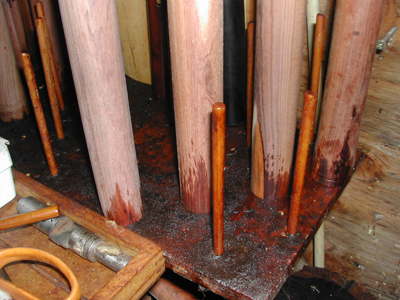
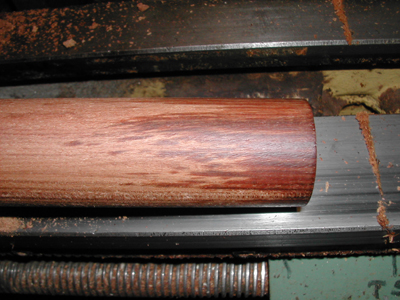
I have some interesting observations about Mopane and oil. It seems ready and willing to accept oil through end grain - below is an image of some Folkflute headjoints before sanding and finishing that have been sitting on the pins that I usually use for oiling flutes. A little bit of oil remains on the platform, and wicks up into the unoiled flute part via the end grain. If I leave these sitting long enough in enough of a “pool” of oil, it eventually wicks to the other end. I have noticed this occur in a few other woods including boxwood and to a much lesser extent blackwood.
It may be that some of the differences in wood absorption simply has to do with the porosity of longitudinal pore space.
As I was reading Casey’s last post, I thought, “Yes, indeed, the porosity of longitudinal pore space…” Then I thought, “It’s been confirmed, I’m a wooden flute nerd, at home in a world of wooden flute nerds!”
Check the humidity, dude. I think you’re starting to crack.
Not to get somewhat back near the topic, Casey’s pictures of mopane flutes absorbing oil reminds me of the experiment that we did as kids with celery and colored water. You could turn a celery stalk just about any color you wanted by putting it in a little colored water overnight. The water would wick right up to the top. Obviously the same principle at work. However, I doubt that a celery flute would sound as good.
A celery flute would certainly taste better, though. When you got tired of it, you could eat it. H’mm, better use an edible oil, rather than commercial bore oil… (olive oil, anyone?)
Though there is a paradox here too. Are you better off to choose a timber that is naturally largely water (and oil) resistant like blackwood, or a timber like Cooktown Ironwood that will accept large amounts of oil, rendering it largely water resistant. To answer that one, we now really need to do water absorptions tests. Does it ever end?



 H’mm, better use an edible oil, rather than commercial bore oil… (olive oil, anyone?)