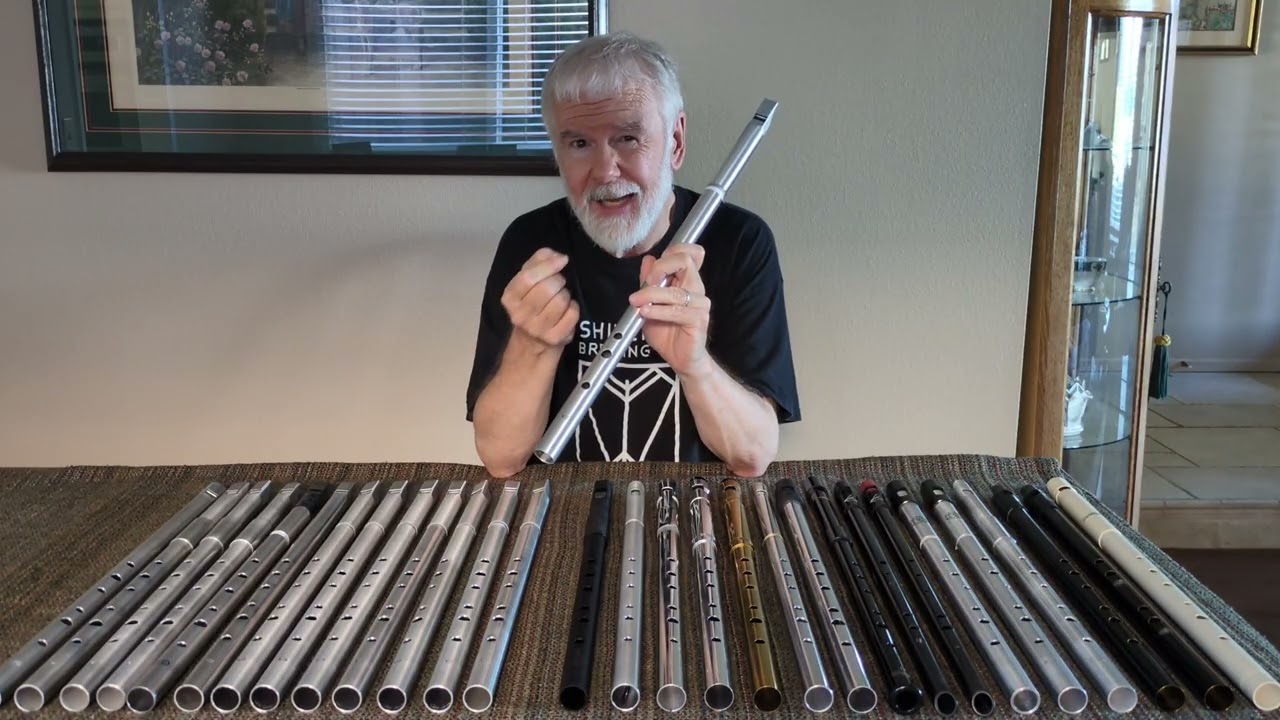
Help me pick a low D whistle

Alright I’ve just had the opportunity to spend some time playing the following new-to-me Low D whistles:

Carbony angled holes

Kerry Pro and Busker

Chieftain V5

Alba

Qwistle

Karavaev

Goldfinch

Clover

Howard close-set holes

If I had a gig tonight where I needed a Low D whistle the only one I could take would be the Alba. It has spot-on tuning, decent low notes, and sweet high notes. (If I had my druthers Bottom D would be a bit stronger.)

I was also able to get an update on the newest models of whistles that I had tried years ago:

Carbony regular holes

Reviol

Burke

Susato

Howard regular holes

MK pro

Back around 2009 I really got into MK Low D’s and ended up owning a half-dozen, upgrading one at a time until I got the very best one I’d tried. (All of them had subtle differences.)

I really loved their unique tone, which I likened to the Kaval. Sorry to say the new MK I tried lacks that special unique tone, though the tone of the new one is nice, a bit on the NAF side. Also those old MKs had sweet easy high notes while this new one has a quite harsh High B.

I was also disappointed with the new Susato. Back in the 1990s I had acquired Susatos in a wide range of keys and ended up with a few Low Ds. The Low Ds were very good players. What really stood out was their exceptionally powerful Bottom D.

Well this brand-spankin’ new Susato has a Bottom D that’s run-of-the-mill for decent quality Low Ds. You can’t really push it, it doesn’t honk. Also those old Susatos had spot-on tuning, while this new one has the strange quirk that the low-octave notes don’t overblow into the second octave in a consistent way- D, E, and F# overblow sharp, G and A overblow true, and B overblows a mile flat.

Just the opposite with the Burke. I had owned and played for a few years a Burke Low D and one aspect of it I didn’t like was the “stiff” High B. This new Burke isn’t like that, the 2nd octave is easier and it’s most noticeable on High B.

With the Reviol this new one plays like the one I used to own, as best I can recall.

So if I had a gig tonight I could take the Reviol or the Burke.

1 Like

That’s really interesting about the Alba. I was talking to a guy on facebook last night who said the Alba is currently his favorite low D. After the chat I went ahead and ordered one, since they’re quite reasonably priced, all things considered. I’m still going to order a Goldie before too long, but the Alba will ship in a few weeks instead of a few months. I’m excited to play it.

That was also interesting about the MK Pro. After reading your comments, it occurred to me I typically see recently purchased ones for sale, not old ones. I wonder if it’s related. I found a video of yours from 17 years ago, and the Mk Pro you played in that sounded better than some more recent videos I’ve seen on them.

I’ve also heard good things about Reviol, and they look pretty reasonably priced, too. They’re on my radar.

Also, it’s a shame they don’t make those bent-neck Susatos anymore. Those looked like they might be fun to play.

I didn’t realise how much of the ergonomics comes from the arm-stretch until I had those angled-neck Susatos in Low D and Low C (both of them keyless).

They felt like whistles half their size to play.

As we know that’s long been a thing with some of the bigger-size Recorders.

1 Like

It’s like Christmas here and I also have a number of Goldie Low Ds to try in a range of windway heights. They’re all new except for the top one which is mine, dated 1999.

1mm “very soft blower”

.97mm “standard soft blower”

.90mm

.87mm “medium blower”

.85mm

.80mm “hard blower”

My favourite players are the “soft” ones .97 and .90 for the reasons mentioned above, and my least favourite is the “hard” one.

Though this is splitting hairs. These are all top-class whistles. They all play like Goldies.

1 Like

What are your thoughts on the “extra soft” 1mm? And how does it compare to the “soft blowers”?

I have to say, while I am playing my Goldie medium blower it sounds to my ears quite like this first YouTube video from Frank you shared, with that bit of rasp. Probably due to the fact that he is close micing it with an SM57 with little or no post-processing so it’s picking up pretty much the same sound going direct to your ear while playing.

But when I hear other people play it from a little further back, it sounds great and smooth. Similar effect when folks add a nice reverb to their videos. I think Goldie whistles need a bit of room reflection to bring out their lovely tone. But if you don’t like the tone while playing it, it might not be for you.

1 Like

That’s a good point. I have a pretty decent space to practice in, as well as the porch, so I’ll be getting some of the natural echo to balance out the sound (perhaps). But even if I still get that “harshness” as I play, I am highly interested in seeing what it feels like to play a perfectly balanced low D. And I may discover that it doesn’t actually bother me in person. Either way it’s gonna be competing with my Alba, which will hopefully be here in a few weeks. I’ll probably put in the order for a Goldie on Friday, and commence a long wait.

Its worth trying one if you can get your hand on one. Goldie’s are a bit of a beast to tame, and there is a bit of a learning curve - they demand a confident and consistent airstream, especially the harder blowers. I can see why pipers like them. If you can provide that, they reward you with very fluid phrasing and soulful consistent tone, making some other low whistles sound like toys in comparison.

1 Like

You know, it’s funny, I sing opera and I THOUGHT I had really excellent breath control… until I started seriously playing the tin whistle

1 Like

Over the last couple days I’ve been doing a lot of “blind testing” (in total darkness so I can’t cheat) of all these various Goldies.

For the .97 and .90 windways there’s two of each, with the current standard Goldie hole sizes and with the throwback big holes. Interestingly my older Goldie has holes nearly as big as the new “big hole” model.

My blind test pitting my older 1mm against the new big-hole .97 and .90 my 1mm came in last.

The .97 and .90 are REALLY close, this morning I slightly preferred the .90 while yesterday it was the other way round.

For me these two big-hole Goldies clearly outperform all of the standard-hole versions.

So what criteria am I using in the blind Goldie testing? Since all play similarly, all have good tuning, all have good efficiency I’m just playing tunes and hearing how they sound.

There’s a Church piece that I’m playing which really highlights the timbre and voicing of the low octave, especially Low E, the usual Achilles Heel. The Low E is strongest and clearest on the big-hole versions.

Then I’m playing stuff that highlights the tone of the 2nd octave particularly High B. I prefer the whistles where all the notes from E to B in the 2nd octave remain civilised and smooth, and ranking lower whistles where the whole 2nd octave is noisy and/or High B is harsh and shouty. (A mild version of this appears on the hard-blower .8mm windway, but even here it’s much less of an issue than it is with many non-Goldies. There are a lot of Low Ds out there where High B has a totally different timbre and volume than the rest of the 2nd octave.)

1 Like

Ha!

With my High Whistles, a vintage Feadog and some vintage Generations, the 2nd octave is SO easy that many people, when they try them, wildly overblow.

Especially Sax and Brass players who are used to putting so much air through their horns.

1 Like

Interestingly the Reviol’s windway is even WIDER than the Goldie 1mm.

I don’t know if Reviol offers various windway heights or if this is standard.

1 Like

Hi

Did you sell your low d whistle pls?

Ps sorry to hear your hands are suffering. Hang in there with the flute. :grinning_face:

Thanks Paul

I haven’t posted it yet, got a bit of a cold. Will put it up this coming week, thanks for getting in touch.

Hi

If you want to send me details I am looking for a new whistle

Here’s my review of all of the various iterations of Colin Goldie Low D whistles.

Comparing 8 Goldie Low D Whistles

And my review of 30 Low D whistles from a number of makers.

Best Low Whistle? I tried 30, here’s what I found!

(I receive no money from YouTube.)

2 Likes

This might explain my confusion with a comment you made in another thread about the Burke being stiff in the second octave; because I find it exceptionally easy all the way up to the high B on my 2025 model. I guess you were basing that assessment on an older version that has since been modified.

1 Like

Yes indeed, it was back around 2005 that I began my big buying & trying phase, acquiring at that time Burkes from Low D to High D and several in between. All of them were a bit stiff in the high notes.

The Low D (“Pro Viper”) in addition had rather weak Low E.

Having recently had the chance to play a 2026 Burke Low D it’s clear that Michael has somehow sweetened the high notes and strengthened Low E, quite a feat!

The new Burke Low D is a much better player, however the characteristic Burke high air-supply issue is still there.

1 Like

If you find your way to Green Valley, Arizona, my wife and I have a guest bedroom with a queen-sized bed and a love for all things whistles.

I have been fortunate enough to meet Richard. He is truly a blessing to this community with years of service in answering questions and sharing his perspective.

I would certainly enjoy hosting you and letting you experience many of the Low D whistles in my collection. I am assembling this collection for this very reason. Life is to short not to share the beauty of these instruments.

2 Likes

I’d love to see it. I bet it’s incredible!