John Gunn was a Scottish flute teacher, working in London. He wrote “The Art of Playing the German Flute” in 1793. I’ve extracted his stuff on tone, which I think is very interesting. He gives clear instructions on blowing towards the centre of the flute, rather than the edge. I’ve annotated it with some explanations where I think it may not be clear, and a bit on the science to explain why blowing at the centre works.
It’s interesting that Gunn, at just before the start of the 19th century, Nicholson, well into it, and Rockstro, at the very end of it, all agree on this approach. I’m not sure when we moved away from it, I can only imagine it was part of the more relaxed French approach of the mid 20th century.
Interesting reading Terry. Thanks. I’ll be trying some of that, although I hesitate to change things up too much, kind of like my golf game, you know.
When I was first learning to play, I learned to blow a flat stream of air across the hole and cut the stream of air in half with the opposite edge of the hole.
This morning, I tried a bit of blowing down into the hole, and it worked.
I couldn’t get to the C&F forum late last night, so I found another flute forum (I’d say it was classical flute) and here’s a couple of things they said:
First of all, don’t be afraid of the high notes. Really go after them. Make sure that your throat is open, your jaw is lowered, and that your are not pinching your lips. Your aperture should actually be quite large and open. High notes are all about support and airspeed; not about a tighter embouchure. Tightness is contrary to tone production.
To add to what fluteguy said, make sure you are not clenching your teeth in the back. That is an issue I see with a lot of students.
Honestly, I don’t know how you’d play the flute with teeth clenched.
So, If I change my embouchure, will it be like changing my golf swing? Will my playing suffer for an extended period, like Tiger Woods when he changed his swing?
I think not. I think it will be a slow change, possibly, sort of what happens when you I practice octaves and harmonics and playing on a smaller flute.
James Galway covers half his blowhole with his lip, and his tone is Ok. Nicholson actually says that different lip shapes produce varied tone colours, which makes sense. I suppose we should aim to have mastery over all the possible variations, I sometimes find the ITM purist seeking after that “hard” tone a little narrow in ambition, the flute has so many possibilities of expression, I just wish I could get 'em under proper instinctive/ subconscious control!
Does the conical flute have more tonal possibilities than a cylinder?
I wouldn’t say ‘more’, but I would say different. Due to their shapes, they are different animals. Having said that, I do think I still sound like myself on either; the differences are subtle and probably more based on the player’s imagination, experimentation and practice than on the physical nature of the instruments.
Folks like Mr. McGee may have a very different opinion than mine–listen to them first.
There are certainly lots you can learn from (good) classical flute players, but keep in mind that what differentiates one style of playing from another is what a player looks for in their playing and the sound/tone produced doing whatever’s suggested. Trying different approaches isn’t a bad thing, since different things work for different people, but if you’re going for a particular sound and approach, it’s probably best to find people that get that sound and try variations within that context.
Gunn gives a very good description of how I have to blow my Monzani flute to get it to play well. It’s quite different to any other flute I’ve played over the last 30 years and has taken me a couple of months of practising to get my embrochure into (a new) shape. Definitely blowing into the flute: if I play a G and hold my right hand behind the blow hole, I can feel almost no air on my hand.
In what follows, I’ve added subject headings to make it easier to find your way about, I’ve replaced all the old-fashioned f’s with s (my favourite was “foftnefs” - “softness”) to make it readable, and broken up a few impossibly long sentences and paragraphs.
What you replaced weren’t fs but a similarly-shaped letter known to typographers as ‘long S’. The grapheme is similar to that used in lc f, but without the crossbar [ ∫ ].
Long S followed by short s can combine into one kerned (joined) letterform, still occassionally used in German: ß.
In the Gunn publication, f has the cross bar, as you’d expect, but the “long S” has half a cross bar - it sticks out to the left, but with nothing to the right. The difference is so subtle I needed to use the microscope to confirm it! Given the about 9pt font I can imagine only the young would be cable of discerning it reliably unassisted. Presumably the context assisted the reader sufficiently - I can read it fairly effortlessly after a while.
Roman and italic letterforms for long s vary somewhat. In some roman forms, the stem of the long s has a shoulder on top left of the stem, where the vertical stroke gives way to the curve. This is particularly true in titling typefaces (large print for titles). In smaller faces, the shoulder can be somewhat subdued, and in italics it’s usually absent.
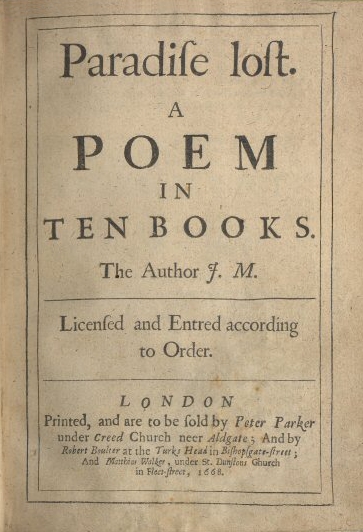
You can see both versions here, on the coverpage of an edition of Paradise Lost:
The Roman version is in the largest type (‘Paradise’; in ‘Lost’, you’re seeing a special kerned stamp, combining two letters in one grapheme) and to see the italic, you’ll need to squint and examine the words “Bishopsgate” or “Dunstans” in italics at the bottom.
The face in “Licensed” is still a titling font, albeit a different face than that in the large title, (which seems to have been a narrow cut of the main face).