Just my $.02
Anything available in the GHB repertoire can be played on a flute, in “the same” key - A Mixolydian. (Although as is commonly known, pipes are usually actually tuned to Bb or b)
Just my $.02
Anything available in the GHB repertoire can be played on a flute, in “the same” key - A Mixolydian. (Although as is commonly known, pipes are usually actually tuned to Bb or b)
Yeah, I can over-analyze sometimes.
Strathspeys on flute, listen to what fiddlers do. A lot of Scots fiddlers use rests to accent some of the highly-stressed beats in a strathspeys. Those are excellent opportunities to take a big puff of air. If they don’t insert a rest then they play the big note louder. Those are excellent opportunities for breath pulsing. But alas, it’s true that one needs a good G# to play a lot of Scottish tunes.
The main thing with Scottish tunes, especially strathspeys, is getting that snap and lift. There’s no fancy tricks to get it right; it’s all expression.
I haven’t heard Chris Norman’s approach to piobaireachd on flute but on Martyn Bennett’s breakthrough album, Bothy Culture, he plays a lovely ground of Red Hector of the Battles on whistle.
Piper/Innovator Finlay MacDonald displays some lovely flute playing on his self-titlled CD too.
As for bagpipe tunes, I try not to comingle my piping and fluting. If you want to play along with a piper use an Eb flute.
Cheers,
Aaron
In class Chris Norman encouraged us to experiment with supple time changes to bring a strathspey to life, to speed up some notes and slow down others and not stick to a mechanical interpretation of the changes in syncopation. He called strathspeys the tango of Scottish music, and emphasised to play it with fire, so it really gets under your skin. I really like his strathspey playing style, and was tremendously encouraged to start learning strathspeys, which I avoided before since the rhythmn seemed so difficult.
~Hans
Here is a great strathspey which Chris Norman plays on The Caledonian Flute: The Darling
Very good to practise a snappy g#!
X:0
T:Darling, The
R:Strathspey
B:The Athole Collection
M:C|
L:1/8
K:B Minor
f|c<F c>B A<F F>f|c<F c>e f2 f>e|c<F c>B A>F F<f|e>c A<c B2Bf|
c<F c>B A<F F>f|c<F c>e f2 f>a|c<F c>B A>B c<f|e>c A<c B2Bd|
c<f f>^g a>cc>B|c<f f>^g a2 g>f|c<f f>^g a>f c<a|e<c A<c B2 B>d|
c<f f>^g a>cc>B|c<f f>^g a2 g<b|f<a ^g>f e>c c<a|e<c a>c B2B||
It is from the Athole Collection, 1884, which contains over 800 Scottish reels and strathspeys.
You can download the whole collection in abc format from Scottish ABC Music
Aaron, The Darling is obviously a tune from the piping tradition, being constraint in one octave. And there are many others like this. Would you always prefer to play such tunes on the pipes rather than the flute?
~Hans
Good for you. No, i was just ribbing you a little for casually mentioning your acquaintance with someone that most of us can only worship from afar.
Have a few meals with Matt, Glauber. He’s quite jolly !
I haven’t chased him over my proposed festival because Mrs Molloy promised to get him to ring, and I haven’t been well enough to chase him. Jean-Michel says he’ll do the festival for 1/10 th of the price ( but he isn’t too well known here ).
I shall try again for next summer if I am still alive ! ( I am not sure I am alive now - the world seems very strange !).
Hang in there, old fellow. I am.
The Darling doesn’t fit on pipes. The lowest note is a first octave F and the highest note is a second octave B. That’s just a hair out of range. But I would consider playing it on flute.
There are enough tunes so that I don’t feel the need to play all pipe tunes on flute. Some tunes like the Jig of Slurs, Brenda Stubbert, and Jenny’s Chickens (aka Sleepy Maggie) I will keep as pipe tunes. But I learned Gravel Walk on pipes first and now play it on flute.
Strathspeys are all about lenghtening the long notes and shortening the short notes. Here’s a mp3 of a tune played as a strathspey then a reel. The beat of the strathspey is consistent but you can hear the Strong-Weak-Medium-Weak pulse.
Chuir i Glùin air a’Bhodach, Braes of Balquidder
Cheers,
Aaron
Isn’t the Scottish tune “Hector the Hero” a strathspey? Laurence Nugent plays a great rendition on flute.
“Hector the Hero was composed by Scots fiddler James Scott Skinner to honour Major-General Hector MacDonald, who had a distinguished career in the British Army, starting off as an enlisted soldier and rising through the ranks. He committed suicide in 1903 after accusations of homosexuality.”
Written in 6/8 time as a lament.
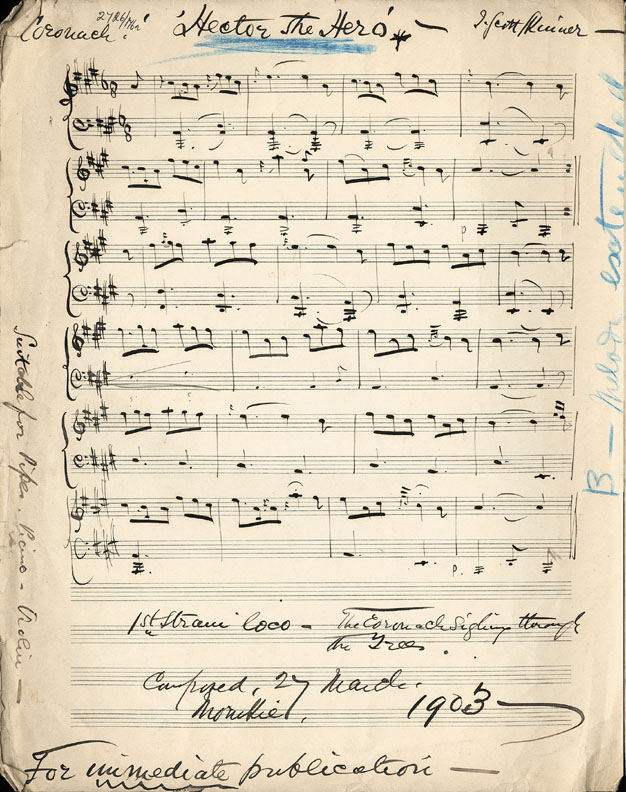
Lament him, ye mountains of Ross-shire;
Your tears be the dew and the rain;
Ye forests and straths, let the sobbing winds
Unburden your grief and pain.
Lament him, ye warm-hearted clansmen,
And mourn for a kinsman so true
The pride of the Highlands, the valiant MacDonald
Will never come back to you.
O, wail for the mighty in battle,
Loud lift ye the Coronach strain;
For Hector, the Hero, of deathless fame,
Will never come back again.
Lament him, ye sons of old Scotia,
Ye kinsmen on many a shore;
A patriot-warrior, fearless of foe,
Has fallen to rise no more.
O cherish his triumph and glory
On Omdurman’s death-stricken plain,
His glance like the eagle’s, his heart like the lion’s
His laurels a nation’s gain.
O, wail for the mighty in battle,
Loud lift ye the Coronach strain;
For Hector, the Hero, of deathless fame,
Will never come back again.
O rest thee, brave heart, in thy slumber,
Forgotten shall ne’er be thy name;
The love and the mercy of Heaven be thine;
Our love thou must ever claim.
To us thou art Hector the Hero,
The chivalrous, dauntless, and true;
The hills and the glens, and the hearts of a nation,
Re-echo the wail for you.
O, wail for the mighty in battle,
Loud lift ye the Coronach strain;
For Hector, the Hero, of deathless fame,
Will never come back again.
That’s the one. A very satisfying tune to play.
There’s some interesting old Scottish flute music from 1720’s to 1890’s
here http://www.purr.demon.co.uk/flute/