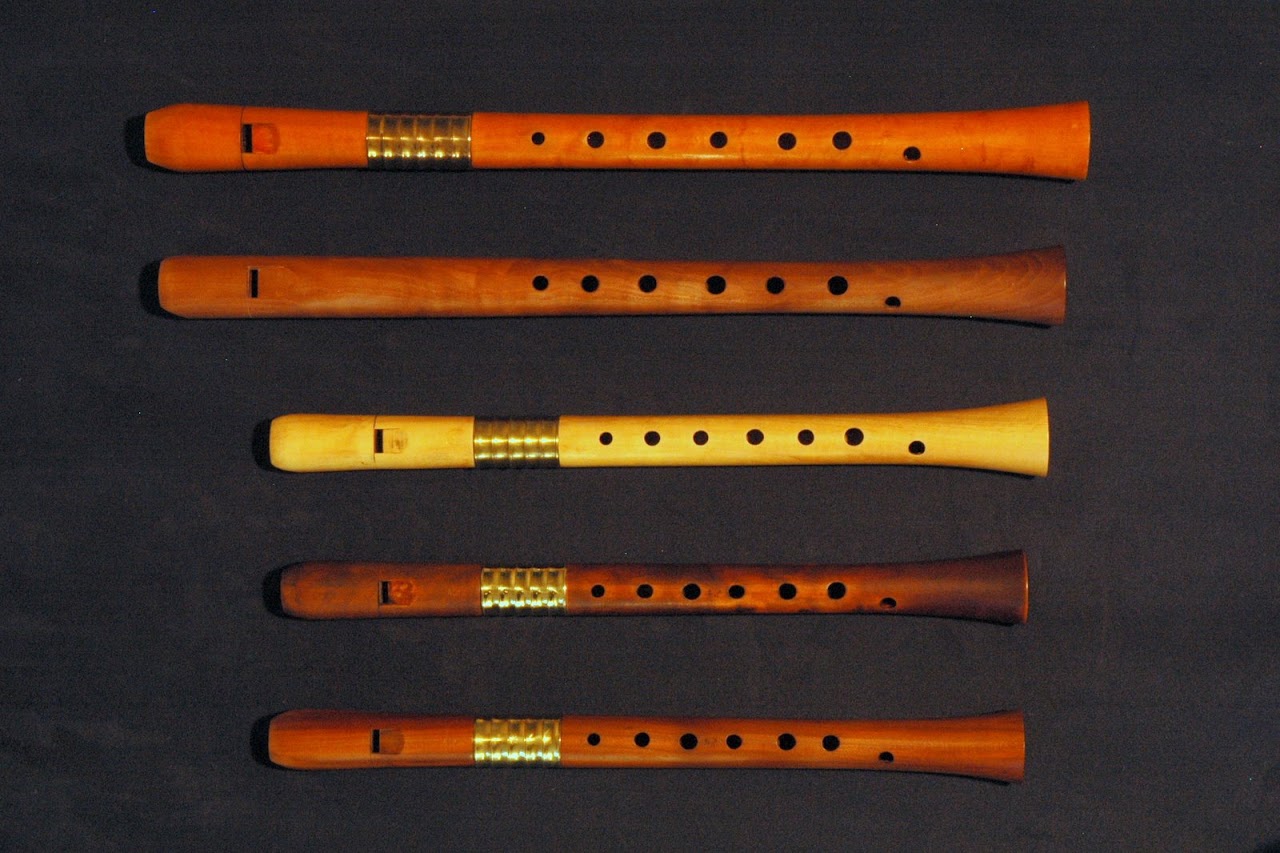
Just asking for opinions or comments, subject “Non-whistle fipple flutes”
OK, so its recorders
Back in my early WhOA days, I wasn’t always all that selective in my purchasing, IOW, I’d buy anything with a fipple if the ebay price seemed right.
What makes it REALLY dumb was that I don’t like recorder fingering and never really had much use for them once I’d gotten them.
As a result, I have a pretty fair little collection of things like old recorders (including one in Bakelite), school flutes like Angel Recorders, Melody Flutes and a “Fitchhorn Song Flute”, a couple of ocarinas and similar things.
What do you guys think - any point to trying to sell this stuff or should I start giving my numerous nephews and nieces very annoyng Christmas gifts?
I couldn’t give my two Angel recorders (a soprano and an alto) away to save my life. Glad I’m not dying or anything. I suppose I could try the Christmas gift route…but I’m terrified they’d be regifted to me! Let me know if it works for you, and if it goes well, I’ll have an entire year to decide who to stick with them this time next year!
I also have such a collection and they are in drawers and shelves and other places except on Christmas lists or my will. The kids will just have to fight over who gets to throw them away or hide them in a box for yard salers to “discover”.
Reverse WhOA is a difficult disease to treat.
Mack
I had three fairly good quality recorders (treble, alto & tenor) which I kept going back to, just to remind myself how unpleasant they sound. I gave them to a charity shop (I think you call them thrift stores?). Not very charitable, I know…
I think some of us are curious about most anything musical. I have amassed a collection of odds and ends over the years myself. They mostly gather dust nowadays although a couple have seen playing time on stages as a novelty. The value of most of these things to others is nil. I see groups of such instruments (cane tourist whistles, flut-o-phones, cheap plastic recorders, etc.) on eBay all the time and they do sell for low prices. Occasionally such a cache will include one or more identifiable instruments such as an old Gen, Feadog or even a Hohner whistle. A skilled eye can spot a deal. If clearing the clutter is your goal, eBay might be an outlet but it takes some effort to list the items, write descriptions, take pictures and , hopefully, ship them out in the end. Kids like your nieces and nephews on the other hand may be curious and receptive to an instrument of any type with little to no effort on your part to pass them along. You might consider ear plugs for their parents.
You mention a bakelite recorder, Chuck. If that is a Dolmetsch recorder it may have some value to certain recorder players. I have spoken with a few players that really like those old Dolmetsch bakelite recorders. They would rather play the bakelite recorder outdoors or in nasty weather rather than their prized exotic wood recorders since they still look like a wooden instrument. Some of these players seem to prefer the Dolmetsch over many of the plastic models available today including the Aulos and Yamahas. I’m not sure why but individuals like what they like.
I may have missed something somewhere, but to my untrained ear, my descant recorders, (Dolmetsch, Yamaha and Moek “Tuju”, all with baroque/english fingering) play just like a six-hole whistle if I keep the thumb-hole closed.
Ignore the RH4 (pinky) hole, keep the thumb-hole closed and try it. It’ll still sound like a recorder, but for some music that’s no bad thing.
Yes, I know the published fingering charts show differing placements, but try it anyway … unless you critically hold F# or C for a long time you’ll probably not notice the difference
NOTE : this won’t work with German fingering, the F-hole is too small (but you can drill it out … I’ve done it on a cheapo no-name plastic instrument)
… to my mind, it’s difficult to see how they can’t but play like a whistle, there’s only two notes that are (supposedly) fingered differently in the D major scale, the F# and the C# … using the whistle fingering on the recorder produces an F# that’s only 5Hz lower than the F# on my Clarke original, the recorder with “all fingers off” (except the thumb) is actually closer to C# than the Clarke whistle !
This isn’t to say that the recorder isn’t even better in tune if one uses “proper” recorder fingering, but it does go to show that using whistle-fingering on a baroque recorder is as valid as necessary in a “whistle context”, for want of a better term.
Just an idea if anyone wants to try out a recorder, but is fazed by the concept of learning a “foreign” fingering pattern … don’t be … if you’re happy enough with the eccentricities of the tuning on a Clarke “original”, you’ll not notice the differences when playing a baroque recorder. Obviously, if you’re naturally “pitch perfect”, this will sound like a total anathema, but then your whistle probably cost a lot more than my Clarke … or my second-hand Tuju for that matter
On most baroque recorders (soprano) I’ve tried, F# xxxxoo will be a quarter tone or so flat, and needs to be breath-pushed up. The 2nd D x|xxxxxx will tend to a Q-tone sharp; you can pull the foot joint out a bit, but that exacerbates the F# problem. On some recorders you always need to crack open the thumb for a decent tone in the 2nd octave. Other small annoyances include oxxooo as B instead of C-nat, high xxoxxo as B instead of g#. So yes, it’s doable, but …
I guess my current feeling is that if you’re going to play ITM on recorder, you might as well play it as a recorder and work out how to adapt the tunes and ornamentation to the native fingering.
I still have my Dolmetsch bakelite soprano that I bought as my first recorder around 1967 for $6 IIRC. Yes, it’s a sweet instrument, easy to speak, good intonation, and the narrow profile is comfortable to hold. I’d say something like the plastic Yamaha Rottenburgh fills the same niche nicely nowadays in terms of tone, playability, and value.
I guess my current feeling is that if you’re going to play ITM on recorder, you might as well play it as a recorder and work out how to adapt the tunes and ornamentation to the native fingering.
I agree entirely … I was simply trying to point out that if one had access to a baroque recorder and just wanted to try it out, using “normal” whistle fingering wasn’t too far off-tune … sorry if I appeared to over-state my case
FWIW, the transcription I’ve got of “The Star of The County Down” in a key of “one sharp” includes neither C# or F#, so is an excellent choice as a “pick up and play” tune on either instrument
I’ve been so dying for an opportunity to drop this example in the Whistle Forum and get away with it
[Edit - To clarify: this is not an example of I/STM: this is an arrangement of a well-known Gow tune, by a classically-trained musician, played by an ensemble specializing in Early Music.]
Oh, no apologies needed, Kypfer. In fact, I think that experimenting with what you described is a good thing. It’s a great way to understand the subtle differences between the two instruments.
Glad you liked it. it is, indeed, one of those instruments you hint to, in their wide-bore form (see a recent thread at the Folk/World winds forum for more info). Sadly, I have no further details into this specific instrument (other than “I so want one”). It belongs to a species that look gorgeous, sound wonderful and are expensive.
Besides for playing Renaissance music, many feel the way they sound lends itself well to playing Trad. It seems that the repertoires of O’Carolan and Gow are sort of the common ground where Early Music and I/STM can meet and have some fun (“Ye Olde Feffione, meade ferved”).
Did anyone else find the phrasing odd in this version of Neil Gow’s Lament? It seemed to me that, in several places, she took breaths in the middle of what seem to me to be the natural phrases.
This tune is lovely on an A whistle in the key of D. I have a Burke composite A that has a flutey sort of voice I particularly like for slow airs, and Neil Gow’s Lament is my favorite tune to play on it. (So maybe I’m the one with odd phrasing on this tune, and the version on the video just sounded odd to me because I know the tune so well and it isn’t how I play it. I admit that I am very much a creature of habit.)
I like this tune a lot and have played it a lot. To my ears the lady does seem to breath more often than I would like to - maybe that monstrous r******r takes lots of air? I also felt that the middle section got a bit lost. But then what do I know? I am not really a musician yet.
Out of interest how does my phrasing compare with yours? Do you have a recording?
My favourite you tube recording of this tune is the one by Niel Gow.
That is a lovely version, but it is not Neil Gow playing. Take another look at the video. I’m not sure how old Gow would need to be to have a video out, but certainly more than 100.
I find the phrasing different but not odd on the other video mentioned. The phrasing is quite like that used in some baroque playing and after all this is an early music group. The recorders are Adri’s Dream (sp?) instruments. I have one of the mass produced ones from Moellenhauer and they are doubtless playing the hand crafted version. The do take more air than my other recorders but I don’t think that is the reason for the phrasing. There are several places where an “obvious” breath point is skipped and the player goes past it to another point to breath and there are also several places where the phrases are made very short. I think this is a performer’s choice. Probably not the choice that would be made had the players listened to the many fine fiddle versions around, but still a conscious one. And, one that I enjoy. Listen to the other youtube of Quadriga. They are amazing.
I was thinking the instruments were from another maker based on a Ganassi format possibly by Grinter, Hulsens or Netsch. But the profile of so many renaissance recorders are similar thanks to Fred Morgan that it is difficult to tell exactly who the maker may be from the quality of that YouTube video. Adrianna Breukink certainly was influenced by Ganassi type recorders (and others) in developing the Dream recorders but all of the Dream recorders I have seen (Mollenhauer and Breukink) show the characteristic raised beads unlike those in the video. Who knows?
Regarding the phrasing etc, I owe everyone an apology, for I was too hasty and careless in my wording:
My writing “this example” without further qualification leaves the reader under the impression that this was provided as an example of ITM (STM in this case) played on the recorder, which of course it is not.
When I posted my reply, the thread was dealing with some differences and similarities in playing between whistles and recorders, and I thought the video would be useful in illustrating the point, being a recorder played with recorder technique by a professional. It had the added benefit of containing a tune that might be more recognizable to trad players/listeners than the repertoire usually associated to the instrument, and I felt this would help highlight the similarities and differences. Finally, it was not only played by professionals, but also professionally filmed and recorded so the quality was enough to make the listening useful (and hopefully enjoyable).
But, as noted, this is not an example of I/STM: this is an arrangement of a well-known Gow tune, by a classically-trained musician, played by an ensemble specializing in Early Music. My apologies again.

 I suppose I could try the Christmas gift route…but I’m terrified they’d be regifted to me! Let me know if it works for you, and if it goes well, I’ll have an entire year to decide who to stick with them this time next year!


 … if you’re happy enough with the eccentricities of the tuning on a Clarke “original”, you’ll not notice the differences when playing a baroque recorder. Obviously, if you’re naturally “pitch perfect”, this will sound like a total anathema, but then your whistle probably cost a lot more than my Clarke … or my second-hand Tuju for that matter