… tapered bore wooden low D with large tone holes?
Just wondering.
Phill
… tapered bore wooden low D with large tone holes?
Just wondering.
Phill
Almost perfectly, thanks. I have one and have been playing it almost entirely monogamously for some months (and its teaching me a lot). I cannot really afford another whistle, dont really want one, and cant justify one either. (Maybe I am just trying to keep my fading WhOAD alive. ) The only competitor (sweet) has small tone holes too. It got me wondering.
The Bleazy has a wonderful sound, and I cant imagine not using it. But I am having a little difficulty getting a good Eb/D# (whats the difference?) for one tune that has taken my fancy. On my other low whistles (with larger tone holes) I can hit a reasonable Eb/D#, but the lowest tone hole (B3) is quite small on the Bleazy and its driving me nuts. 
Phill
Five minutes a day (or ten minutes a day), methodical practice.
It can be done. Patience. Nuts is good.
let’s not be startin’ an other of them squirrel runs…
A Professor Peebody of Western music theory could perhaps proffer a puffy proposition.
However, if you want a tangible, hands on, sense of the difference you might find a very good sitar or sarod player
who has set his or her sitar up for C as tonic and ask himorher to play the first 3 notes of the the following raagas (both of which have the intervals 1 2 b3 4 5 b6 b7  :-
Darbaari
Jaunpuri
the b3 of the former will be more D# and the b3 of the latter more Eb. You will actually hear the difference and the fine difference will be emphasised by the just intoned drone agaisnt which the player does this.
the curved one is for d# the straight one is for Eb
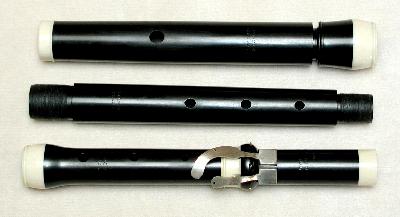
----click & scroll
Thanks for the encouragement - but the hole is ~5mm diameter. I am not sure I have heard a half note there yet. And its not a note one can slide into from the D (in my novice opinion). As you say, I may get it with practice. It would be nice to need only one whistle (Do I hear cries of ‘heretic’?) and I want it to be this whistle.
Thanks Denny and Talasiga - I wasn’t even sure if there was a difference as I have three written versions: One uses just D, one use D#, the last Eb. But if you say there is a difference, then I will accept that.
It is slightly worrying as it implies that I may need to be more accurate than I probably am at present. Currently, on a big-hole whistle, I am hitting something that sounds approximately half way between D and E and hoping that as I get better I might be able to find the best sounding intermediate tone.
I am sure that neither my ear nor my grasp of music theory are well enough developed to understand the difference yet, but its nice to know.
Phill, try coming down onto the near side edge* (closest to your hand) of the B3 hole more vertically, with the tip of your finger instead of the flat pad. If you play flat-fingered like me, this means curling your B3 finger slightly before you strike the half-hole. To go from D# to D, you can push your finger forward while flattening it. And to go from D to D#, curl your finger while retracting the tip toward the edge of the hole.
Another technique is to strike that same near side edge of the B3 hole with the hard first knuckle joint of the finger, with the finger straight and angled around 45 degrees to the whistle. To go from D# to D, you simply “lever” the last joint of the finger down flat onto the hole, using the knuckle as the fulcrum. For D to D#, lever the finger back up.
The B3 hole of my Copeland high D is also 5 mm, and I have no problem producing a decent D# with either technique. So maybe it will work on your low Bleazey. Let us know!
Thanks for those practical suggestions MT, and thankyou also for the reassurance that it can be done! Although your skills surpass mine by some stretch and it may take me a lot of practice. It certainly seems like one of those skills that I will have to learn through ‘whistle monogamy’ as my fingers have not yet learnt the fine motor skills and discrimination needed.
The difficulty in half-holing the small hole for Eb is the reason the one-key flute became so popular so you shouldn’t blame yourself.
Another approach would be to ask the maker what he would charge to put a simple, old-style brass key on if you really want that note and want to keep that particular whistle. A one-key whistle. Keys tend to be expensive though.
Garry
Interesting suggestion Maihcol, though (and excuse my blundering ignorance here) would I not need two keys to get two notes even though there is one hole? Or does the solution rely on the fact that the key requires a larger range of movement, and so allows a finer degree of control?
And would a key be a permanent and slightly ugly attachment to a really elegantly shaped whistle?
I might have to allow myself two whistles. 
You wouldn’t want to put two keys on for D#/Eb - the majority of the early one-key flutes only have…well one key for this - the double keys never really became popular.
It’s easier to bend pitch on a flute than a whistle but just the usual single key would do well enough for you - maybe if the maker left it so that the Eb was a bit flat it would help give you a D# if you wanted it but these differences are really very fine anyway.
The key would be permanent alright - for ugly you’d have to look at some photos of one-keyed flutes with the simple brass key to decide for yourself…You might not like the “early” woodwind look for a modern whistle - then maybe a more modern key design would be better but might be more expensive.
Garry
Oh dear, now I am confused, and probably confusing. 
Here is my assumption history - where did I go wrong?
Or have I got it farce about ace?
Hmmm… partially depressed. A good description for my state of mind realising that there are two distinct notes between D and E.
Thankyou for your patience Gary.
there is not…on a piano
a piano is in equal tuning
go wiki “just” and “equal” tuning
equal is just so’s ya can play in different keys without retuning for each one
except on the instruments that allow bending enough to do both
just just sound right 
Ok - that would be confusing alright…Just think of the whistle or flute as having an additional hole below B3 - so you’d have seven toneholes on the whistle. That seventh hole has a key to keep it closed most of the time so your whistle would play just like it does now if you didn’t use the key at all.
Then when you want that D#/Eb note, you put all six fingers down as you would to sound D but you use the bottom hand little finger to depress the key lever which opens the key and allows that extra 7th hole to sound. That hole is higher up than the end of the whistle which gives D - and so it sounds a higher note than D.
This is normally described as giving Eb - a note in between D and E. There’s a relatively fine difference between Eb and D# - some 20 cents or so depending on how you add it up - some say more but that’s more theory than you probably need…and you can generally fudge this difference by blowing harder or softer if you need. A flute is more flexible in this respect than a whistle. If you look at pictures of one-key flutes you’ll see what I mean… Modern Boehm flutes and saxophones also have this key, along with all the rest.
My internet connection is a bit too slow for photos but the link Denny pointed to above, Rick Wilson’s “Old flutes” will have some. A Google on “one-key flute” should get you even more.
Garry
Thank you Garry, you have cleared that up nicely. I understand it now. I don’t think I would adapt well to a key on my whistle. I guess I could learn, but I will stick with trying to get the half hole working.
I think I am making progress - perhaps I could prevail upon chiffers with good ears to tell me if I am getting somewhere with the Eb/D#, or whether I am fooling myself? I have a couple of snips from the tune up on box.net.
What I mean is am I getting a note somewhere near Eb/D# not have I got either one exactly
Thanks in advance
Gary the link was to the Baroque page…the picture was the only one with two keys
DrPhill yer makin’ too much of a few cents…just my two
I figured that. In practical terms I would be happy playing a note somewhere in the vicinity…
My reasons for ‘depression’ were that I had fallen into a hole in my (admittedly weak) theoretical understanding. I had naively assumed that Eb = D#. But you are right - I wont hear the difference, I cant play the difference, so I dont really care…
Yet