Do you tongue when playing octave jumps?

So I’m trying to work on my technique and one of the things I’m working on is trying to do less tonguing.

The tune Drowsy Maggie that I’m learning has these fast intervals in the first bar. Drowsy Maggie (reel) on The Session . I can play them fine with tonguing, but I find it very difficult to adjust blowing strength this quickly without tonguing. Every note in the b-e-D-e-b-e sequence needs a very different amount of air on my whistle, and if i don’t get it right it squeaks.

When I do use tonguing it somehow much easier to control.

Have you experienced similar? Is this just a matter of practice or do people commonly tongue large interval jumps when played quickly?

1 Like

I’m a beginner, and my impression is that proper tonguing technique is way more complicated than I expected, so who knows if you’re “supposed to” or not. But I will say this. Some of my whistles, it’s trivial to hit that D without tonguing, and others not. It’s also much harder on a low D than a high D. Could just be your whistle.

1 Like

Yeah, I think it’s partly because the Tony Dixon that I’m currently playing requires quite a lot of air in the second octave, so that jump feels extra hard.

Which Dixon? I have a DX005 high D and it’s one of the easier ones to make the jump without tonguing

Yep that’s the one I’m playing rn :sweat_smile:

1 Like

I don’t know how traditional this guy’s technique is, in part because he’s French, but he’s pretty darn good. One of my faves on YouTube, in fact. It looks like he recommends tonguing those notes. https://www.youtube.com/watch?v=x6d-lRwbks8

1 Like

I can usually switch octaves without tonguing, depending on the leap. It’s way harder on some whistles than on others, but it’s possible on all of them with enough practice - unless you’re trying to, say, leap from low D to high A or something. In which case, some whistles can’t really handle it without tonguing.

Anyway, I usually tongue when switching octaves all the time regardless of which whistle I’m playing, because (1) I think it sounds better/crisper, and (2) it’s easier, so why wouldn’t it?

3 Likes

I had to check the sheet music to figure out what you meant.

I’m going to translate it into ABC notation lingo, which spills over into forums like this, where caps mean low octave and lower-case means 2nd octave.

E2BE dEBE

which is I think is the phrase you mean.

Speaking for myself I have never tongued that passage on either flute or whistle.

That’s the classic ITM “rocking” phrase which should sound smooth and flowing, rather than pippity-poppity.

Yes such phrases, and any phrases that jump around, involve precise breath control.

I’m a fan of breath-control exercises like this. Keep in mind caps is low octave and lower-case is 2nd octave. So “D” is Bottom D and “d” is Middle D, etc.

D E D F# D G D A D B D c D d D e D f# D g D a D b D

All absolutely with no tonguing whatsoever, entirely legato.

I would practice using both closed and open Middle D, and with both C natural and C sharp.

It takes a ton of control to go Bottom D > high b > Bottom D legato/no tonguing with all the notes sounding clear and in tune.

There are dozens of “rocking” phrases, all have a “pedal” from which you go up middle/high/middle or go down middle/low/middle.

A good one is found in The Hunter’s House The Hunter’s House (reel) on The Session

B2gB aBgB

which again I play legato.

5 Likes

For a long time I worked on using almost no tonguing. You can definitely learn to play phrases like those without tonguing. It’s not too difficult on most high whistles. In his Homespun tape tutorial, Cathal McConnell talks about tonguing and lists whistlers who used a lot of it and those who used little, and then he explains that aside from expression, it can be useful to get the highest notes to play cleanly. That was a long time ago when most beginners would have only had access to Generation, Walton, and the like.

I’ve recently started listening to some non-ITM whistle players who mainly use low whistles–like Fred Morrison, Ross Ainsley, and Ali Hutton. I was surprised at how much tonguing they use. Not so much for octave jumps, but just as expressive tools. In one of Ali’s tunes, for instance, he plays a fast triplet in one octave [ b a g ] with tonguing the first time through the tune, but without the second time, and then with it again before the end. Fred Morrison’s Lochaber Badger has a ton of tonguing the first two times through (which he does hard enough to make a percussive sound), and almost none the last two times.

1 Like

For sure when Low D whistles appeared (1970s) the jury was out about how to approach them.

There was a long-established flute style with little or no tonguing, and a long-established high whistle style with plenty of tonguing. So…just what was a Low D whistle meant to sound like, a flute, a whistle, or somewhere between?

Being a fluteplayer when I picked up a Low D whistle I played it like I played flute, without tonguing. But as I’ve played Low D whistle more and more I find myself tonguing more and more, as if the Low D whistle’s whistle-ness is exerting itself.

But still the “rocking phrases” in question I play legato. To me it’s their nature.

(BTW these rocking phrases generally start with either a quarternote, or a short roll, and for sure whistlers, who often tongue cuts, will often tongue the cut that starts the short roll that starts the rocking phrase.)

1 Like

In series of octave jumps I can either tongue or not, but trying a tune like “Gravel Walks” with octave jumps, I note I tend to tongue the high note and then just drop the octave, but for different tunes I’ll do whatever seems appropriate.

3 Likes

I try not to use any tonguing while playing the tin whistle if I can avoid it. When it comes to Drowsy Maggie and other such tunes, I slow down the tune and practice adding an ornament at the point of of the octave jump. Once I find an ornament that works, I practice at the slower speed with the ornament and gradually increase the speed. Sometimes it works and sometimes it doesn’t.

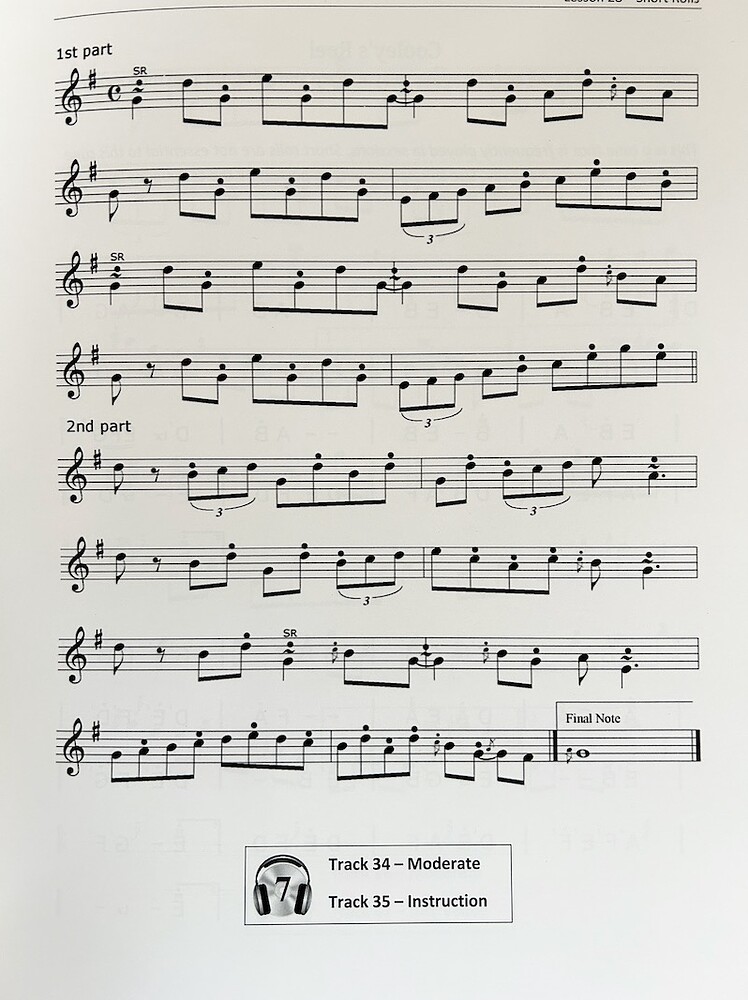
In a previous iteration of the tonguing debate Paddler posted a scan from the Mary Bergin tutor. Reproduced below without comment, it may provide some insights on how to approach pedalling movements.

2 Likes

Do the dots represent tonguing?

Yes, that’s how she notates tonguing in her tutorials.

1 Like

Very true that different whistles will force you to tongue a note (or something) to get a clean, non-squeaking note, but there is more to tonguing. Where it is applied will have some impact on the phrasing of a passage, dividing groups of notes into a coherent phrase. And tonguing a particular note, then doing something different the next time around- a fingered ornament or even a legato transition, will make playing sound less repetitive. To really make this stuff work, focus on your rhythm!

1 Like