Hi all. I recently buy a D low whistle from Dixon (aluminium body and black plastic head). I got still a problem with the low D fingering. It switch very quick to a high D (with same breath al along low scale). Is it a well known problem with this Dixon whistle or has somebody a tip that it sounds clear? If I play on my M&E flute, is no problem with the low D…
The flute and the low whistle are two very different instruments, requiring very different breath technique. Don’t judge a whistle by a flute’s performance or by a flute’s air requirements.
I’ve owned several Dixon low D’s. Never had an issue with octaves flipping. Nor have I had that issue on any of the dozens of Dixon whistles I have owned. Maybe others here have had a different experience.
Make sure you are sealing all the holes properly. I am sure you knew that already. Use the Super Duper EZ Grip, formerly know as the Piper’s Grip if the stretch is an issue. I suggest the SDEZ Grip regardless of the stretch. It results in a lot less stress in the fingers and hands.
I have not seen or heard you play so I can only suspect you may be blowing too hard thinking that you will get a similar volume from a low whistle as you would get from a flute. Won’t happen. Low whistles, by their design, will generally produce less volume than a flute. That’s a matter of how the tone is generated on each instrument. The Dixon is also a fairly quiet low D as low D’s go. So I would suggest that you endeavor to back off on the breath pressure and just enjoy what the Dixon has to offer. It is a very pleasant whistle to play and has a nice timbre.
Best of luck with it. Have fun.
Feadoggie
Thanks for your answer. I discover indeed there are two different instruments. Problem of breath I think: I breath regurlarly until the low E and for the last step in D, I must slow down (just a little bit difficult for legatos). Consequence of this: the D is less loud than the other ones. It’s maybe because a low whistle has a cylindrical bore and a flute a conical bore?!
Oh I forget this: what’s the Super Duper EZ Grip? Can I a grid somewhere find?
Right, low whistles will tend to be quiet in the low end, especially if you are used to “honking” the low D on a flute. The Dixon can be a rather demur low D. It is one of the quieter ones out there. But it is still a fun whistle IMO.
Not exactly. Dixon does make a tapered/conical bore low D, but not in aluminum AFAIK. It is called the TB012, I think, and is all polymer. The tapered bore helps even out the tuning of the upper notes across the octaves. I am not sure it increases the volume much at the bottom end. As I said, the noise making mechanisms for the flute and whistle differ. The whistle will be inherantly less loud than the typical flute at the same pitch. Whistles depend on air velocity to drive the tone. Low velocity produces the low notes. Since the air jet is spread out across the windway that means you need a lot more air to generate the velocity to hit the higher notes. You have to blow harder to hit the higher notes and the volume increases. Does that make sense?
It is what is also called the Piper’s Grip.
Here is what it looks like.
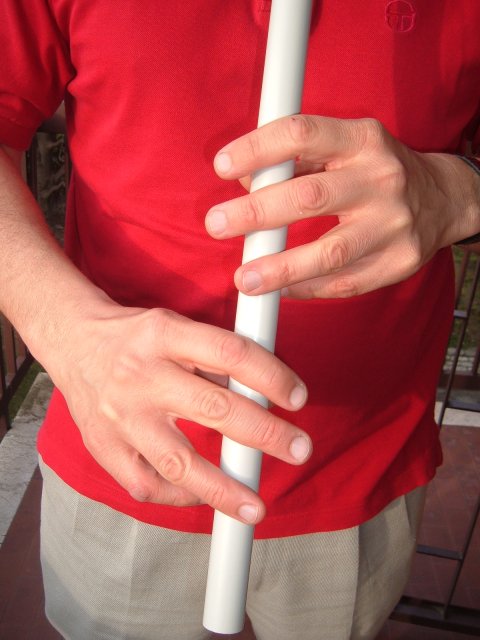
Here’s a thread with a good description and valuable discussion.
https://forums.chiffandfipple.com/t/pipers-grip-step-by-step/63881/1
And here’s a video demonstration.
https://www.youtube.com/watch?v=nca0OT5e6yI
Hope that helps.
Feadoggie
Many thanks for your explanations. Very clear, now I can further  . I think the piper’s grip is much easier because the holes are straight aline, what isn’t with the most of flutes (D hole is for right or left hand). The symetry is no more a problem with this kind of grip (maybe one day I’ll buy a real bagpipe
 ). I’m not sure but there is maybe another explanation, more historical according to Irish trad music?!..