I’m getting on his list for a new keyless flute. Was wondering how boxwood sounds compares to Blackwood? Thanks, John.
I can’t speak to Olwell flutes specifically, but I’ve owned three boxwood flutes: two with a half-lined headjoint and one with a fully lined headjoint. I found that the half-lined ones really brought out the qualities I associate with boxwood: responsiveness and a “buttery” quality. To my ear, this means a somewhat darker, warmer tone and perhaps a more “diffuse” sound compared to harder woods, which tend to have a more focused sound. This is particularly noticeable in the second and third octaves. Of course, this assumes that everything else is kept constant. But for a while, I had one boxwood flute (unlined hj), and another unlined hj by the same maker, with the same embouchure cut, in a hardwood similar to cocuswood (solomon blackwood).
I was able to test both headjoints on the boxwood flute and on an antique cocuswood flute. The difference was quite noticeable in both cases. In fact, I found that the difference between the two headjoints on the same body was greater than the difference between the two flutes when fitted with the same headjoint.
I have two keyless Olwells - a Pratten in Boxwood and a Nicholson in Blackwood. The flutes have different playing characteristics apart from their woods. I hear the Boxwood as a sweeter, lighter sound and the Blackwood as harder/darker. Perhaps with more overtones. People often describe Boxwood as having a buttery sound and I think that’s right. My Boxwood flute also has no tuning slide so is very light and that lightness in hand may influence my perception of its sound.
Describing something as ephemeral and subjective as sound is at best an exercise in imprecision. But for me the Boxwood is sweet, light, buttery. And the Blackwood is dark, direct and resonant.
Hope this helps! And congrats! They are wonderful flutes.
I have keyless Olwells as follows: lined Boxwood, unlined boxwood, and lined Blackwood which is currently for sale. I have also owned a lined keyless Cocus Olwell and I have played other lined and unlined Blackwood and Boxwood Olwells over the years. My observations are as follows:
- Boxwood is significantly lighter in weight than Blackwood. Well, most of the time: There can be cases where pieces of OLD growth Boxwood can be as heavy or heavier than some pieces of less dense Blackwood, but that type of Boxwood from the old English estates is largely long gone.
- Unlined Blackwood is brighter (tonally) and produces more perceived volume (cut) than unlined Boxwood.
- With lined headjoints, the brightness and perceived volume differences between woods are largely negated, and the metal liner definitely increases the brightness and cut/volume of both woods beyond unlined Blackwood.
- Blackwood is more likely to crack, fact. That said, Olwells are less likely to crack than most makers’ flutes, but it can still happen, as evidenced by mine and a rare few others I, and others, have encountered.
- A Boxwood Olwell is extremely unlikely to ever crack. Boxwood in general is much less susceptible to cracking than Blackwood, and I’ve never seen, nor heard of a cracked Boxwood Olwell. Not saying it has never happened, just not aware of any occurrences, and I tend to pay attention to such things.
- Boxwood is prone to warping and ovaling if exposed to extreme dryness, or sometimes extreme moisture. Blackwood rarely does this. That said, the Olwells do an excellent job of seasoning their Boxwood, which is super important, so their Boxwood flutes seem to rarely change shape. I’ve owned and run across many Boxwood Olwells over the years and I’ve only seen one that I can recall had bent slightly. I could mention another maker where 70% of their Boxwood flutes I’ve seen were warped… but I won’t go there.
- Boxwood is a PITA if you play daily, or nearly daily, for long sessions because it absorbs moisture and the top tenon can swell and get stuck in the barrel section. Sometimes to the point where you have to wait a day or so for the wood to dry enough for disassembly. The only EFFECTIVE fix for this is to seal the bore completely with something like superglue or an epoxy compound. We used a marine epoxy on the recorder and flute bores where I worked. All of that said, you are unlikely to have a significant problem with an Olwell Boxwood flute swelling this much if you aren’t playing an hour+ daily.
- Boxwood can get dirty and stained, you just gotta deal with it.
Those are the main differences that come to mind. I don’t really agree with a lot of the descriptors people use for the sound of Boxwood instruments, like “Buttery” for example, no offense intended to anyone. I used to hear Boxwood instruments being played virtually all day long, every day while working. I heard them being played alternated with Blackwood, and rosewood, and even Ivory instruments. There are definitely tonal differences between the woods, however “Butter” isn’t a tone or a frequency I can hear. Butter doesn’t have an effect on perceived volume or projection. Bright? Yes. Dark? Sure. Ringy? OK. Piercing? Can definitely be a thing. Mellow? Yes, but a better description might be something like “Lower volume than x and with less brightness than y” or something to that effect. I’m really not trying to rag on anyone, just suggesting we can all, myself included, probably do better, at times, when attempting to describe the sound qualities of instruments.
I really like both Blackwood and Boxwood. If I weren’t allergic to the Rosewood family woods I’d Choose lined Cocus, then Blackwood, and Boxwood last, for a session instrument. I prefer the bright tone and cut of the harder denser woods for those noisy environments. For just playing at home, it would be unlined Boxwood for the less bright tone, lower volume and better balance in the hand afforded by the lack of liner which shifts the weight WAY left on a keyless flute. Liner actually makes for better balance on a keyed flute, IMO.
There ya go, pick yer poison!
Great post Loren! I agree with everything you said there.
On the point quoted above, I’d just like to add that I think boxwood would be an excellent candidate for vacuum-based resin infusion. It is a fairly involved process, but not too difficult or expensive for a maker to get into, in terms of up front costs.
Basically, you season the wood as normal (for many years), but before doing the vacuum infusion process you got through a sequence of weighing, cooking/drying, weighing again cycles to ensure that the wood is devoid of all moisture. Then you immerse it in a liquid column of heat curable resin, inside a vacuum chamber, and leave it under vacuum for about a week.
After all bubbles have ceased coming from the wood (which means that there is no longer any air inside the wood), you release the vacuum and let atmospheric pressure force the resin inside the wood. Again, this may take about a week while you watch the fluid level slowly drop in the chamber as the wood absorbs the resin.
Once all the resin that can be absorbed has been absorbed, then you remove the billets, wrap them in foil, and cook them at 200 F for several hours in a convection oven. This cures the resin to an inert solid inside the wood itself, which prevents the wood from taking in any moisture in the future, and hence prevents it from moving due to humidity changes.
I’ve used this process on a wide range of flute woods. It works very well on some woods, and not at all on others. The woods that it works best on are those that absorb moisture easily, like boxwood and fruit woods. The woods that it works least well on are the oily woods that don’t readily absorb moisture.
I’ve used it on Castello boxwood and a lot of different fruit woods, including English hawthorn, with very good results, but I have yet to try it on true boxwood. The density of these woods increases substantially (often by well over 50%) bringing their density inline with tropical hardwoods. It also tends to improve their machinability.
All in all, it is a very effective process, and while the process itself is time consuming and hence, on balance, overall more expensive than using premium woods like blackwood, a maker can do it in batches ahead of time, and most of the time delay is incurred in parallel with other work.
And one really nice property is that it provides many more options for players who have allergy issues.
2 Likes
Amen. I have had many an inquiry about flute woods where the customer was wanting me to recommend a wood that embodied some special quality, and they would use highly subjective words to describe the quality–a bit like wine a connoisseur talking about flavor. This is usually a pointless exercise, and I’ve heard terms like “buttery”, “silky”, “sweet”, “warm”, etc.. Like yourself, I tend to confine myself to dark or bright with maybe some commentary on perceived volume. Anything beyond that isn’t really helpful (even if it’s fun to play with words).
I agree Jonathan, and in fact we did something similar where I worked: We used pressure tanks to infuse the wood with oil, some other ingredients and drying agents. Not as effective at completely stabilizing the wood as what you are doing, but the process was simpler and less time consuming, and also didn’t add a lot of weight to the finished wood. We actually did the pressure oiling in addition to the bore sealing epoxy, so maybe it worked out to the same overall amount of time invested? Don’t know, but I do wish more flute makers would adopt similar processes for their Boxwood and other less dense/more porous woods.
Yeah, I get why people do it, and I don’t have feelings about that, which is to say I’m not judging them, its just not helpful from a maker’s point of view, or a buyers, or a reviewer’s IMO. I do think there are times when additional descriptive terms can be helpful. Since we’re talking Olwell’s here I seem remember a number of years ago reading somewhere that Patrick described Cocus as sounding “Glassy” or glass like in tone compared with Blackwood, and I thought to myself, “Yeah, that’s what I hear”, and it does fit, in a way. That said, I’d try to describe the difference in a different way now, though I’m not sure I’d do any better at it. I mean what does a “Glassy” flute tone sound like in my mind, your mind, the next person’s mind? For my part I’d have to think about it, then try to come up with something that made sense to others. I think audio spectrum analysis is probably the best answer to this dilemma, but that’s a whole other subject.
That said, there is a place for poetry and emotive writing in the world, and I wouldn’t advocate eliminating that when writing about flutes and music, just saying those maybe are not the best tools for describing sound in certain contexts.
Agreed! Yes, I’ve only ever had an issue with the more poetic language when trying to discuss tangible characteristics of the flute. As you point out, words and images are personal things, and my conception of something like “silky” or “glassy” might not align exactly with another persons ideas. But I have no problems getting more flowery when I’m talking about my individual experience of a flute, but that’s a different hat.
1 Like
John, not specific to Olwell flutes, but a Google(AI) search put together an interesting chart for me. Search for “compare Acoustic and Tonal Properties of boxwood to african blackwood”
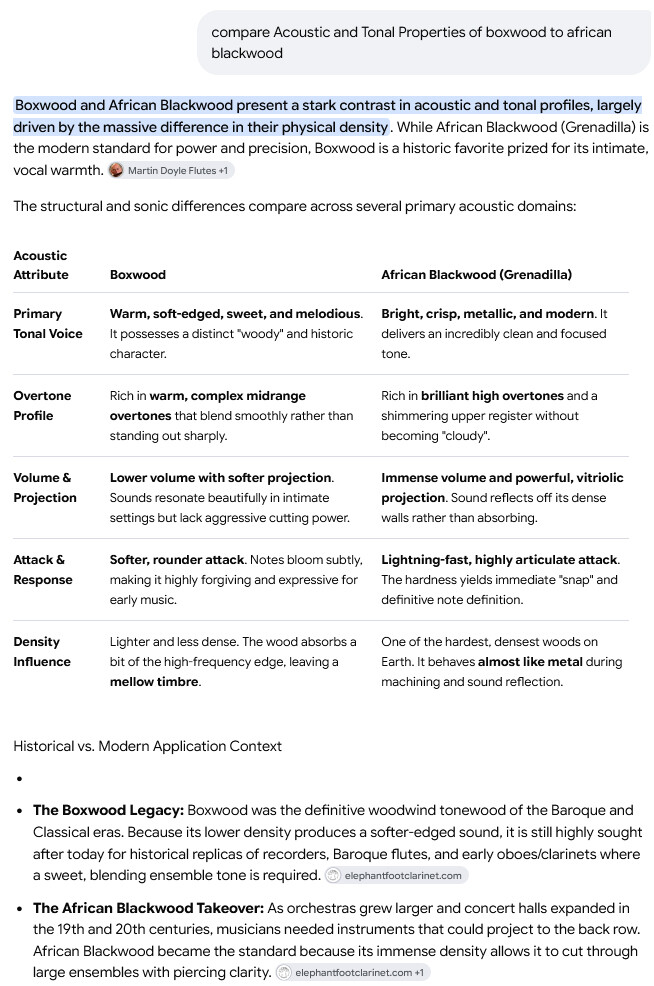
I remember reading Martin Doyle’s evaluation of the various characteristics of different woods and being skeptical. Not of his opinions (which are perfectly valid), but rather of the entire process of trying to characterize woods this way. I’ve often wondered what would happen if we could organize a blind test on a large scale. Get a few makers with a reputation for consistency and have each of them make one of their flutes from a different wood (such as boxwood, ABW, etc.). No metal linings in the flute. Then get together a group of experienced players and do a blind test where they can evaluate each flute without knowing what they were playing. True “blindness” wouldn’t be entirely possible because there are going to be slight differences in weight from flute to flute, but if none of the players know ahead of time what woods are being tested they are less likely to try to guess. And maybe this can be overcome by using a heavy metal for the bore rings on the lighter flutes and something ultra-light on the heavier flutes? Try to get the weights more similar maybe.
Would we track a consistent ability to discern woods based upon these qualities that we so often associate with them? Or would it be more like the famous blind testing of the old master’s violins against the modern makers?
I’ve done informal blind testing with customers in the past where they are listening to different flutes being played, and when they can’t see them and don’t know ahead of time what the material is, they are utterly unable to distinguish one wood from another. I don’t believe that there are no differences between woods, but I do have a lot of skepticism about a player’s ability to consistently distinguish these differences. But that is not to say that I’m not open to having that skepticism erased! There are experienced players with very finely tuned ears who might easily pick up on things that I don’t.
But I’ve had enough customers swear they prefer one wood over another, but then when they play them blind they simply can’t make the distinction. So as always, I’m left wondering where confirmation bias overwrites “objective” reality. But it gets even murkier because I’m not sure I believe there is an objective reality ;-).
I have an older keyless boxwood Olwell Nicholson model with no tuning slide, just corked joints.
The first thing you notice about it is that it weighs nothing. I don’t have a blackwood Olwell with a slide to compare, but it’s noticeably lighter than any other wooden flute I’ve ever played.
It’s exceedingly easy to play and quite forgiving for someone who probably should practice flute more to keep up my embouchure, but I don’t think that’s specific to it being boxwood, all the Olwell flutes I’ve tried were wonderful.
I have come quite close to doing this recently. I have three models of D flute that I make: a large hole Pratten model, a medium-large hole Rudall model (after serial number 6264), and a small hole flute modeled on an antique American flute by F. Riley. I have made each of them in several different materials: blackwood, stabilized boxwood, plum wood, hawthorn, dogwood, black locust, etc. In my flute making process I go to great lengths to try to dial in dimensional consistency (but admittedly they can never be precisely identical).
I’ve had several players over to my house, lined up all the flutes on the same table, with everyone sitting in the same spot in the same acoustic space. And then we have taken turns playing the same model flute in different materials, different models in the same material, and we have each alternated being either player or listener.
I’ve done this with 6 different players so far, some of whom were very talented and experienced musicians in general and flute players specifically. The subjective feedback has shown almost complete agreement. Here is what people have said (and this agrees with my own perception).
As a player, you can tell the difference, but the acoustic differences are quite small, and nobody was really able to say that one material was definitively better than another, just subtly different, and perhaps suiting different musical requirements. The feeling in the hand, due to the weight, was immediately noticeable, and pretty much everyone agreed that a lighter flute makes it easier to relax your hands, and is an advantage.
As blind listeners people tended to initially think they could detect differences, but the more we repeated the process, perhaps playing the flutes in different orders, the less certain they became. The consensus was that the acoustic differences are tiny and subtle.
Its much easier to hear the difference between two different flute models in the same material than it is to hear the difference between materials. But as a listener, even this difference is nowhere near as obvious as it is when you are a player. Players have to give different inputs to different model flutes, and you quickly understand what you are playing and how far you can push it. Different models are clearly preferred or disliked by different players, and there is little consensus on this. Choosing the right model is an important personal choice.
But once you are giving your chosen model the right input and the air in the bore is resonating well, each model starts to sound like you. Hence, the most dominate difference is that each player sounds like themselves, regardless of what flute they are playing and what material it is made from. But they may have to do noticeably different things in order to sound like themselves.
So, order of importance, as a player: 1. your playing skills, 2. the model of flute, 3. the material. And I would say that the material is a distant third.
Oh, and all the flutes in the test had tuning slides and half lined heads, so there was not a full head liner masking the effect of the material. We also tried a lined head for comparison with the Pratten models, and it did make a noticeable, but still relatively small and subtle difference. Most people could not decide whether it was an improvement acoustically. It was just a bit brighter. Everyone noticed that it was heavier.
My takeaway from this is that it does make a small, subtle difference, which you can notice as a player, but the magnitude of this is so small that it really doesn’t matter to most people. You’ll sound like yourself regardless. The ergonomics, weight, and visual aesthetics are much more noticeable, and you should probably let those drive your decision. Well, those and other care and feeding aspects that Loren mentioned.
Oh, and one final insight that came from this set of experiments: density of the wood really does not make any noticeable difference acoustically. Some of the flutes were only half the density of others, and people couldn’t really tell the difference acoustically. Bore finish, and the ability to machine fine details and sharp edges is much more critical, and this is determined more by how fine grain the wood is than how dense.
2 Likes
This is very illuminating, and is probably as close as I could hope to get to a formal “study” on the subject, and it definitely lines up with my own experiences and observations.
I heard a quote that was attributed to James Galway (no idea if he actually said this, but it seems probable) where he said that 90% of the sound of a flute is coming from the player. This certainly aligns with your observation. And my own experience has been that after the player, the elements of the flute design play a much more substantial role than the material. Tiny changes in the bore, the embouchure cut, etc.. can have a noticeable impact and (as was posited by Coltman in his study on materials) it is likely that these nuances (and the player themselves) are what players are actually hearing, even though they often attribute them to the material itself.
You sum this up well here:
When customers ask me for a wood recommendation I usually encourage them to choose a wood they think is attractive, or has some other utility (i.e. is hard enough for rougher handling, is light enough for comfort if they have physical issues, etc.), because those subtle differences between wood types are just too tiny to weigh in the balance. As you say:
My own first-hand observations. Can’t speak about others.
First question is which bore profile? They are distinctively different.
I had a keyed boxwood in the Nicholson profile for several years. I still have a keyed cocus in the Pratten profile and one in the Nicholson.
The Pratten/Nicholson discussion aside (and they are significantly different not just generally but in the Olwell shop)…
… you should know the boxwood flute is likely to be a little thicker overall than the blackwood because of density and such. It’s not uncomfortable, just noticeable. I couldn’t tell you how slight it might be, but I can say you will feel it if you have the two side-by-side.
That said…
I think you will prefer the boxwood. Everyone I’ve spoke with seems to prefer the woodier, buttery sound it produces over a blackwood or cocus. There’s an aesthetic about it as well that seems to appeal to folks, likely because of the color difference.
Upside: They’re gorgeous flutes. The grain on a good boxwood is hard to beat for beauty. If it were me again, I’d change my order to make them faux ivory rings since it’s even more striking rather than sterling. Or consider perhaps a darkwood ringlet that would give it added contrast and beauty. It’s your flute. Make it stand out (if you want…some would prefer not to).
Downside: Aside from the swelling issue Loren pointed out (and the “solutions” offered around that revelation), boxwood left me in a constant state of cleaning the flute exterior. Dirty fingers onto boxwood leaves the “fingerprints” of darkness around the toneholes. It was the one thing I hated (and still do) about boxwood. I have Rudall originals that I adore playing but hate having to clean the fingerprints (which you never get on darker woods). And they never really come perfectly clean.
I live in dry climate and have had boxwood flutes warp. It’s purely aesthetic. Doesn’t harm the sound one bit. Never happened with my Olwell.
Another recommendation: If you’re able, get on the keyed flute list (if they’re even taking names, that is) now. You’ll wait a while, but better to be on it when you can and if you’ve got the time. I was in my 40s when I got on his list and waited about 10 years. At 64 now, I’m not sure I’d do it that way. But it’s a worthy investment.
Enjoy the flute, whichever you choose, John!