Good point, however, typically the entire structure you’re referring to would be called the “headjoint”. The headjoint includes the block as well, but can not be confused with the block, as the term “Fipple” can.
Loren
Well, I wouldn’t call the windway-soundblade combination a “headjoint”. Calling it that would suggest that it was once separate from the rest of the whistle. The term could apply to some whistles, but certainly not to the Clarke Original, Laughing, Shaw, etc designs, where the soundblade was never joined to anything.
That’s right, because you call the windway the windway, and the the blade the blade or (more correctly) the labium. There is no point in combining the two, as they are distinctly different parts of the instrument, with radically different jobs and designs.
The point is, you need terminology that is clear, and not confusing, for purposes of communication. This has already been largely standardised for years now:
There is the complete headjoint, which includes all the components, and then each individual component within the headjoint - The beak, the Block, the Windway, The Chamfers, the Window, the Walls, The Ramp, The Labium, etc. None of these terms have multiple meanings, so these are the standard terms used. Fipple is not a standard term, and as such is not typically used by makers or others who are knowledgeable about these types of instruments.
Of course, people are free to use whatever terminology they like: Call your teeth your “Grill” if you like. Or call the diamond encrusted gold false teeth that go over your teeth your “Grill”, or call the grill on your car your grill - depending on the crowd, you may or may not be understood without a visual representation. OTH, if you choose to use the term “Teeth” there is little room for misunderstanding.
By the way, a whistle mouthpiece that contains no removeable block, would be called a blockless headjoint design.
Loren
I’m offering my artwork up for anyone interested in making an accurate diagram with correct terminology. I created this for the local Irish music academy to give to their students. I used a common style plastic cheapie headjoint since I figured most students would have something similar. If you would like a larger file I can email one. It would be, IMHO, a nice addition to this site to have a sticky thread of terminology for beginners to reference. Any takers?
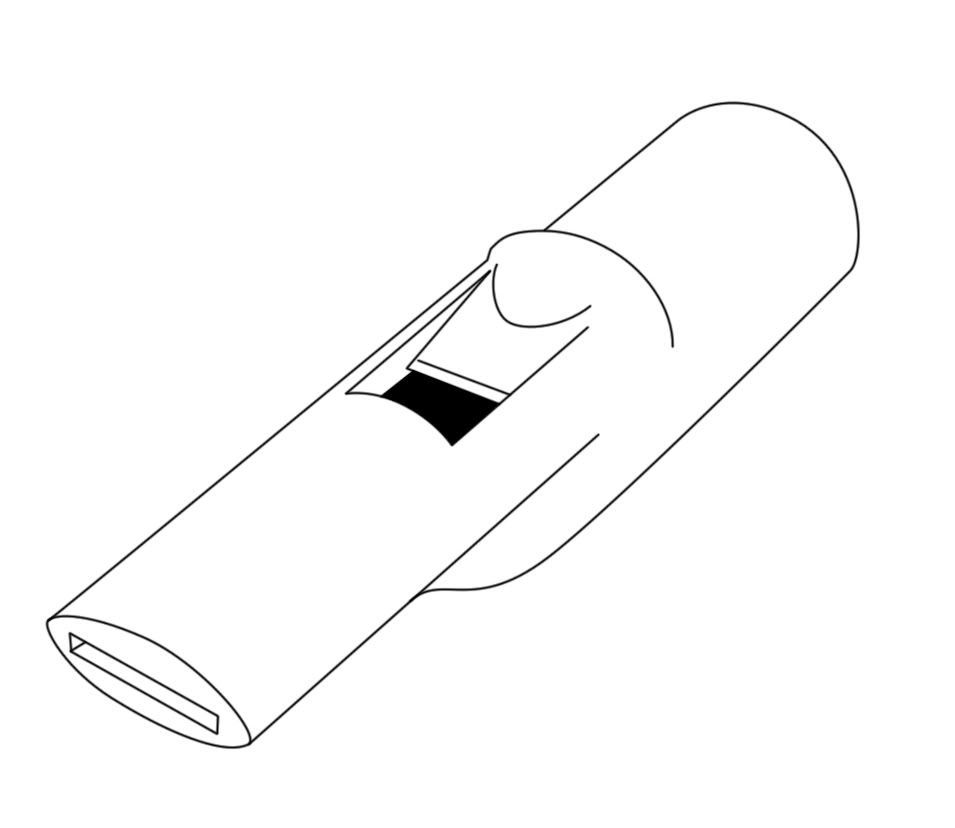
Call it what you will, it’s still a whistle! 
–James
(This is my gentle reminder that what you call the pieces and parts is far less important than your ability to use them to make music. If you can’t play the tunes, nobody’s gonna care if you know what part of a whistle the labium is.)
P.S. Edited to add:
straycat82, nice drawing of a fipple, there! 
Ok, here’s something I need to really know…what do you call that big hole where the wind comes out? You know, that gap of space just before the labium.
I have been calling it the “windway exit” the “mouthpiece hole” and all kinds of terms, but I’d really like something definitive and authoritative to call it 
I call it the window.
–James
I call it the window as well.
sounds good to me, thanks you two! It seems so obvious now (edit to add: and I see that up in loren’s post too..i feel like such an idiot now).
Hey, if I mark up that picture, would you mind if I used it on my website?
Also, do you think you could do one of an Abell-style whistle, with tuning-slide and everything? I could put them up on my website as part of some kind of faq…
I’m fine with anyone using this, I created it for teaching purposes so all are welcome to use it as such. It would be nice to be given credit for the rendering (Johnny Kerr) but I’m not likely to check up on it and make a fuss if I’m not. We’re on the honor system here folks
Wanderer, I would be willing to do the same for an Abell but I would need some good clear picture references as I’ve never owned an Abell. I’m also very busy normally so I couldn’t guarantee I’d have it done right away.
Cheers,
Johnny
Cool I’ll see what I can get for you..no hurry on my end either. I’ve been slowly putting together a FAQ for a couple years now  I definitely apprecaite it, and would give credit, and a link to your website if you want..
Hi, everyone! Just popped in to see how all my “virtual” friends were doing during my hiatus and I just couldn’t resist. So here, now, for your viewing pleasure, is an only slightly tongue-in-cheek picture of a plastic fipple, annotated as only an idiot with access to MS Powerpoint can annotate! Many thanks to straycat82:

I’ve always thought of the two main pieces of a tuneable whistle as headjoint and body or tube; the headjoint would then have a plug or fipple. In one-piece tuneables (black diamond, Humphrey), I think of the entire headpiece as the mouthpiece or fipple interchangeably. In one piece non-tuneables (Overton, e.g.), the fipple or plug seems like its one piece construction with the body but is actually a separate (as told by the seams) plug of the same material.
James - did you have all that stuff ready or did you run and compile it? 
Nice job, but I don’t like the equation of “pure” and “hollow.” To me, tonaly, hollow is a negative - not as to personal preference but as an objective negative. I guess I equate hollow with “tinny” - a bad thing.
A whistle can sound pure and still have chiff (defined as that lovely popping upon striking notes) and be full or round and have a resonance (almost a vibrating or depth of timbre).
See - I just confused heck out of myself!
Philo
PhilO, I agree.
I didn’t like using the word “hollow” but couldn’t find a good word that I thought would work better to put across the idea of a sound made up almost entirely of the fundamental with little overtone content and not having any “extra” (i.e. non-musical) sounds in the mix.
If you know enough about music to understand what I just wrote, then you’re not going to be needing a definition of “pure,” anyway.  If you don’t know what a “pure” sounding whistle sounds like, then chances are you don’t have the background for that explanation to help much.
It’s always a challenge trying to define a concept like that in such a way that you get the thought across without having a common frame of reference.
Anyhow, I do know what you mean, and I do agree.
–James
P.S.
export DEST=chiffboard.mati.ca
export ID=jpeepl
cat terms.txt | while read TERM
do
@call(@post --board=$DEST --uid=$ID $TERM)
done


I think i’d use the term “clean” to describe a pure sound. My burke is pure in that it has a nice clean sound. It still has plenty of harmonics in it, but those harmonics work cleanly and therefore subtlely with the fundamental as apposed to uncleanly and therefore more forcefully with it like they do in the scratchy whistles.
Looks real nice. However, I don’t think they are going to let anyone carry on a plane, blue tac stowage, and if they see condensation  they will take it for that too.
“Labium”, really?
Loren, what’s the term you hold as the gold standard for the windway - “urethra”?
Perfect. Yes, “fipple” qualifies the type of headjoint it is in terms that you have set out.
Here’s another term I’ve seen pop up in a few reviews. Wondered if anyone could clarify: “pure drop.”
Yes, Labium, really. Took me a while to get used to using the term, but you will find it is the standard terminology among Recorder makers.
Loren