contracting out pipemaking

Yes, there are some excellent woodturners out there. This doesn’t offer a lot of assistance in the pipemaking department, however.

While everyone has their strength, and there are no doubt some pipemakers for whom woodturning is a weak point, the typical pipemaking timbers behave quite differently from the timbers used by most woodturners. Ebony and african blackwood, for instance, prefer techniques that are nearly like “machining” techniques when compared to the behavior of other hardwoods. This means that the highly developed skills of woodturners are not necessarily right for the job without further adaptation… even the turners’ tools have to be ground differently for these very dense hardwoods than for other timbers, for best results.

In the end, the amount of time that could be saved by having a woodturner do the “beads” on chanters, regulators, and drones - which is pretty much all the turned stuff - would be a small proportion of the work that goes into a set. For most makers it’s not worth the bother of sending stuff out and waiting for it to come back in, etc… and it of course requires a high degree of standardization. Not ideal for a “bespoke” pipemaking service. And how many (good, skilled) woodturners would want to do this work? There are parts of it, like turning thin timber drone slides to fit hand-rolled ferrules, that aren’t particularly suited to woodworking lathes either.

In other words, it’s a subspecialty within woodturning. Unless a woodturner had a specific interest in pipemaking I don’t see a skills fit here.

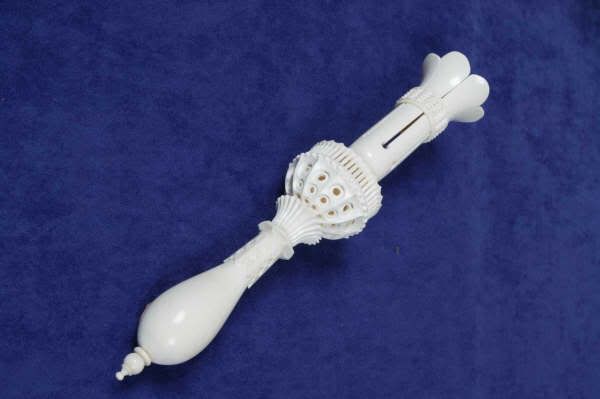
Now, once upon a time, when ivory and bone ornaments were more common in general (i.e. pre-plastics age), there was a specialist class of craftspeople who did pretty much nothing but ivory and bone turning. There is a belief among a number of pipe historians (presumably with evidence, though I don’t know the details offhand) that in the days of the classic pipemakers, some makers did indeed contract out their ivory turning to these specialists. For instance, I have heard several people express the opinion that the famous ivories on the “beehive set” were in fact either third party turnings or, more likely, aftermarket additions, rather than the work of Kenna (who stamped the chanter) or Ryan (who, IIRC, is thought to have made the body of the set). However this craft is now extinct except for the odd[*] hobbyist, who in any case probably doesn’t use ivory any more. Bagpipe makers are probably the primary “ivory turners” nowadays, practicing their skills on plastic.

So Rory, you are about 100 years too late, sorry. :wink:

Bill

[*] - and I do mean odd…

If this kind of skill could be applied to the turning of ivory(plastic)mounts and the wood parts it would certainly make for spectactular pipes

RORY

… and no doubt cost the pipemaker more than they would wish to spend. :laughing:

I am not saying that farming the work of turning out hasn’t, couldn’t or shouldn’t be done, but to date I am unaware of any pipemaker that makes a regular habit of this, nor would condiser it a viable exercise.

On the other side of that coin, I might be one of the first in line for a flat-pitched fullset kit, should one become commercially available and was crafted by a reputable pipemaker.

My pipemaker has told me that it is the metalwork that takes him the most time and grief. He keeps the simple woodturning stuff as a relief for himself. The amount of time he’d have to spend checking another’s work would erase any savings. The market is too small, and the quantities involved for the type of jobbing out that you are suggesting just don’t justify it.

djm

Nobody mentioned copy turning lathes which are said to have been worked by one pipemaker during the 80s and are still whispered to be in use in another workshop.

I have heard of makers allegedly having their keys cut by the bucketload.

I think Davy Stephenson does something with CNC lathe,s


Does anyone know what the letters"CNC " stands for.

RORY

CNC = Computer Numeric Control

No E

Computer Numerical Control

Did a course some years back in using CNC machines (Lathe and Mill) to see if it was viable but decided cost outweighed any advantages. As Bill said turning is only a small part. Using hand control means you can feel changes and compensate especially in boring and reaming.

The examples of ornamental turning above show just what a lathe is capable of if you have the time and from surviving sets of pipes some makers were certainly in possession of ornamental lathes e.g. the Reids from a set that could once be seen in the Horniman Museum London. Yes Rory it has been applied to pipes.

Chris

Peter has heard of pipemakers “alledgedly having keys cut by the bucketload”

Can’t see your problem here. Dave Williams for example almost always used cast keys on his pipes - are you suggesting his product was sub-standard as a consequence. He was pretty disparaging about a certain other pipe maker who spent a lifetime with an old hacksaw cutting regulator keys!

I’ve also heard comments on Long Note programmes about the old pipemakers that some of them had the tapered brass sleeves for drones etc made by outside contractors.

Ken

I think you may be thinking of contrabass regulator extensions, which may have been made by specialist brass instrument fabricators. Have never heard such a suggestion for other metal parts.

Cast keys are probably OK (provided the casting quality is high enough - jewelry grade), and I am experimenting with them, but they are not as strong as hand-forged keys. For this reason I am reluctant to use them for chanter keys, but perhaps having the keys cast to approximate shape followed by a hand cold-forging pass would produce an equally strong key. This would of course take you halfway back to the totally hand-forged key approach in terms of fabrication time and effort, so possibly not worth the expense of the casting stage.

The likes of Kenna, Coyne, and Harrington formed their regulator keys from sheet, which was folded to form the side tabs - this may also end up being stronger than castings, depending on the details. Certainly many of these old keys have held up well over >150 years.

I don’t see a problem with machine cut keys or casting, provided the end result is strong enough and well formed - there will be considerable hand work involved in getting from machine cut keys to the end product.

Bill

Can’t see your problem here

I have no problem. I just hear hear the talk of ‘so so and does this or that’ as I have no definites as to who does what I put it the way I did, I have no problem with the idea.

If you ask me (and I fully realize here that nobody has… :laughing: ) farming out the work of having keys mass cut on ‘the press’ is a good idea. It is the pipe maker’s design and saves a gazillion man hours.

Farming out the turning projects just isn’t feesible from a financially sound stance, plus, the “hallmark” of the true pipemaker’s work and art is somewhat (if not completely) compromised.

Peter, that’s fair comment. I just wasn’t quite sure what you were suggesting

Bill the reference to the metalwork on drones being done by an outside contractor related to the fact that some of the old sets have very fine dovetail joints running the legth of the tuning pieces on the drones. The commentator suggested that work of that standard was probably done by a sub-contractor. I don’t have the tape to hand so I can’t be more specific but I think it was in the programme about Egan.

Ken

???

I confess that I am having trouble imagining what might be meant by “dovetail joints running the length of the tuning pieces…”. No clue, sorry, I’m just not getting it. I’d love to hear the programme about Egan though, I never ran across it…

I’ve been looking a fair bit at Egan sets lately and didn’t notice anything unusual there, or which might have been suitable for subcontractors. But perhaps this is in reference to a particular set with unusual features…

Bill

Dovetail joints on the seams - yes I know exactly what you mean Ken. Unfortunately a lot of pipe makers have not studied manufacturing techniques of other instruments such as in this case the brass family and I believe this what Ken is referring too.

Not easy to describe but I will try - sketch below should help. The sheet to be formed into tube is cut wider than the circumference of the desired tube. Cuts are then made every 10mm or so from the edge into the point where the circumference is. Sheet is rolled into tube and the tabs resulting from the cuts are slotted together one on top of the corresponding one alternatively over and under giving a double thickness all the way down the seam which is then soldered then beaten and finally drawn up to desired size on a mandrel which may be parallel or tapered.
The technique produces a very strong seam much less liable to split when forming bells and very tight bends.

Needless to say most pipemakers (myself included) just go for plain butt joined seams

Chris

… not with my butt you don’t. :open_mouth:

Ah yes of course. I would have called that a “finger joint”.

I have never seen this on any drone ferrules, bends, or other drone parts.

I have seen it on contrabass regulator extensions, which may well have been contracted out on occasion.

Bill

there will be considerable hand work involved in getting from machine cut keys to the end product.

At the moment my chanter keys are forged from strip and regulator keys cut from 1/8" thick brass by bandsaw. However having seem some very nice keywork on reproduction early woodwind cut out by a specialist engineering firm using a laser I am now looking to have a ‘bucket load’ cut out. Finish on the cut edges was very good and does not need a lot of cleaning up.

I guess it depends on the keywork style. I’d be looking to either fold the cut keys in the manner of Kenna/Coyne, or, using thicker sheet (like your 1/8" brass), would wish to thin or at least round the touches. Do you leave the whole key a uniform 1/8" thick?[*]

Still, attractive insofar as keywork is a big time sink.

  • (nothing wrong with that of course, I just hadn’t considered it before)

Perhaps pipemakers should have their own forum to discuss materials and methods or is there a protectionist attitude amongst them ?