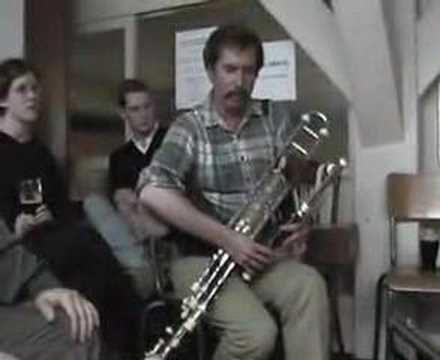
Does anyone have video or sound of a contrabass regulator being played?
I seen many photos of them but they seem to be very rare in actual use, at least in recorded use.
Same for any other nonstandard regs?
A set was discovered more or less recently that has a bass reg a full octave below the ‘normal’ bass. Some sound off that one I can tell you (I heard a recording). I don’t feel it’s up to me to post anything more specific about that.
There are recordings of the ‘regular’ contrabass ones knockig about though and also of extended bass ones (doown to D an octave below the middle reg) Joe Doyle, Ronnie Wathen play(ed) the odd note on them.Others too but let me think on that one for a bit.
[edited to weed out some typos]
https://www.cl.cam.ac.uk/~rja14/music/index.html
Have a listen to the Richard O’Mealy recordings on this page, plenty of low-end honking on those (O’Mealy’s reg style is very unlike that of most modern day players)
O’Neil Taylor Set, nicely displayed.
My Taylor set (the Cummings set) has a beautifully made contrabass. Here I play one contrabass note to finish The Bold Trainer O. It’s definitely a handy thing for a bit of a flourish at the end of a tune 
That said, I don’t have it on the set these days as I’ve yet to find a way to play the set with the contrabass attached that doesn’t obstruct the playing the other three regs in some way. This is perhaps a reason why Prof Cummings himself appears not to have played the set with the contrabass either. Of course the set was probably not made for him originally, so the contrabass would not have been something he ordered from the Taylors.
Good find, I’d been trying to remember the name of that Froment set’s owner (Guilloux). Which has now led me to this
As for other ‘nonstandard regs’ Tom Kannmacher has done a bit of stuff featuring an “E” regulator setup.
I’m not sure that the contrabass regulator is the most pleasant sounding thing ever, even if they do add a great touch of visual showmanship (if I’d been playing on the stage back in 1820 I’d have got one for this reason alone)
Dicky Deegan has that double bass extension, or whatever the correct term is.
https://www.youtube.com/watch?v=p07PCVD8UoA
That said, I don’t have it on the set these days as I’ve yet to find a way to play the set with the contrabass attached that doesn’t obstruct the playing the other three regs in some way.
Amen to that. I have a 4-reg CP Froment with the double-bass reg providing D, E, and F#. That reg plays beautifully, but I find it difficult to reach the tenor reg with it mounted, so I’ve dismounted the double-bass reg for the time being and I play it as a full set instead.
Yeah that’s a neat video, looks like it might be kind of awkward and take some getting used to
That Williams paperclip set has an additional reg on the high end, not an extra bass.
Those big Froments weigh a ton, Taylors too.
There’s probably a reason why things have settled at three regs for everyday use.
There’s a massive Coyne set that was supposedly made for use in a church setting, as an ersatz organ of sorts (I believe it has no drones or something like that, that’s my memory of it anyway).
Does it? Just going by the video I thought it was a 3 reg set but with a paperclip shaped contrabass in place of bass?
That’s how I remember it. I remember him saying he wanted high sounds against the chanter and asked Dave Williams to make a high reg. I seem to recall him playing high ds against tunes and I was very close to the thing on various occasions. I have some recordings I made at the time. Mind you, that was during the eighties and recollections are slightly dim by now.
He did always seem to have a bit of a fixation on having extra bells and whistles on his pipes.
This extra reg had E, Fnat, high C# and “back” D.
High D was the only tone that Marc used frequently, the other tones were a bit troublesome and hard to get in tune.
The paperclip design was of course meant to be reminiscent of the Vandaleur set.
That is pretty much my recollection. I hadn’t really watched the video above but it does look like he ditched the fourth reg on that occasion.
The Vandeleur Moloney must have been the inspiration but the various sets claiming the capt Kelly pedigree used that configuration as well, Colgan did at least some of those. I suppose the proper description is ‘trombone slide’ but we always used to refer to the Williams instrument as the ‘paperclip set’.
Is the trombone slide to lower the bass reg an octave then or is it just a flourish on the outboard connector for a fourth reg?
Seems awfully bulky given the other ways of getting both smaller and contrabass regs.
In the first video the bass reg has a “normal” reed cap and the extra high reg is next to the tenor. In the second video the bass reg looks to be fed by the trombone thing and the high reg doesn’t seem to be there but presumably it could be fitted into the other end of the trombone.
This getting fierce confusing, as they say.
In the two videos posted Marc Guilloux is playing two very different sets. A big Froment flat set and the D Williams paperclip set.
The Ennis/Coyne use to have a contrabass regulator. There’s a photo of it somewhere on the NPU photo archive. It’s not clear what became of it, though.
