Comparison of High D Whistle Bores

There have been some discussions before of whistle bores and impact on the upper octave. The descriptions of bores are generally pretty vague and meaningless - “narrow,” “really narrow,” “wide,” etc. Based on my whistle acquisition syndrome, I can provide specific bore measurements for the following, from smallest to largest diameters:

Killarney Brass D: 11.8 mm
Tony Dixon Cupro Nickle (Delrin head) Trad D: 12.8 mm
Tilbury Aluminum D: 14.0 mm
Kerry Busker Aluminum D: 16.0 mm

As expected, the Killarney is really easy to bounce into the upper octave. At this point it is my favorite of the group.

The Tilbury has a richer (stringier tone) sound in the lower octave but has taken some practice to get into the upper octave. It has a distinctive tone compared to the Killarney (in a good way) and has grown on me.

The Kerry Busker is a bit different beast. It is my newest and I still cannot reliably get, or stay in the upper octave. I think I am still underblowing for what it requires - and when I do get into the upper octave, it screams. Based on my still limited experience, I am not sure it will ever be as nimble as the others.
Another thing is distance from windway exit to lip. You can make a whistle harder or easier to hit the second octave at the same bore size, just by changing this dimension. So it makes bore size less useful than I would like. Because some makers will make a larger bore whistle, and then it still overblows too easily, or the other way around. My tilbury Bb was a perfect example of this. It had a good bore but still overblew way too easily. When I sold it, the person I sold it to also complained about it haha.

I will say that there seems to be a good balance where when lip space is good bore does exactly what you think it should. My MK pro low D is a smaller bore than my Reyburn low D. Its much easier to hit the upper second octave, and the Reyburn can be pushed harder in the low end.

Another thing to note is air use and volume effect of bigger bore. Bigger bore are said to be louder. In the case of my Reyburn this is true. but what people usually leave out is bigger bore usually always have a wider windway, which makes it louder, and also ups air use. So idk how much of the louder is actually the bigger bore.

I feel like the terms ‘wide, narrow’ etc are in relation to the average for that key. My Reyburn low D is definitely a wide bore, being wider than my MK, which I think should count as standard. But obviously if someone doesnt have something to compare to or compares wrong, then the terms are pretty pointless lol. Like if the MK was actually a small bore, my Reyburn could actually be standard bore, and I’m just wrong in thinking its wide. So I usually like to just go for raw dimensions. Someone can tell me the bore and I’ll decide if I think its wide or not haha.

Holy moley there’s no way I would play whistles with bores that wide.

Some comparisons:

Feadog D 11.5mm

Generation Bb 14.2mm (cf. Tilbury D above)

Reyburn G 15mm (cf. Kerry Busker D above, a WIDER bore than a Mezzo G!)

Burke G 16.8mm (cf. Kerry Busker D above)

So the Feadog in D bore is pretty similar to the Killarney. It will be interesting to see whether we build up a compendium of bore sizes vs. the relative nomenclature bandied around.

For me, the Kerry Busker in D is the only one that I am not (yet) comfortable with, so as mentioned above, there may be other factors that modify how the upper octave behaves in addition to bore diameter.

You’ll probably find that bore is fairly standard among traditional-playing D whistles. It goes back to Generations and has been copied by most of the moulded-plastic-top brass-tube whistles.

The ratio is around 23.5 which Burke more or less maintains throughout their various sizes.

Many other makers have the bore getting relatively narrower as the size gets lower, for example my great-playing Goldie mezzo F (25) and Goldie Low D (24.6)

Which is why the Burke Low D has noticeably stiffer high notes.

I haven’t tried the “Busker,” but I have owned a few “Thunderbirds” of his, which are AFAIK a fairly similar design. The Bb, which has roughly the same bore as the D and C, is an absolutely excellent busking whistle all-around. Loud but not too loud, nice strong low octave, takes a bit ore air than I’d like but not horrifically so (and the volume tradeoff is worth it). Plus, most importantly, it can pressed into use as a self-defense weapon if the need arises!

The high Ds I’ve had/played have been borderline unworkable for me, they just require way too much air and absolutely belt out the top notes. Well, I should say that’s what they do if you have enough lung power to even get them to sound! Once you get the hang of them they’re certainly loud and have a full, rich tone in the lower octave, but I ended up selling them on because they just didn’t agree with me.

What’s funny is that the Susato Kildare whistles are similar in that they make multiple pitches with the same bore, and again the ones on the lower end of each series IMO play much more nicely than higher ones. The D in the “S” series feels more manageable to me than the Chieftain/Kerry ones, but the B with the same bore diameter is a lovely whistle also well-suited to busking. I’ll have to find a ruler to measure out the bore diameters of that and the Dixon polymer whistle I have that plays quite sweetly in the second octave, to add to the list.

I tend to think of something much less than 1/2" or 12.7 mm as narrow bore and anything much above that as wide bore. The Burke wide-bore brass is around 14.3 mm (9/16), and that’s about as wide a bore as I think is practical for a d whistle. 16 mm for a d whistle is well beyond anything I’d think desirable.

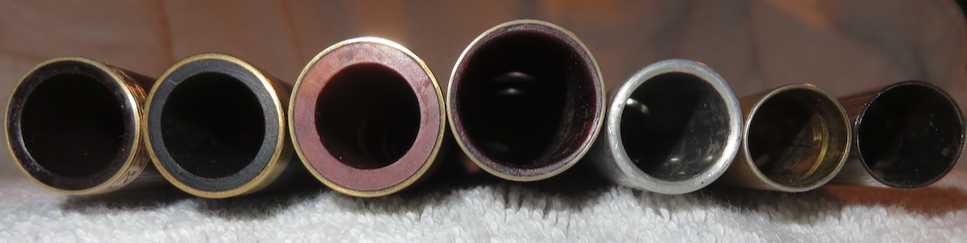
These are all high D whistles. OZ on the left, then Milligan, Hermit Hill, Kerry Custom/MacManus collaboration, original Kerry Songbird, Reyburn, and Killarney on the right. I’ve sold some of these, and kept the outstanding ones. This pic shows the dramatic difference in bore sizes, which can be generally related to overall volume. Larger = louder in most cases.

Wow, that one in the middle is ridiculous. Knowing the rest are d’s, I’d think it was a G. The Hermit Hill has a wall so thick I’d think they’d need to undercut the tone holes.

Wow, quite a selection of whistles! I would love to see measurements to add to the collection.

Here are some internal end bore measurements for high D whistles I have on hand:

Clare 2 piece = 11.2mm
Generation = 11.6mm
Goldie = 12.3mm
Kerry Cobre = 13.3mm
Kerry Custom/MacManus = 15.2mm
Kerry Songbird = 12.3mm
MacManus = 12.3mm
Milligan = 12.2mm
OZ Delrin Vizor = 12.3mm
OZ Vambrace = Unavailable - on loan
Reyburn D = 10.9mm
Shaw = ~8.4mm OD
Susato Kildare = 11.5mm

Flexismart, thank you for taking the time to make the measurements. The Kerry Busker Aluminum D at 16.0 mm still seems to be a bit of an outlier, even compared to the Kerry Custom at 15.2 mm that looks huge next to its brothers. This is not a huge difference, but still pushing it even further than the Custom did.

I’ve had, and have several of Phil Hardy’s high D whistles.
The most useful of them is the Kerry Songbird (no longer available to buy new).
The Mezzo D (now called a Busker) is great for playing in a train station where brakes are squealing - in fact, I sold mine to a busker in Spain doing just that.
The Kerry Custom/MacManus I bring out when the PA has gone on the fritz.
The Kerry Cobre is a great practice whistle, but I don’t play it in public - the tone character is very different than any other whistle I have.
The most impressive Kerry whistles I have are a Chieftain C from 2005, and an early Chieftain Bb modified to have a tuning slide by Colin Goldie. Both are a pleasure to play.

Overall the best of this crowd of high D whistles, ranked is:
1 OZ Vambrace
2 Goldie
3 OZ Vizor

For gigging, I generally use the OZ Vizor D and C - being delirin, I don’t have to worry about cleaning them while rushing out of the hall. The Goldie is a fantastic whistle but it’s not tunable, so I tend to leave it out of my regular kit.

Hi all

Great work on assembling the data so far. I wish the companies offering whistles thought to put the bore size on their promotional material to give us some idea of what they are offering!

I thought to rearrange the data so far in bore diameter order, so we can get an easy visualisation of where they cluster. I’ve also added in the sizes of the thin-walled tubing you can buy through hobby outlets. You’ll see I’ve put in 2 line returns between well separated clusters, but only one between the 12.0 and 12.2mm bores. Are they two clusters or almost a continuum?

Reyburn D (10.9mm)
7/16" tubing (11.1mm)
Clare 2 piece (11.2mm)


Susato Kildare (11.5mm)
Killarney (11.7)
15/32" tubing (11.9mm)
Generation (11.9mm)
Feadog (12.0)

Milligan (12.2mm)
Goldie (12.3mm)
Kerry Songbird (12.3mm)
MacManus (12.3mm)
OZ Delrin Vizor (12.3mm)


1/2" tubing (12.7mm)
Dixon Cupro-nickel (Delrin head) (12.8 mm)


Kerry Cobre (13.3mm)
17/32" tubing (13.5mm)
Walton’s Mellow D (13.5mm)


Tilbury Aluminum D (14.0 mm)
9/16" tubing (14.3mm)
Burke Wide Bore (~14.3 mm)


19/32" tubing (15mm)
Kerry Custom/MacManus (15.2mm)


5/8" tubing (15.9mm)
Kerry Busker Aluminum D (16.0 mm)


I didn’t quite know what to do with the “Shaw = ~8.4mm OD” data point. Is that for real?

And I’m assuming all the above are cylindrical whistles. It would be interesting to throw in some conicals as well, although getting the measurements is a bit trickier. Anyone have a conical whistle and measuring facilities? The only thing I have here is an unmarked 6-key English B flageolet, conical from 12.75 down to 9.7mm. If we take the mean of those diameters, we’d end up with 11.2mm, which would put it in the first cluster above. It’s a very quiet instrument, made all the more so by thick walls and small holes.

Feel free to toss in more datapoints if you have any!

Note: Burke High D whistles come in Narrow, Session and Wide bores.

Amended, thanks. Anyone have figures for the Burke Narrow and Session High D whistles?

Sorry I owned both but never measured them. I suppose it’s because my interest is Low Whistles, which I do usually measure.

As I recall the “narrow” Burke is around the same, or a tad wider, than the classic Generation bore (my Eb Generation and D Feadog both have .453 bores) while the “session” is really too wide to give a nimble 2nd octave.

Here is a dump of inside diameter measurements at the foot for whistles purchased new within 2022, so these should reflect the maker’s current work. These measurements should be good to within 0.01" and 0.1mm.

  • Brass
    Burke Brass, Narrow Bore High D, tunable: 0.47", 12mm
    Alex Dewilde, Brass head with plastic fipple High D, tunable: 0.50", 12.8 mm
    Setanta, Brass head and fipple High D, tunable: 0.50", 12.8mm

  • ABS
    Susato Kildare Very Small Bore (ABS) High D, tunable: 0.40", 10mm
    Susato Kildare Small Bore (ABS) High D, tunable: 0.46", 11.8mm

  • Wood
    McManus High D in Blackwood, tunable: 0.50", 12.7mm
    P.G. Bleazey High D in Mopane, tunable: 0.37", 9.3mm at foot; 0.50", 12.8mm at middle joint
    Jos. Morneault High D in Rosewood, tunable: 0.45", 11.5mm
    O’Brien 3-pice High D in Granadillo, tunable: 0.5", 12.7mm

Thanks, JackL. I’ve assimilated your data dump into the list so far. Let me know if I got anything wrong!

As you can see below, I’m having a play with formatting. Some parts of the list start with the whistle type. Others start with the whistle bore size, with a view to showing where there are clusters and gaps. Any strong views either way, or better suggestions?

Note that I’ve started a separate list (at bottom) for tapered whistles. It would be nice in many ways to be able to assimilate them into one list, but we’d need to agree on how to massage the data!


CYLINDRICAL WHISTLES

Susato Kildare Very Small Bore (ABS) High D, tunable (0.40", 10mm)


Reyburn D (10.9mm)

7/16" bore tubing (11.1mm)
Clare 2 piece (11.2mm)


Susato Kildare (11.5mm)
Jos. Morneault High D in Rosewood, tunable (0.45", 11.5mm)
Killarney (Brass), tunable (11.7mm)
Susato Kildare Small Bore (ABS) High D, tunable (0.46", 11.8mm)
15/32" bore tubing (11.9mm)
Generation (Poly head, brass or nickel body) (11.9mm)
Feadog (Poly head, brass body) (12.0mm)
Burke Brass, Narrow Bore High D, tunable (0.47", 12mm)

Milligan (12.2mm)
Goldie (12.3mm)
Kerry Songbird (12.3mm)
MacManus (12.3mm)
OZ Delrin Vizor (12.3mm)


12.7mm: 1/2" bore tubing
12.7mm: O’Brien 3-pice High D in Granadillo, tunable (0.5", 12.7mm)
12.7mm: McManus High D in Blackwood, tunable (0.50", 12.7mm)
12.8mm: Dixon Cupro-nickel (Delrin head)
12.8mm: Alex Dewilde, Brass head with plastic fipple High D, tunable (0.50", 12.8 mm)
12.8mm: Setanta, Brass head and fipple High D, tunable (0.50", 12.8mm)


13.3mm: Kerry Cobre

13.5mm: 17/32" bore tubing
13.5mm: Walton’s Mellow D


14.0mm: Tilbury Aluminum D


14.3mm: 9/16" bore tubing
14.3mm: Burke Wide Bore


19/32" bore tubing (15mm)

Kerry Custom/MacManus (15.2mm)


5/8" bore tubing (15.9mm)
Kerry Busker Aluminum D (16.0 mm)


TAPERED WHISTLES
P.G. Bleazey High D in Mopane, tunable (0.37", 9.3mm at foot; 0.50", 12.8mm at middle joint)

For my own attempts to understand these things I want not only the bore ID but also the sounding length.

I know it’s a complex issue but for simplicity of measuring and comparing I use bell-to-blade.

Because two whistles can have the same bore but different length-to-bore ratios.