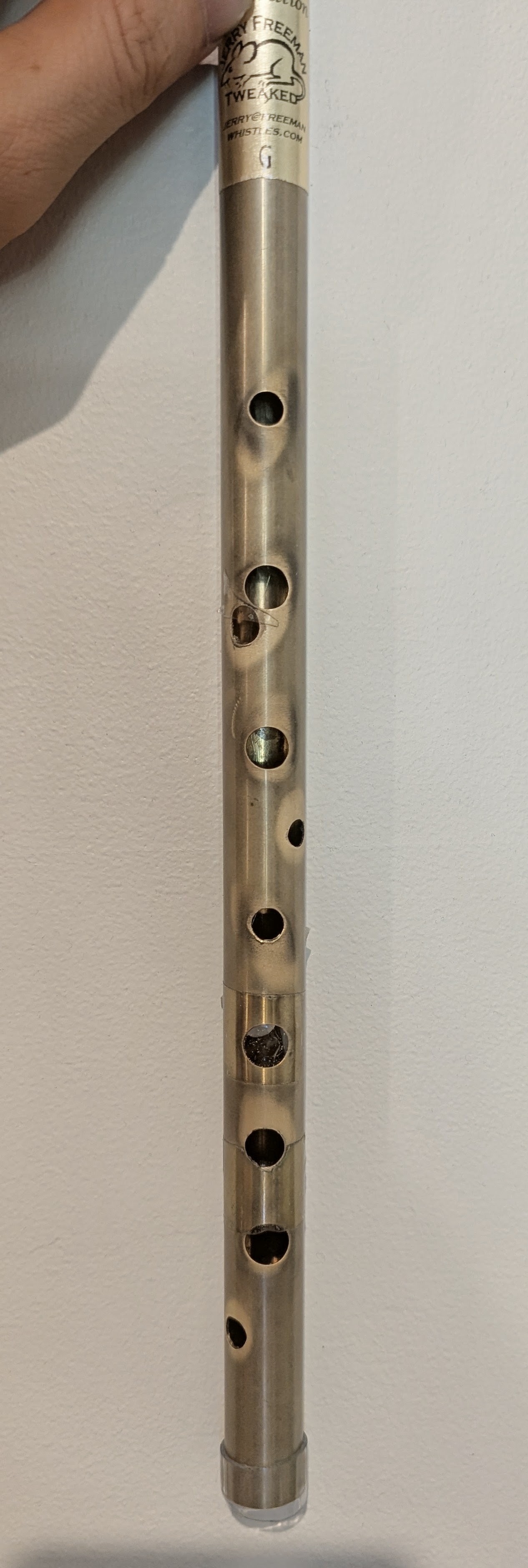
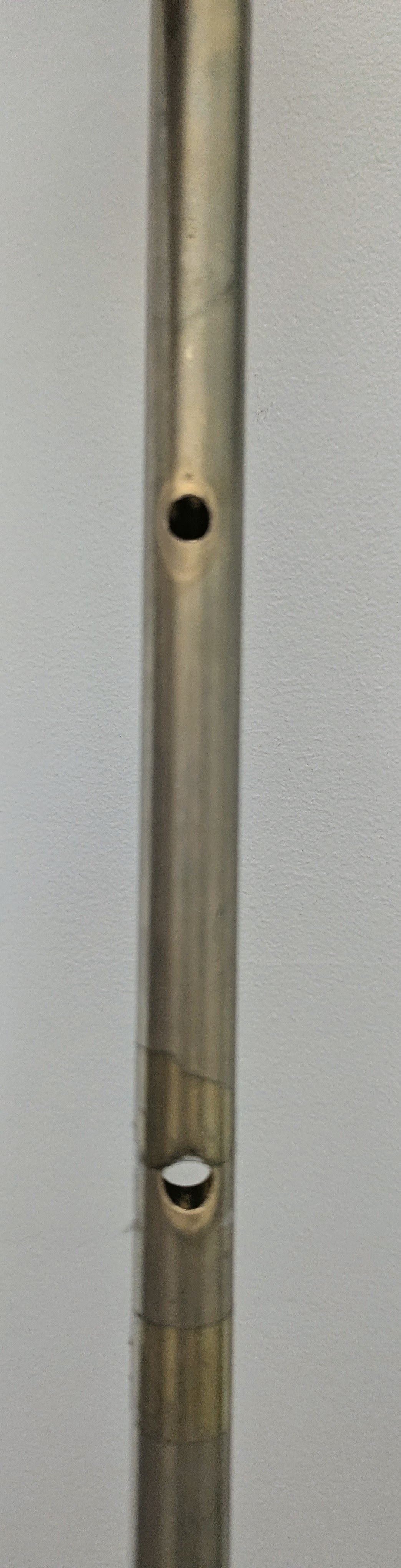
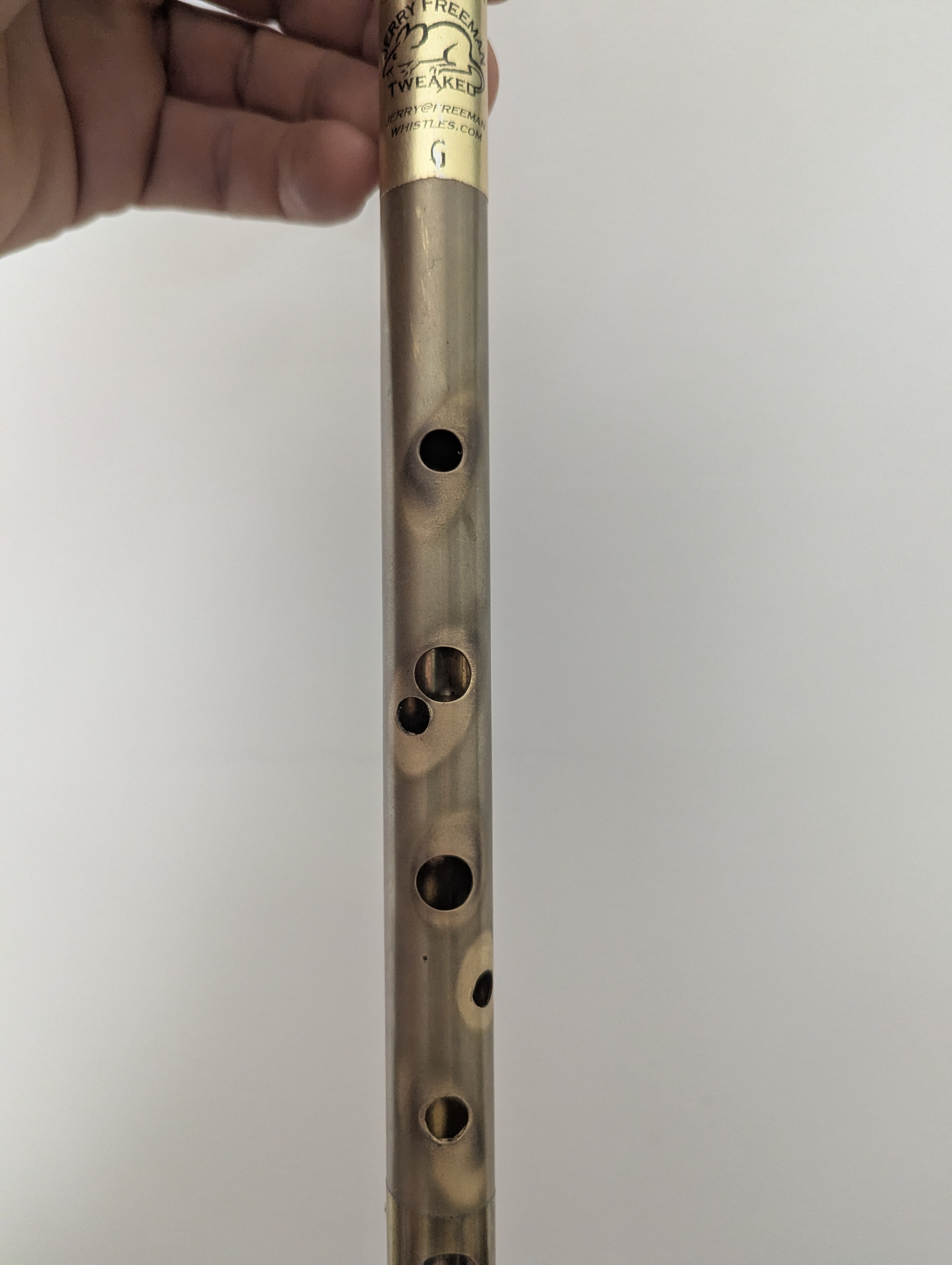
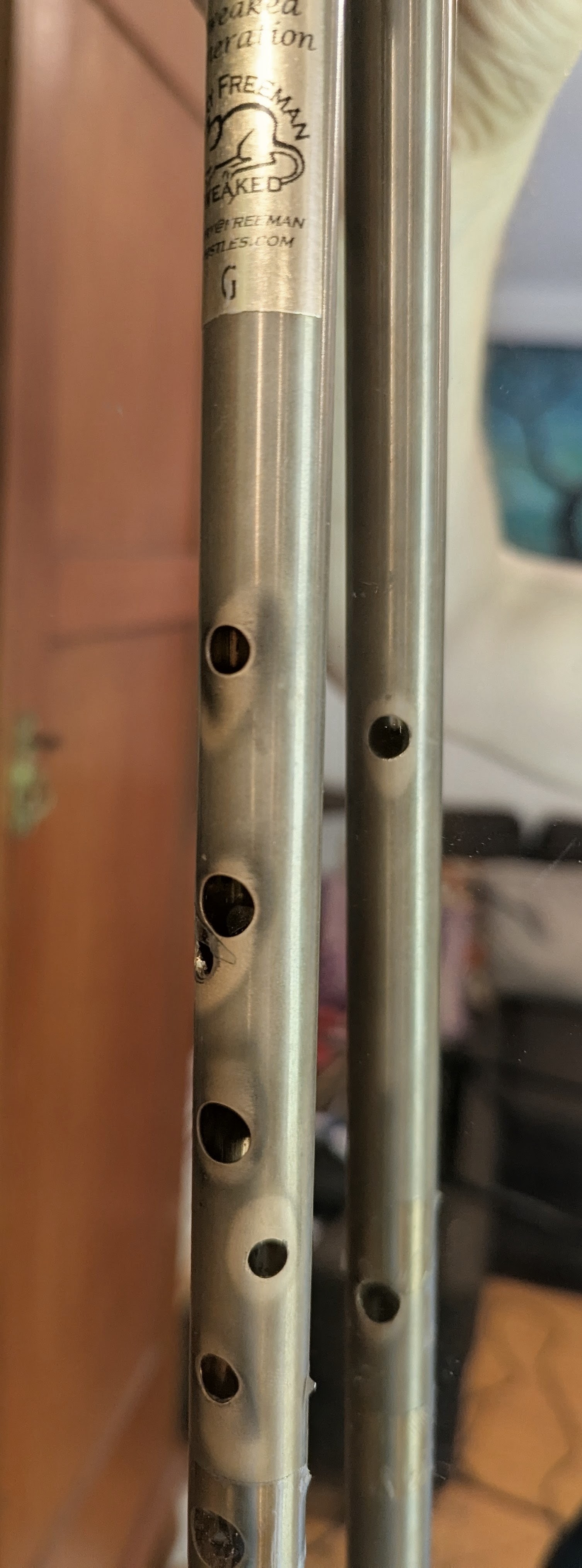
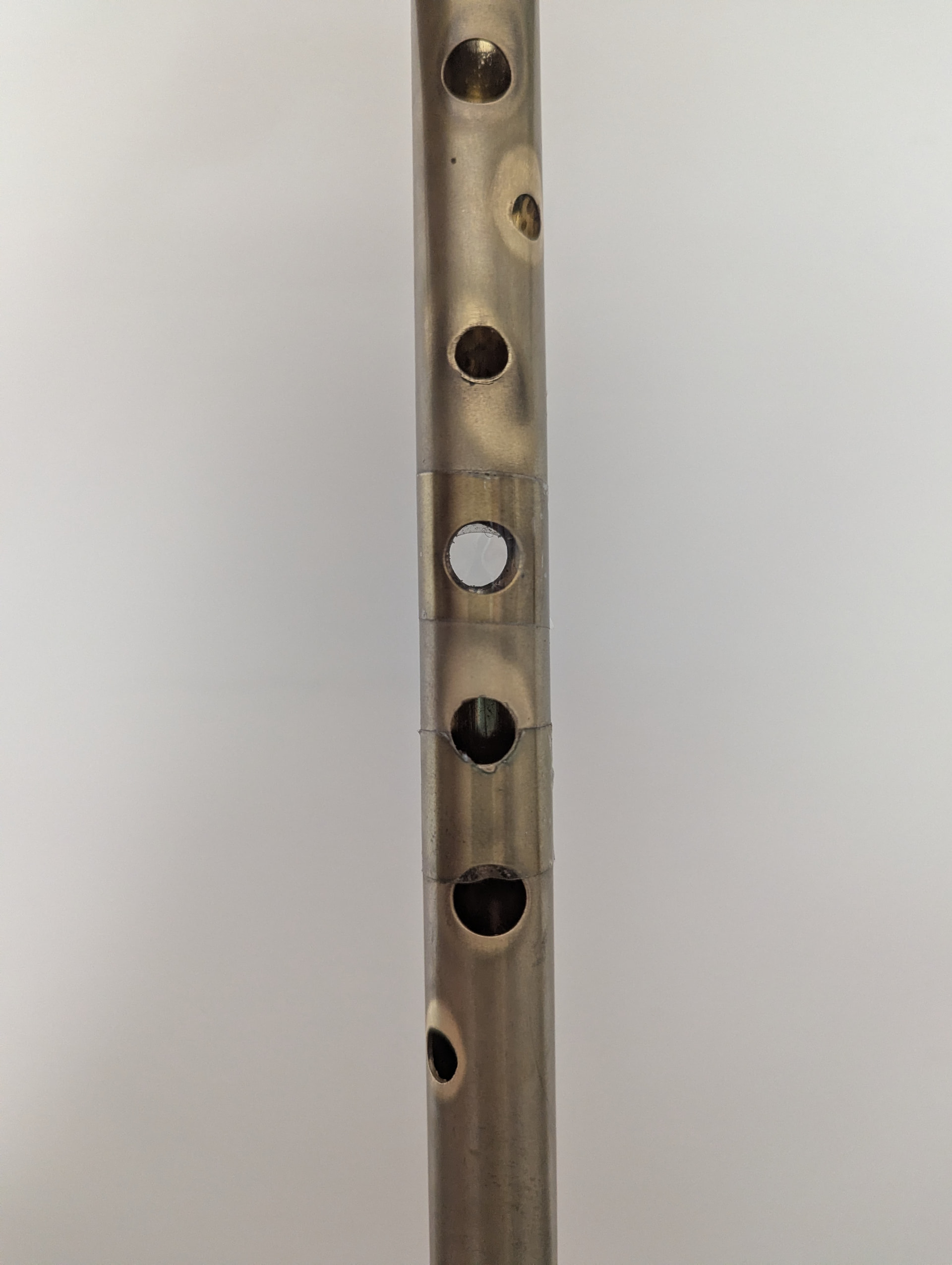
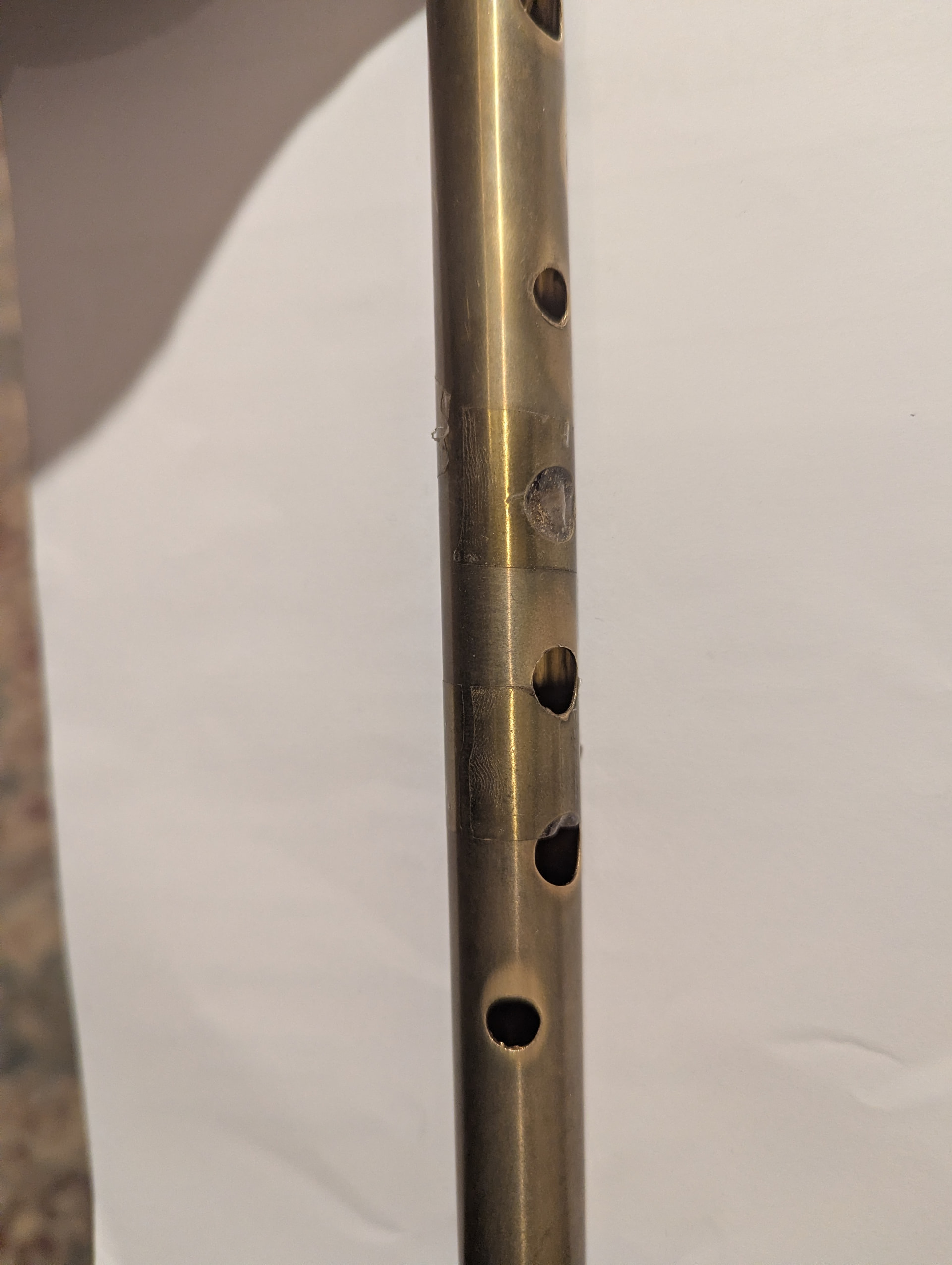
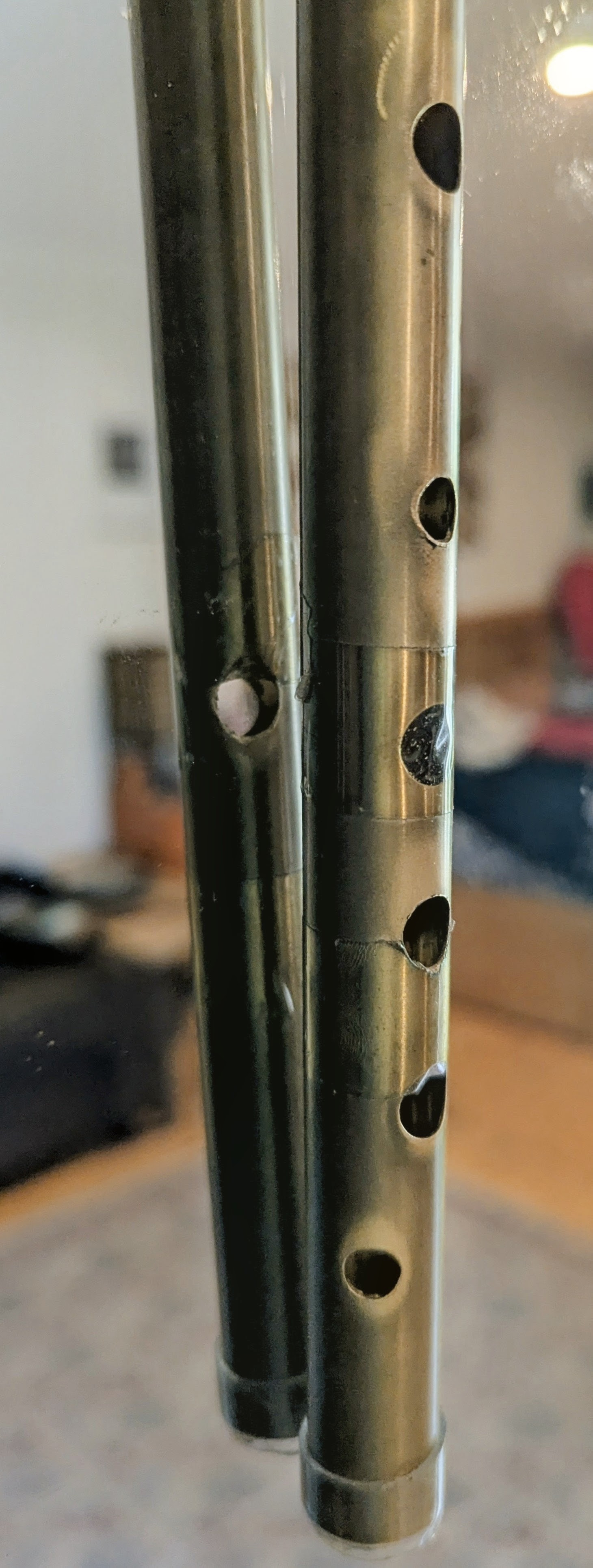
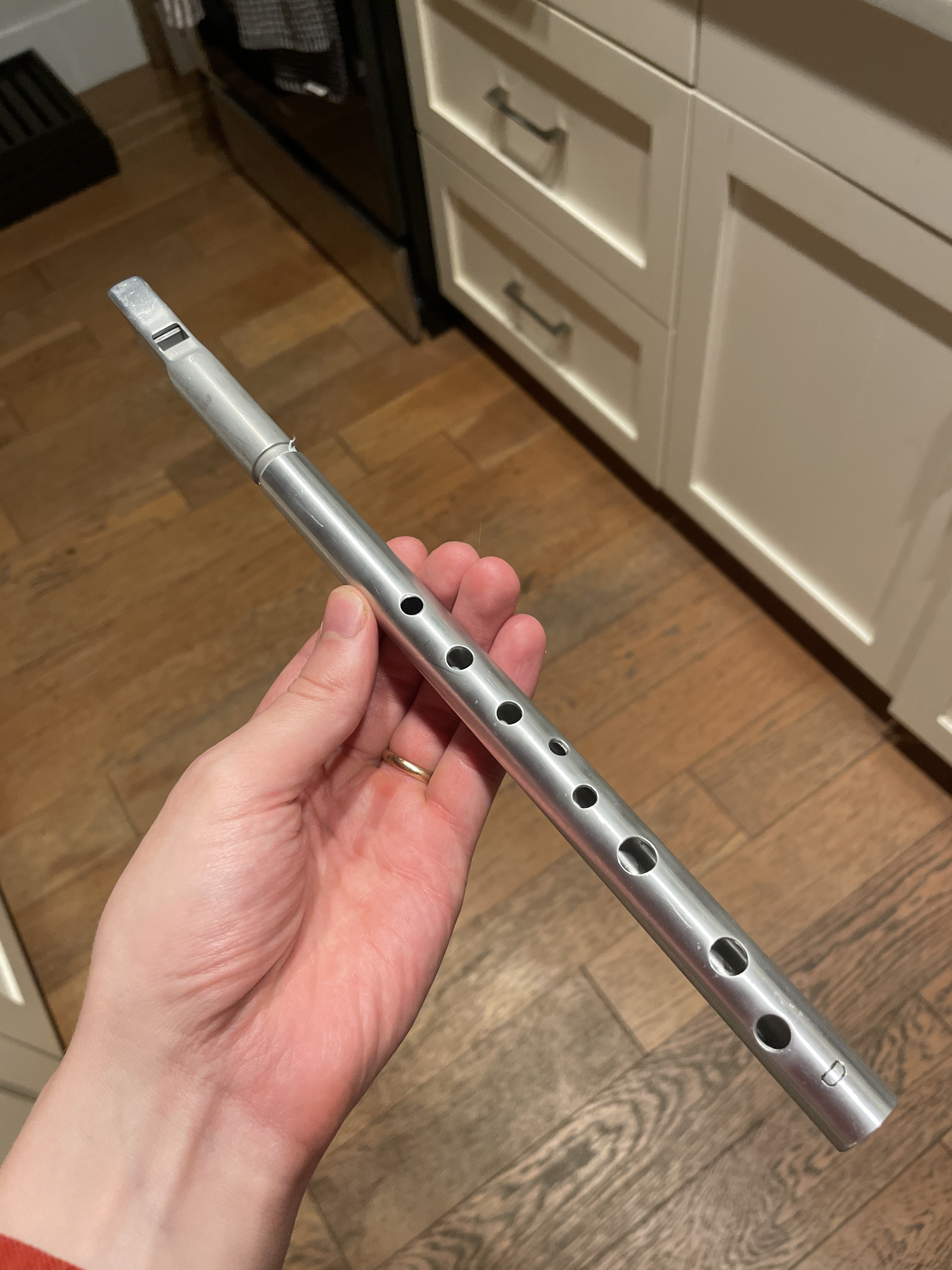
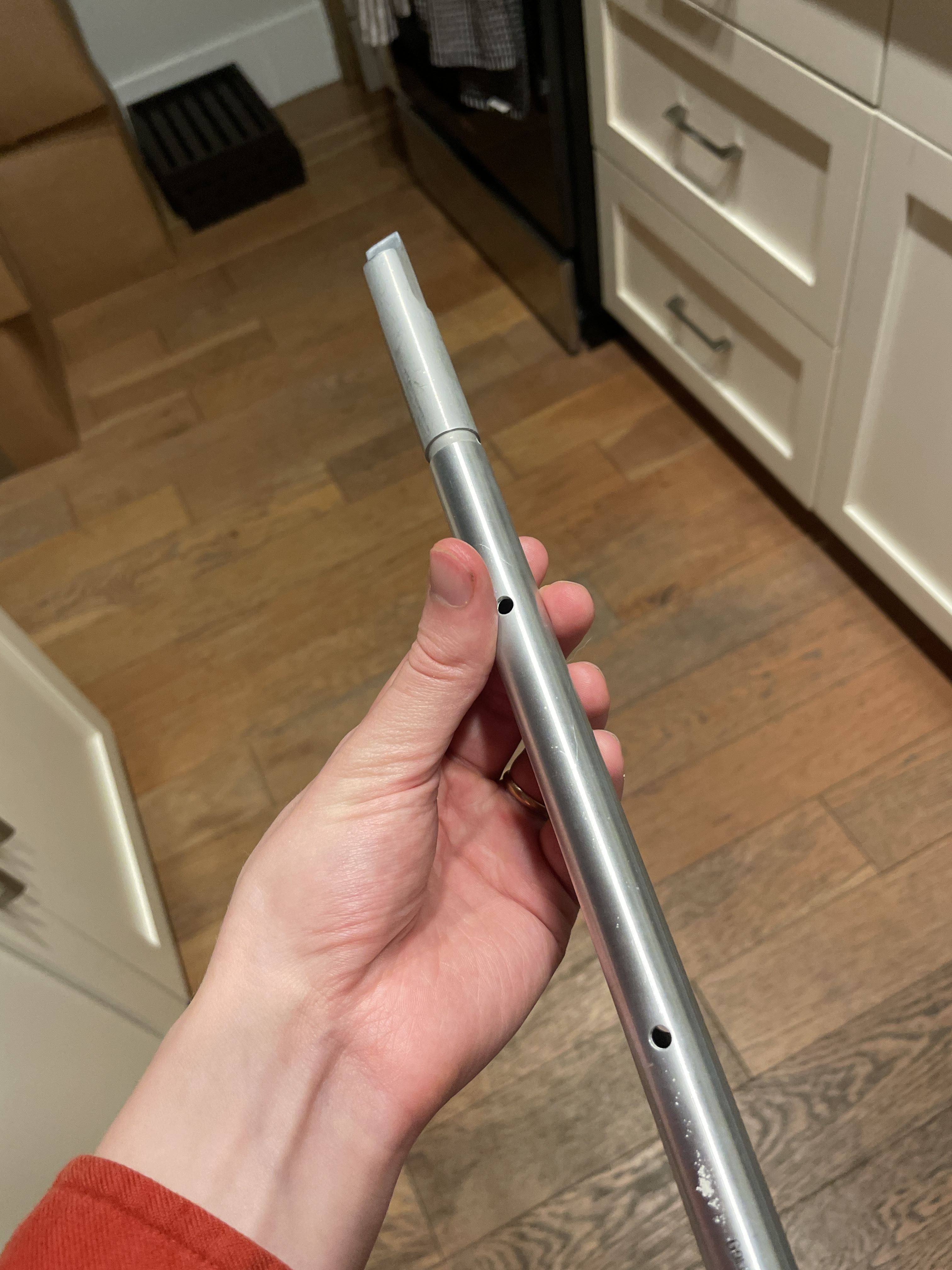
I’ve created a chromatic whistle design. Works very well & is very similar to 6 hole fingering. It has 2 thumb holes & 2 little finger holes + a secondary hole for Bb.
You keep your little fingers & thumbs down until they’re required.
The E hole is taped over, and replaced with a thumb hole on the back at exactly the same point + a new hole is added halfway between the taped over hole & the D hole.
Now the standard F# fingering gives you F natural & F# is achieved by this fingering with the right thumb removed - which is the basically the only change to conventional whistle fingering (once your thumbs and little fingers are down by default covering their holes & your A finger is now also covering the secondary hole for Bb).
Only differences are that (1) mine has a back D/venting hole instead of a B flat hole, and (2) the right hand thumb hole is for F natural, not F sharp (which is played normally).
You could photograph it with a mirror behind it so that all the holes can be seen at once, thereby making it easier to see where the upper thumb hole is relative to the holes on the top.
What I really want to see though is a diagram of which holes are covered for each note. First set out at the top where the holes are using some format like T1234 T1234 or 1T234 1T234 so that the relative positions and fingers used for each hole are clearly set out, then put entries underneath for the first octave scale starting at the top and going down semitone by semitone. Use O for an open hole, H for a half-open hole, and X for closed.
My higher-pitched chromatic whistles I do the following:-
T1234 1234
OXXXX XXXX
OOOO OOOO
XOOOO OOOO
XXOOO OOOO
XXHOO OOOO
XXXOO OOOO
XXXXO OOOO
XXXXX OOOO
XXXXX XOOO
XXXXX XHOO
XXXXX XXOO
XXXXX XXXO
XXXXX XXXX
I tried using two thumb holes, but the lower thumb is too important for stability in holding the instrument, so I got rid of it and used half holing for the least needed note that could no longer be directly supported.
My low D semi-chromatic whistle does the following:-
T1234 124
OXXXX XXX
OOOO OOO
XOOOO OOO
XXOOO OOO
XXHOO OOO
XXXOO OOO
XXXXO OOO
XXXXX OOO
XXXXX XOO
XXXXX XHO
XXXXX XXO
XXXXX XXH
XXXXX XXX
I had to get rid of one of the holes because the stretch issues were killing my hand, and the way to make the lowest hole function well was to make it big and push it lower down the tube where it has to be played with the pinkie, and I find that very comfortable.
I made whistles using both T1234 T1234 and 1T234 1T234. The latter was horrible to play, while the former was fine apart from any note where the lower thumb had to be lifted as it made the instrument too unstable. I will never make an instrument with that second thumb hole for my own use again, but if a masochist wants one drilled for them, they’re welcome to it.
OK, here you go. For simplicity, let’s call my little Bb hole effectively a half-hole.
1T234 1T234
C# OOOOX OXOOX
C XOOOX OXOOX
B XXOOX OXOOX
Bb XXHOX OXOOX
A XXXOX OXOOX
G# XXXXO OXOOX
G XXXXX OXOOX
F# XXXXX XOOOX
F XXXXX XXOOX
E XXXXX XXXOX
Eb XXXXX XXXXO
D XXXXX XXXXX
I seem to be able to manage the stability problem. Moving the ‘E’ hole a semitone lower so that standard F# fingering becomes F natural also has the effect of creating a much more natural hand shape (noting that I’m mostly playing Alto whistles between Bb - G at the moment).
If you want to see the design in 3D, I’ve done an approximate version here: Instrument Workshop
I like both of those, for people who find them comfortable. I don’t think there’ll ever be a standard arrangement that will suit even half of all players, but 3D printing should make it easy to produce cheap whistles of reasonable quality to let people try out multiple systems so that they can then push for higher quality instruments to be made using their preferred arrangement and know that they’re investing in something they’ll like. You have to play them for some time to find out if you’re compatible with them as it takes time to adapt. Of course, a better solution would be to redesign our DNA to give our species 12 fingers instead of 10. God messed up on that.