Sorry for the slow response, had the band here this morning to prepare for our St Paddy’s Day gig in the tiny township of Mogo tomorrow. You’ll love the name of the place we’re playing at. “Grumpy & Sweetheart’s”. No, I don’t know the backstory either!
Hmmm, I interpreted it a bit differently, so I went investigating.
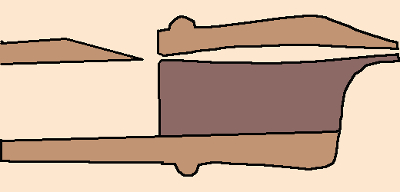
To do this I cut another 40mm piece of 13.3mm tubing, but in this one, I tapped a hole 5mm in from the Calibrator end and screwed in a PTO spigot. So when I push it on to the Calibrator the spigot will commune with the air around the output of the Calibrator. I’ll call it “LPTO + 35mm tube”.
So start with the end of the Calibrator open to air…
20L gives 73.5 at the upper PTO
Add the LPTO + 35mm tube, upper PTO drops to 66.5mm
Plug Upper PTO and measure at LPTO, -8mm
Diff mode between UPTO and LPTO, 73.5mm
So the Calibrator still has circa 73.5mm pressure across it, but when plugged into the 35mm extension, a partial vacuum forms at the Calibrator output, “sucking down” the UPTO pressure? 66.5 plus 8 being close to 73.5. Differential mode measurement between the PTOs takes that into account. Plausible interpretation?
All of this suggests to me that trying to measure downstream from the Window or Calibrator is just adding to our confusions!
This suggests that when you measured with the flowmeter below the calibrator it wasn’t that the flowmeter discharged to open air, but that there was > something > below the calibrator. To take a closer look at this, I’d appreciate it if you could measure the pressures for flowmeter → pressure takeoff → calibrator → 130 mm tubing → open air on a couple more calibrators, perhaps the three tapered calibrators, at 5, 10, 15, and 20 L/min. Then I’d like to try a similar test on the Feadog Mk 1 and the old Generation whistle heads > with and without > the whistle tube plugged into the whistle head, again at 5, 10, 15, 20 L/min.
I’ll wait till I hear your interpretation of the above before doing anything more!