I’ll have a think about those questions, Tunborough.
But I’ve just been having a play on a bit of a whim. Remember earlier, I’d said:
“I’m imagining that we need to connect the end of the food chain to a servo-controlled vacuum source, connected to sense the pressure at the junction between whistle and flow meters, and strive to keep that at zero by cranking up the vacuum. That way both whistle and flowmeters will be functioning at atmospheric. This is the kind of stuff I used to have to design and build back in the Research School of Physical Sciences and the Research School of Earth Sciences at ANU. But fortunately fate intervened, and I became a fat-cat flute maker instead. Ahem…”
The notion of trying to balance out the pressure across the device-under-test by applying a vacuum where normally it vents to air has stayed with me. And I racked my brains, (both cells at once!) to remember what if any sources of vacuum I could pull into play. And then remembered a ghastly little airbed pump/sucker I had somewhere. I turned all the somewheres upside down and found the sucker. Mine is red, but it looks suspiciously like this one:
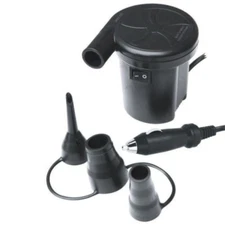
Connecting its Deflate port to the output side of a 20L/Min flow gauge revealed it was capable of sucking about 8 L/Min. I’d have liked more, and some way of controlling its suction, but beggars and choosers applies. Aha, “some way of controlling its suction”? You’ve got a variac, haven’t you? (Younger readers might need to look that word up. Essentially its an autotransformer - a crude electromagnetic way of controlling mains voltage via a big knob.) And sure enough, I can now control my vacuum flow from 0 to 8L/Min, and the vacuum pressure from 0 to -360mm.
So I set up the Pressure Regulator feeding the LH Flow Meter, feeding the 30 x 4mm calibrator, now feeding the suction pump, with a pressure takeoff between flow meter and calibrator. And wound up the Pressure Regulator for 20LMin flow with the sucker off. I could hear the flow coming out of the sucker blow hole and vents. The pressure meter showed 110mm - that’s the backpressure from the Calibrator and the so-far inactive suction pump. Now turn the pump on and start advancing the voltage from the variac, and the pressure meter drops down to zero. And if I keep going, starts indicating negative. The flow meter might have dropped a smidgeon - perhaps to 19.7 - rather hard to be sure of. But we are now operating with both the Calibrator and the Flow Meter at atmospheric pressure. A bit harder to do with a whistle but if we can run any calibrating tests with a Calibrator we would appear to be ahead.
So, of course, my mind races ahead. How far can we push this thing? I plumb in the 2nd flow meter, and crank up the flow. I can’t get all the way to 40Lpm and balance out the back pressure of the Calibrator and suction pump, but I can get to around 34.4. Pressure is now 306mm until balanced out by the added suction.
And so then comes the big question. The system is sitting there pushing 34 odd L/Min through the flow meters and calibrator, but we have the pressure at that junction balanced out by the suction. So I should be able to disconnect the lower end of the Calibrator from the sucker pump and it shouldn’t make any difference. We’re replacing “0mm pressure relative to atmospheric” with atmospheric itself. Sure enough, maybe a little flicker but not measurable.
So this suggests to me that we don’t have a significant problem with the simple setup of Pressure Regulator > Resistor > Flow meters including the valve> Manometer takeoff > Device-under-test > atmosphere. Sure there will be back pressure applied to the flow meters, but it doesn’t seem to affect them dramatically.
Have I convinced anyone? Does this new facility offer any new ways to further investigate your various concerns?

