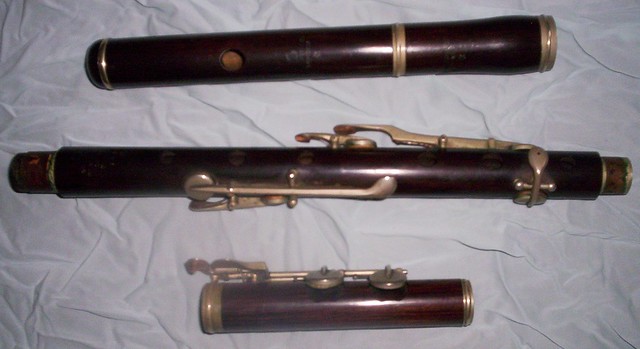
I recently bought an old rosewood 7-key pin-mounted simple system flute, in need of repair.
I don’t have a good enough camera to capture the detail, but the inscription on the middle joint reads:
BESSON & Co.
198 EUSTON ROAD
LONDON
ENGLAND
2448
(headed with a flower motif and footed with a 5-pointed star)
Given the photos, the description and the serial number, can anyone tell me when this flute was made? I have searched online for Besson serial numbers, have only been able to find those for brass instruments.
This page http://www.wildwinds.co.uk/index_files/page0009.htm shows a similar flute, but with 9 keys and no tuning slide, serial# 1234, dated 1869-1919. I can probably safely say that my flute was built during the same period, but it would be good to narrow the margin a bit, if possible.
Potentially a good flute. A little more information will help us to help you. It appears that the lower mid-joint tenon is reinforced and has a metal tenon protecting ring, no? Does the corresponding socket have a metal reinforcement? It appears the upper mid-joint tenon is missing the corresponding metal reinforcing ring. Does the tuning barrel socket have metal reinforcing? Is the Head fully or partially lined? Can you determine if the head joint crown is wood or perhaps some form of Bakelite type plastic? Can you tell if the key axles have screw heads?
Can you tell by close examination if the springs are attached to the key with screws? And finally can you see little metal inserts the springs ride on??
Note to Jem: this appears, at first glance very like my Douglas flute, built in France and sold in England.
This is great, Bob - just the kind of reply I wanted.
-You’re right about the reinforcing ring on the lower mid-joint tenon; there is no metal reinforcing in the socket.
-There is, as you point out, no reinforcing ring on the upper mid-joint tenon, but there is one inside the corresponding socket of the tuning barrel.
-The head is fully lined.
-The head joint crown looks very much like bakelite (although I would have to cut a piece off it to be 100% certain)
-The two long keys (F-natural and high C-natural? I’m new to keyed flutes) have the springs screwed on. On the 3 short keys on the mid-joint, the attachment points are hidden by the corks, so I can’t be sure; they each have a little dark dot above the attachment point, which suggests they might be riveted.
-The free ends of the springs do indeed ride on metal inserts.
-The rod mounted keys on the foot joint use a different spring system - simple straight wire springs, wrapped around the mounting pins at one end and passing through an eyed pin on the rotating tube at the other.
Great. These elements all point to a higher grade of French Manufacture. The fully lined head inclines me to think this flute was made for the English market. The French habitually used Cocus wood, calling it Palisander. The apparently smaller embouchure or tone-hole also speaks to French origin. Also the single mid-joint strongly suggests this flute was meant for the English market.
Can you sound this flute? If you can, at what extension of the tuning slide can you achieve a note approaching A=440 Hz? This flute may approach a modern tuning scheme. The indicator for this will be the absence of any appreciable flat foot on the D, if you can sound it. The other bonus will be that you can use relatively modern clarinet pads to easily re-pad it.
Bob
I can sound the flute if I tape over the split that runs the length of the barrel. It gives 440Hz with the slide extended about 11mm (without having warmed it up). I can’t sound anything below A at the moment, partly due to ill-seated or absent pads, partly because I’m not much of a flute player.
The wood looks very much like E. Indian rosewood to me, but it could be cocus wood - I haven’t got any samples to compare with.
Yes. This flute will in all probability be well worth fixing up. The barrels have a
depressing habit of splitting. A normally fairly easy fix, except for the French
habit of flaring both ends of the tuning slide to mechanically stake
the receiving tube in place. Modern adhesives eliminate this need.
The flute I have is well in tune and responsive at modern pitch. The
harmonics speak freely are well in tune. The bottom notes are loud
and responsive, and of course the Boehm (sorry Jem, no umlauts )
style rod and axle foot is easily managed.
Where are you located?
Bob
Yes, quite a long way! However, not that far, at least as we 'Murcans reckon distance, from a member here, jemtheflute, who is also in Wales. He is a wealth of information and DIY advice for fixing up flutes. He may be of material aid as well. .
Jem, really, I am surprised you haven’t chimed in up to this point. Hmm, you must be very busy with your “real” life
Ah well, I expect he will be by shortly. . . .
Patience, patience! Yur I be. Was in work all day Weds and at a session in Chester last night, so not online, and having a lie-in this-morning. Now making my first chiff-check of the day. Will look at photos and comment sensibly later. Llandidloes isn’t very far from me (near Wrexham) - about an hour and a half’s drive… maybe a little less, c55 miles but on slow roads.
Welcome, mousecorns. You could fetch it to visit… and get in a session too - Dolgellau Welsh sesh next Weds, or Selattyn (mostly ITM, near Oswestry) every Thurs, though I’m not attending the latter regularly these days, so let me know…
Do you know “Cornelius” from Llanidloes?
I can go one better than that - I am Cornelius from Llanidloes. How’s that for a claim to fame? I’d love to get to the Dolgellau session again sometime - it’s been too long - but, unfortunately, Wednesday evenings are usually taken up.
Ace! Hi David.
Well, if you can make it to Selattyn sometime soon, let me know and I’ll go along.
I can help with a little more info on Besson - on my Facebook there are some photos of New Langwill index entries for the firm. It had a complicated history and I don’t think you’re going to narrow down a date much. The flute is certainly French or heavily influenced in many details of the manufacturing, but could still have been made in London - perhaps by French craftsmen.
I have two Besson flutes here at present - one, a Tulou “flûte perfectionée” from the French F Besson Paris branch of the firm and detailed in this FB photo album, which includes images of the Langwill Index entries for the firm. The other is an 8-key simple system Eb flute from the Besson & Co. London branch of the firm (it has the 184 Euston Rd address, the flourished capital B and 5-point star stamps and serial no. 10921. The keys are somewhat different in style from yours, but typically French on an otherwise Pratten-ish, large-holed English type flute. I haven’t done a full photo set of it, but it is the bottom flute shown in this FB picture of a bunch of Eb flutes. The long F key on yours with the reversed spring looks quite like that on the Boosey & Co in that shot! Unfortunately FB-uploaded photos can’t be displayed here on C&F, so you’ll have to follow the links.
OP’s photo!
What is the sounding length of your flute (embouchure centre to foot end, slide closed?)
Couple of other points - the “flower” stamp isn’t - it’s a very fancily curlicued capital B. The black dots in the touch surfaces of the smaller keys will be the ends of spring screws, not rivets, almost certainly. It’s an 8-key flute, not 7.
Maybe a Welsh or nearbye thing (Jem)…has the flute x7 keys or provision x8? I recently bought a flute that was supposed to have x6 keys and it had only ever x5 LoL.
What is the sounding length of your flute (embouchure centre to foot end, slide closed?)
The sounding length is 568mm
the “flower” stamp isn’t - it’s a very fancily curlicued capital B.
Yes, I can see that now.
The black dots in the touch surfaces of the smaller keys will be the ends of spring screws, not rivets, almost certainly.
I bow to your superior knowledge. I assumed, because they were ground and polished perfectly flush with the keys, that they must be rivets, but I suppose there’s no reason why screws couldn’t be similarly ground and polished.
It’s an 8-key flute, not 7.
I must have been counting the two lowest keys (C# and C?) as one.
SL=568 should be good for c440 tuning with no flat foot, with a bit of luck.
“Palissandre” = “rosewood” according to my French dictionary, and they seem to use it in a parallel way, i.e. not botanically/species specific, but cabinet-makers’ terminology, any wood which looks like that - just as our English language non-specialist antiques dealers mis-name cocus as rosewood (and for all we know, cocus may well have been used by cabinet makers as a rosewood - I’ve never heard of any work on that).
Absolutely. Also “Palissandre” = “Bois de rose”… I.e. almost any member of the genus Dalbergia (excepts the black ones that are called “ébène”). I tend to hear more “palissandre” from guitar makers, and “bois de rose” from flute makers, but that could be just me.
Palisander, I think, usually means Brazilian rosewood. But different wood species with similar appearance and properties often get traded under the same name - and the same name may be used differently in different countries. The only reliable marker is the botanical name - and accurate species identification can sometimes only be done under a microscope.
There may be an etymological link between palo santo and palisander, but I’ve never heard of them being synonymous.
Bottom line is that true cocus (brya ebenus) is not a dalbergia and botanically would not be accounted a rosewood. But that didn’t/won’t stop cabinet makers and thence antiques dealers calling it “rosewood” in English or “palissandre” in French because it looks like and can be used like other true rosewoods. Much the same happens with grenadilla getting called “ebony/ébène” when it isn’t. The usage of palisander in English appears always to have been more specific than that the French cognate.


 It gives 440Hz with the slide extended about 11mm (without having warmed it up). I can’t sound anything below A at the moment, partly due to ill-seated or absent pads, partly because I’m not much of a flute player.
 Yes, quite a long way! However, not that far, at least as we 'Murcans reckon distance, from a member here, jemtheflute, who is also in Wales. He is a wealth of information and DIY advice for fixing up flutes. He may be of material aid as well. .
 Now making my first chiff-check of the day. Will look at photos and comment sensibly later. Llandidloes isn’t very far from me (near Wrexham) - about an hour and a half’s drive… maybe a little less, c55 miles but on slow roads.