Hello. My name is Jim and I come from Scotland. Originally a recorder ( Lover of early music ) player, I’ve been playing whistles now for a good wee while. Recently ‘dipped my toes’ into the world of flute playing by buying a Tony Dixon Duo Whistle / Flute in the key of A. Got lots of questions re flute playing, but felt that an introduction was the polite thing to post first Further info…
I am on the wrong side of 50yrs old
I am a left handed player. ( Which is a real bugger…am I allowed to say “bugger?”…when it comes to choosing suitable instruments, especially recorders or anything with keys )
I own a complete set ( High D to Low D ) of Tony Dixon polymer whistles ( The nice black ones with the wee white ring on the bottom )
4 ) I was a wee bitty shy when it came to posting on here. I originally signed up in 2010 ! This is my first post !
Phew ! Anyway, introduction over. That wasn’t too hard after all.
I’d be very interested to hear from any other left handed players and any tips or recommendations they re instruments suitable for same.
I am entirely left handed in everyday life except for writing. This is because when I was a child in my first years of school I used to write with both hands, but the teachers thought I should be using my right hand only to write, and I was forced to use my right hand.
When I play whistle, or any wind instrument, my right hand is on top.
Excuse me for suggesting this but I don’t think “handedness” has anything pro or con to do with playing the whistle. It does not matter what hand you place on the top. You have to be able to use both hands with equal dexterity as far as I am concerned.
There are righties that play with the right hand on top and I have observed many lefties play with the left hand on top. It matters not one iota to the whistle or the music.
As for pipes or flutes it should not matter either until you are confronted with keys which tend to be designed and placed to be operated by one hand or the other. But I am not a “proper” piper, just a dabbler. The real pipers will be along shortly with a “proper” answer to that one.
I’m not a lefty so its a welcome to the whistle forum. You’ll get a lot of good information hereabouts. Good choice of instrument… whistle. Keep it fun!
I would think that the bag, stock and a chanter with more than the C nat key would need to be configured for the handedness of the player, Everything else would be be the same for either handed use IMO.
David
PS If ScotsJim is anywhere near Glasgow, he could come along to the Glasgow Uilleann Pipers Club. The next meeting will likely be in February after Celtic Connections has finished.
But how does having a particular dominant hand make necessary to turn a set of pipes around or have to re-tool to make left handed keys and such? All of these instruments still require the player to use both hands, arms, wrists, knees, etc.. I still do not see how it should make a difference which side or position you place the dominant hand. Surely it is just as difficult a task to learn no matter where you start.
I’ve taught guitar for 50 years now. (decided I am done with that this year actually). I do not see why there need be a left-handed instrument and I rarely suggest a left-handed beginner go out to buy one. Shouldn’t matter.
What am I missing here? Not trying to pick an argument or anything either. It just befuddles me why, from a behavioral physiology perspective, you would have to have left handed pipes, whistles or flutes.
Being, as part of my job (I’m an accountant), perforce something of a statistician/mathematician, I can never see things like this without automatically asking myself such questions as “I wonder how many left-handed people are killed every year using things made for left-handed people?”
I initially mentioned I was left handed because of the grief it caused me in buying recorders. Many treble / alto recorders have the third hole from the fipple end down slightly off-centre to make for an easier reach. This is no good for lefties. And also, anything lower than a treble / alto, like a tenor say, would have keys on the C / D holes which make these notes unplayable for a leftie.
I am in total agreement with you regarding whistle playing. It doesn’t matter whether you’re a leftie or a rightie, but I’ve recently been attempting to play the flute, and I am limited to a keyless one. Also, I was curious about bagpipes and the like
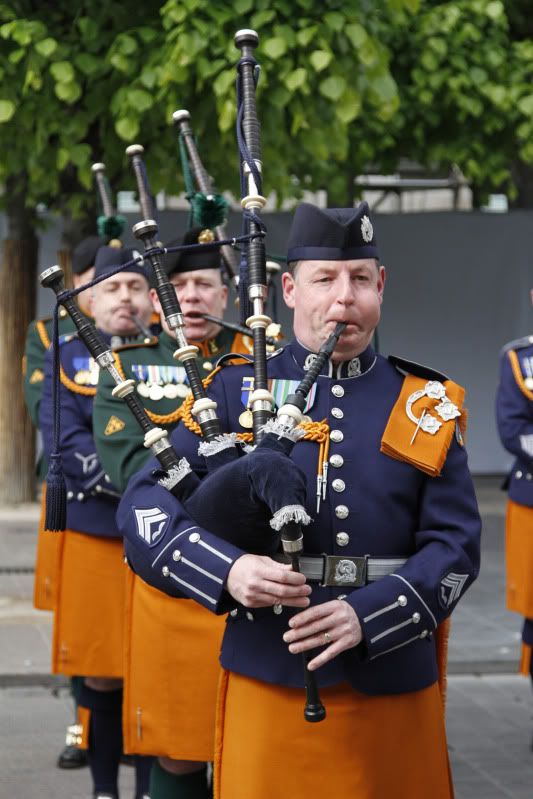
Ease, at the very least. See the bag arm in the first pic above: it always has less reach. If the hands were reversed he wouldn’t have to adopt an outward-divergent position for the chanter like that. It’s doable and can even become comfortable, but it’s not ergonomically intuitive. Add keys and blowing edges, and there you go with flutes. The importance of key placement aside, you can play a righthanded UP set with switched hands, but if you want to play regs you will have to keep your right hand (it’s the bellows arm either way, left pipes or right) lowermost for best access - the only really sensible access, really.
Many thanks David, but, alas ! Although originally from Greenock, a quaint little fishing village on the Clyde, ( Sssh! ) I now live in Bucks for my sins, having married ( as my Aunt so eloquently put it, "the auld enemy! ) an English lass. Otherwise I’d have came along for a look see
But how does having a particular dominant hand make necessary to turn a set of pipes around
There’s the issue of regulator playing..
I am limited to a keyless one
Flutemakers will make you left handed models. That aside, I could think of a number of very fine lefthanded fluteplayers who play right handed keyed flutes as if they flute was left handed.
Right, my understanding was that given how fine-tuned it is, a flute’s working blowing edge is customarily only on one side. I’m not 100% certain, but I don’t know if any flutemakers intentionally make switchable keyless flutes; I would think that over time the edge you blow from would get too much wear from the skin to sustain a dual edge’s best integrity, which is not to say it wouldn’t still be playable…but then what would be the point of cutting two edges? Oh, and there’s lip insets. Blowing against one of those would be a gamble.
But as feadoggie suggests, one can always learn to play other-handed…
I’m curious why most of us don’t, that we have some sort of intuitive preference for hand placement when it isn’t defensible by any outward logic. I’m righthanded. When I first picked up any kind of whistly-thingy, for me, like most other righties, it was always left hand on top. I have no idea where I learned that; maybe it was from watching people, maybe not.
Right, my understanding was that given how fine-tuned it is, a flute’s working blowing edge is customarily only on one side. I’m not 100% certain, but I don’t know if any flutemakers intentionally make switchable keyless flutes
Yes, you’d think that. Yet I can think of a few people who very successfully play Rudalls that appear not specifically intended for left handed playing. I don’t know how that works either but it does.
Same people would pick up any flute and play it by the way, so it’s not that they picked their own flutes to suit their playing.
When it comes to conventions such as handedness orientation, I think it’s arguable that things don’t happen for no reason. If you look at a variety of instruments from widely different cultures over a long period of time and you find that a particular orientation predominates, then it’s worth asking why.
Yes, cultural conservatism can play a part. But innovation and choice are also forces. And given our species-wide trend to right dominance, you can find morphologically similar instruments from China to Ireland using the same default orientation.
One hypothesis might be that cerebral hemispheric lateralization plays a part. Take fingered string instruments. If in right handed people the left brain is dominant for language articulation and the right brain for visual pattern processing, then given our cross-wiring (left brain controls right side and vice versa), it might make sense for the right hand to assume the role of articulating the notes, while the left hand takes on the more spatially complex task of fingering.
Another hypothesis might be that the dominant hand gets assigned to more physically active role. And with simple winds, given the sequential nature of fingering, I think you’ll find the bottom hand is more active than the top hand; if only marginally; but marginally may be enough to tilt the orientation one way. Similarly on keyboards, the more active role of the treble melody hand would orient the treble side of the instrument to the dominant hand.
Clearly, our brains and bodies are adaptive enough to learn either whatever convention dictates or its opposite. But that there ARE conventions suggests to me that there’s more to it than the arbitrariness your post implies.
I doubt it has anything to do with dominant handedness, because as you say, playing any wind instrument or keyboard or string instrument really requires the full dexterity of both sets of fingers. I think it just largely comes down to “which way did the player put the instrument in his hands the very first time he tried playing?” Chances are good that if your first foray into whistle or recorder or whatever was right hand above – and regardless of your own handedness – then you’ll always find “playing left handed” will be more comfortable. Play that way long enough and, when it comes time to try a big whistle or a simple system flute or pipes, you’ll be in the market for a “left handed” instrument, just because that’s what’s now most natural to play.
And of course, this whole right handed / left handed thing is nothing new. Museums are full of old recorders, shawms, bassoons and so forth that have keywork and extra holes built in so that any player would be able to use the instrument. Presumably playing right hand on top was much more commonly found back in the day. Perhaps modern teaching methods (e.g., teaching recorder / fluteophone / penny whistle in schools over the last century) has put paid to the whole “left handed” playing thing for most people. Certainly by the time they get into band, they’re going to have to switch to right hand below style of playing, because no modern wind instruments are designed to be played either way (and only the french horn is designed to be played “left handed” anyway).
I do actually have a “left handed” flageolet, so there was clearly a market for invert wind instruments even into the 19th century.
 Further info…