Subsequent to a discussion I was engaged in recently on head-cork positioning, I got to wondering about the cork itself. On a Boehm flute, the surface of the cork facing the embouchure is covered with brass. Does bare cork provide an appropriate accoustical surface against which the air should vibrate? Is this something to be concerned about? Especially in a flute with a lined head? Tell me what you think, and if you make flutes, tell me what you know. Thanks.
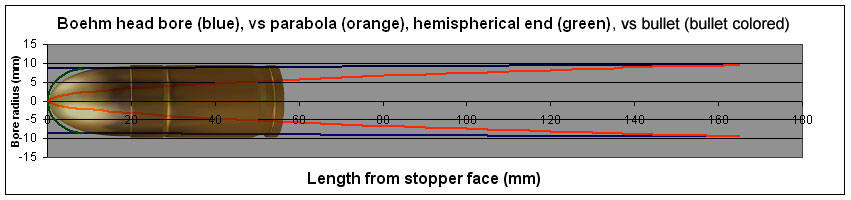
Not only are Boehm stoppers faced with metal but they’re also concave in shape creating somewhat of a bullet shape in the interior of the head joint. I have no idea what this accomplishes from a scientific standpoint though.
Kirk
put down the shovel and back slowly away from the hole…
yer gettin’ inta some dark arts now…
Here’s my two cents. Buy a box of corks (or a case of wine), and do your own comparisons. We’ll wait for your results. Enjoy the wine.
Been there, done that, have opinions that don’t really matter as a result.
feadoggie
I’m with Denny on this one. . . and Feadoggie too. . . .I’m still looking around for my grimoire. . .
Bob
Isn’t the stopper parabolic on a Boehm?
[pauses to check]
Ah, I remembered correctly:
Major innovations were the change to metal instead of wood, large straight tube bore, “parabolic” tapered headjoint bore…> wiki
Ah, that’s about the BORE. Not the stopper face. FWIW, so far as I know the standard Bohm stopper has a flat metal disc face-plate. People have experimented with assortedly distorted and pierced ones, and you can acquire such, but the norm is flat. On antique cylinder headed flutes I have seen and played bare cork, wood (either a wooden face-plate or a solid wood stopper lapped with thin cork) and metal faced. Can’t say as I notice any sound-production differences.
Where are you locating the parabola if it doesn’t include the stopper face? On the side walls alone? A parabola is U* shaped. If the stopper is excluded, the headjoint’s profile has to be something like this ()* to be parabolic.
*diagram is as close as ascii allows. Rotate both by 90 degrees.
While Jem and Sim0n attempt to get their parabolics sorted out…
In the wilds of Dear Old Ireland, it is not uncommon to find a metal facing on corks, the employment of which was traditionally aided by the convenient sizing of the old Irish 10P coin. I had one on an antique of mine that was sent to England for repair, where the Royalists rudely replaced it with a plain disc of silver. Philistines.
Rob
da nerve!!
I’ve never seen one that wasn’t flat.
Not that I get out much
or take the stopper out of every flute I see
http://www.mcgee-flutes.com/Carte-on-Boehm's-patent.htm
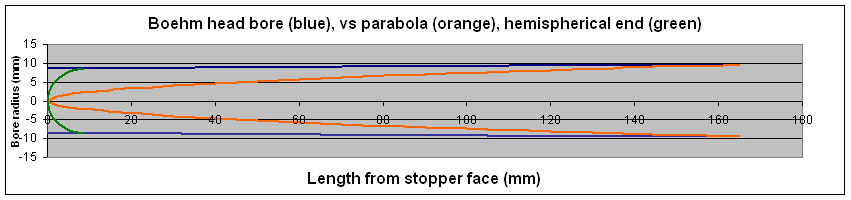
I think that the description of parabola is just to differentiate it from a straight taper.
When is a parabola NOT a parabola? When it’s defined by Boehm.
See http://www.mcgee-flutes.com/Carte-on-Boehm's-patent.htm
The section entitled “Issue No. 2 - the Parabola”. Read the description, Terry McGee’s explanation, and view his sketch as to the profile (see the previous post, as I was editing), which is really conical, with a flat-faced stopper (cork)
Kevin Krell.
I don’t believe it is quite conical either, but has a slight curve to it. I believe that his design was based on empirical evidence.
No. Just no. It’s pretty well known and has been well discussed historically that ‘parabolic’ is something of a misnomer when it comes to Bohm heads. I’m on my mobile so can’t find and link references for you (either Terry’s or Rick W’s websites, I think), but there’s plenty out there about that topic - and I don’t want to divert too far from the OP topic. Bohm himself didn’t call his head design ‘parabolic’ as such. Anyway, inspect the nearest Bohm head and you’ll see. Besides, having a convex stopper face wouldn’t in itself get you a true parabola.
Ah, cross posting here - I see others have done what I could not. In effect the Bohm curve approximates to a segment of a parabola. And his own stopper faces were flat.
Interesting turn of phrase. 
It was fashionable to use a dime here in the US back in the seventies as I recall. But you all probably knew that already. I vaguely recall a guitar pick being used in that manner as well.
I’ve had two plugs in Boehms that were rather concave as Kirk B suggested. I don’t know if that was how they were made or if they were customized by over zealous tuning or swabbing of the flutes though. I did not buy those flutes new. All others have been flat.
I have read once where making the face concave has some acoustic advantages. Can’t remember where though. When I bought my box of corks I did do a bit of that to test it but my results were not worth relating. A couple good whistle makers have used a concave plug face as I have noticed. But that proves little in my thinking since the upstream area of the flute is quite different than on a whistle.
Feadoggie

Denny wrote:
put down the shovel and back slowly away from the hole…
yer gettin’ inta some dark arts now…
Should I worry if my flute came with a five point star inscribed on the head-joint end cap? 
Bob
That’s a cartridge, not a bullet.
Haha! I have achieved internet pedantry!
…what do I win?
Rob
Just remember: A bullet has no friends when it leaves the end of yer bore. . . .
Bob
I’d think that you could carefully consider the genres that ya play 